Every family has that one holiday friction point nobody talks about until somebody is standing in the kitchen with a paper plate, a sheet of foil, and a look that says they are fully prepared to claim half the stuffing as emotional compensation. In my family, Thanksgiving has always been warm, loud, funny, and just a tiny bit feral by the time dessert is cleared. I love hosting it, truly I do, but after enough years of scrubbing roasting pans at 10:45 p.m. while trying to locate my missing glass storage dishes, I finally realized the most exhausting part of the day was not the cooking. It was the cleanup-and-leftovers scramble that came after.
Last year, I decided to handle that post-dinner chaos differently, and I braced myself for pushback. I expected eye rolls, at least one sarcastic comment from an in-law, and maybe a passive-aggressive text the next morning. What I got instead was a lesson in how one very small boundary can change the entire rhythm of a holiday meal, from the way people arrive to the way they leave. Here’s exactly what I did, how my family reacted, what worked, what bombed, and what I’ll absolutely do again.
1. Why leftovers had become the most stressful part of my Thanksgiving
I cook Thanksgiving for 14 to 18 people most years, depending on which cousins are in town and whether my brother has invited a “friend” who turns out to be somebody he has been dating for six months. My standard menu is a 16- to 18-pound turkey, 3 pounds of mashed potatoes, 2 pans of dressing, 1 green bean casserole, 2 pies, cranberry sauce, gravy, and usually one sweet potato dish in a 9-by-13 pan.
The meal itself runs smoothly because I plan like a military quartermaster. The trouble always starts around 7:15 p.m., when everybody is full, happy, and suddenly deeply invested in taking food home. Historically, this meant people rummaging through my cabinets for containers, stuffing hot food into bowls without lids, borrowing my good Pyrex “just for a few days,” and handing me mystery lids in December asking, “Does this go to anything of yours?” I once lost six containers in one holiday weekend. Replacing them cost me $42. Not a fortune, but enough to irritate me every time I opened the cupboard and saw the gaps.
2. The breaking point that made me change the system
My breaking point came the year my oldest niece packed leftover macaroni into my favorite ceramic mixing bowl because all the plastic containers were gone. Gone where? Into the trunks and back seats of people who had already left. I remember standing at the sink, holding a wad of crumpled foil someone had wrapped around a plate of turkey, and thinking: I cooked for two days, spent about $210 on groceries, and now I also have to donate my kitchenware?
That same night, one of my cousins asked if I had “anything bigger” because he wanted to take enough leftovers for his family of five plus lunch the next day. I laughed, but inside I was done. It was not really about the containers. It was about the assumption that the host would absorb every hidden cost: groceries, utilities, labor, dishwasher cycles, storage containers, and the mental load of sorting out who took what.
3. The message I sent before Thanksgiving
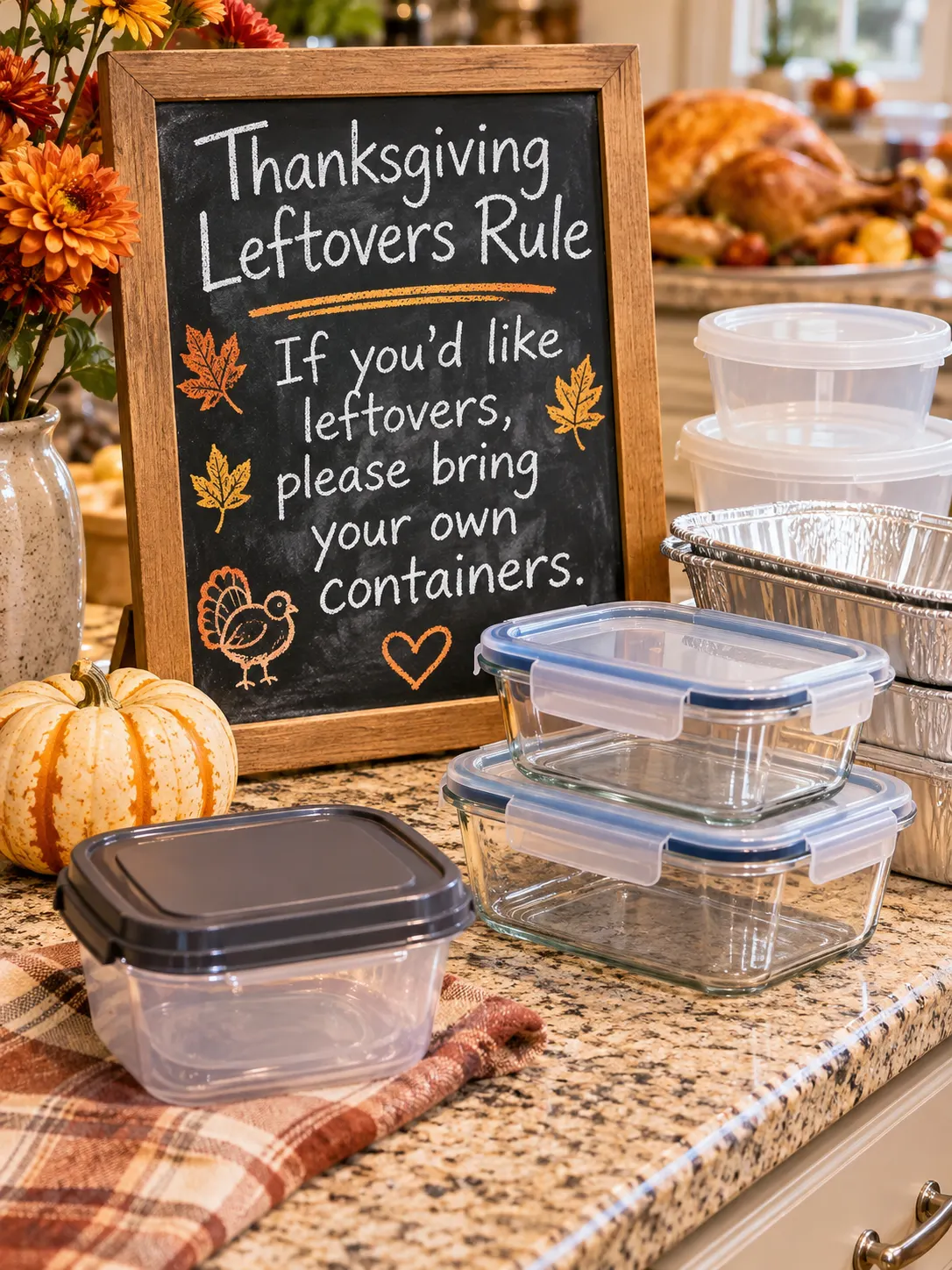
Four days before Thanksgiving, I sent a group text to 17 people. I kept it short so nobody could claim they missed the point. I wrote: “Can’t wait to see everybody Thursday at 2. I’ll have plenty of food. If you want leftovers, please bring your own containers. If you don’t bring containers, no problem, but I won’t be sending food home in my dishes this year.”
I did not apologize, soften it with six emojis, or add “LOL.” I have learned that when you over-explain a boundary, people hear negotiation. The message was practical and matter-of-fact. I was not banning leftovers. I was simply removing myself from the packaging business.
4. The first reactions from the family group chat
Within 10 minutes, my younger brother replied, “This is the most organized thing you’ve ever done.” My aunt sent a laughing face and said, “Noted.” One cousin asked, “What kind of containers?” which told me at least one person was taking it seriously. My sister, who has hosted Christmas before and therefore understands the battlefield conditions, texted me privately: “Good for you.”
There was also exactly the reaction I had predicted. My uncle wrote, “What, no foil this year?” I answered, “Correct.” He sent back a thumbs-up. That was the whole conflict. I had spent more emotional energy dreading resistance than the actual resistance required.
5. Who showed up prepared and what they brought
By 2:30 p.m. on Thanksgiving, I started noticing people arriving with reusable tote bags that clearly did not contain wine. My aunt brought four rectangular 4-cup containers with snap lids. My sister brought a stack of deli tubs in three sizes: 8-ounce, 16-ounce, and 32-ounce. One cousin showed up with a full insulated grocery bag containing eight empty meal-prep containers like he was reporting for duty.
The funniest overachiever was my nephew, age 24, who brought one large aluminum pan, 12 inches by 10 inches, because he said he had “faith in the turkey.” Frankly, I respected that. Out of 16 guests, 11 brought containers. That was far better compliance than I expected for the first year.
6. Who forgot containers and how that played out
Five people forgot. This is where I assumed the awkwardness would begin, but it really didn’t. Two people shrugged and said they would survive without leftovers. One person asked if she could use a zip-top bag from her purse snack stash, which honestly was innovative. My uncle, the foil jokester, looked around for a loophole and found none.
I held the line. I did not go into the cabinet. I did not start making exceptions for “just a little bit of pie.” Boundaries are easiest to enforce when they are boring. I simply said, “I meant it when I texted.” Because I stayed calm and casual, nobody could turn it into a dramatic family referendum on my generosity.
7. The surprising effect on cleanup time
This was the part that sold me forever. Normally, post-dinner cleanup takes me about 90 minutes, with one dishwasher cycle that night and another the next morning. Last year, it took 55 minutes. I know because I looked at the clock when the last guest left at 8:40 and again when I sat down with tea at 9:35.
The difference was not just fewer borrowed containers. It was the end of the whole scavenger-hunt phase. Nobody was asking, “Do you have a lid for this?” Nobody was spooning gravy into a mug. Nobody was wrapping three slices of pie in foil and then asking for a bag. People packed what fit in the containers they had brought, and when the containers were full, they were done. The process had natural limits built into it.
8. How the rule changed portioning in a good way
Before this, the most assertive personalities tended to leave with the most food. That is not always fair, especially when the quieter guests would also enjoy leftovers but did not want to elbow their way to the counter. The container rule unexpectedly made the distribution more even.
Because each person had a finite amount of space, the leftovers were portioned by capacity instead of by confidence. A person with two 2-cup containers might take turkey and stuffing. A person with one large container might make a mixed plate for Friday lunch. No one walked out with half a casserole dish because they happened to grab it first. That alone reduced my hostess resentment by about 80 percent.
9. What I kept at home and why that mattered
For the first time in years, I had a reasonable amount of leftovers for my own household. That may sound selfish until you remember the host is usually the one buying and preparing all the food. The next day, I had about 1 1/2 pounds of turkey, 3 cups of stuffing, enough gravy for two meals, and one-quarter of a pumpkin pie left in my own refrigerator.
That translated to dinner on Friday and lunches on Saturday, which meant I did not have to cook again immediately after hosting. If I had to put a dollar value on that, it saved me maybe $35 to $50 in groceries and takeout over the next two days. More than that, it gave me rest. Hosts deserve leftovers too.
10. The one thing I did that made the system easier
I cleared one section of my kitchen island, about 3 feet by 2 feet, and made it the official leftovers station. I put a cutting board there for the turkey, one serving spoon per side dish, a roll of paper towels, and a marker in case people wanted to label containers. That small bit of staging prevented the usual crowding around the stove.
I also waited 20 minutes after dinner before opening leftovers for packing. This gave me time to wrap the food I knew I wanted to keep in the original roasting and baking dishes before people started serving themselves. That sounds controlling, and perhaps it is, but it is effective. If you host, structure is kindness.
11. The family comments afterward were better than I expected
The next morning, I got three separate messages about the container policy. One cousin said, “Honestly, that was smart.” My sister said she was stealing the idea for Christmas Eve. Even my uncle, who had complained in advance on principle, admitted it “worked better than the old free-for-all.” I consider that a rave review.
Nobody accused me of being stingy, and that had been my biggest fear. In reality, people understood exactly what the rule was doing: not restricting generosity, but assigning responsibility. If leftovers matter to you, bring the means to carry them home. That is a very reasonable adult expectation.
12. What I’ll do differently next time
I will send the text earlier, probably one full week ahead, and then remind people the night before. A four-day warning worked, but a few of the forgetful guests said they saw the message and then simply failed to plan. Holiday brains are crowded brains.
I may also keep a very small emergency stash of inexpensive takeout containers, no more than six, specifically for older relatives or genuine last-minute mishaps. The key is that they would be clearly limited and not nice enough to become household donations I care about. A 10-pack of basic BPA-free deli containers costs around $8 to $12 where I live, which is a manageable backup if I choose to have one.
13. Practical tips if you want to try this at your own holiday meal
Be direct in advance. Use one sentence, not a paragraph. Something like: “If you’d like leftovers, please bring your own containers because I’m not sending food home in my dishes this year.” That is clear, polite, and hard to misinterpret.
Set up a designated packing area away from the sink and stove. If possible, put leftovers out after the main cleanup begins, not during dessert chaos. If your crowd is large, decide whether you want first come, first served or whether you will portion certain dishes yourself. For a group of 12 to 20, I recommend at least one large serving spoon per dish and one sharp knife for slicing turkey cleanly.
14. The bigger lesson I learned about hosting
What surprised me most was how much lighter I felt. Not because people obeyed me, but because I finally stopped volunteering for a task I did not actually want. Hosting often comes with a pile of invisible jobs we inherit without examining them. Some are worth keeping because they create warmth and tradition. Others are just habits that drain the host for no good reason.
This fell firmly into the second category. Once I removed it, the holiday did not become less generous or less loving. If anything, it became more relaxed. I had more energy to sit at the table, more food in my fridge the next day, and fewer simmering grievances over missing lids in December.
15. So, what happened in the end?
What happened is simple: most people brought containers, the people who didn’t mostly laughed it off, cleanup was faster, I kept my dishes, and nobody starved. The world did not end. Thanksgiving was still Thanksgiving: noisy, full, affectionate, and slightly chaotic, just without me standing barefoot in the kitchen at the end of the night trying to remember who left with my 6-cup glass dish.
I’ll use the same rule again this year, and I’ll recommend it to any host who is tired of pretending that leftover logistics magically handle themselves. They do not. Somebody handles them. If that somebody has always been you, it is perfectly fine to retire from the job.