Every December, I drag a small mountain of holiday bins out of my basement storage room, and every December I’m reminded that plastic totes can hold onto more than ornaments and garland. This year, the moment I snapped open the first few lids, I got that familiar musty, closed-up smell that says cardboard, fabric, artificial greenery, and a slightly damp basement have been quietly mingling for the past 11 months. Rather than ignore it and hope the scent would disappear once everything was upstairs, I decided to run a simple little experiment: wipe down the outsides of my storage bins every 3 days for 15 days with a solution of white vinegar and tea tree oil, then pay close attention to what changed.
I’m a practical cook by nature, so I approach household experiments the way I approach a recipe test: keep the formula steady, observe honestly, and note what works, what doesn’t, and what I’d tweak next time. Over those 15 days, I tracked odor strength, surface appearance, drying time, and whether the smell seemed to return between wipe-downs. Here’s exactly how I mixed it, how I used it, and what happened by the end.
1. Why the bins smelled musty in the first place
In my case, the culprit was not one dramatic leak or obvious mold bloom. It was a classic basement combination: steady cool temperatures, limited airflow, a little seasonal humidity, and bins packed with porous holiday items. My basement generally sits between 58 and 66 degrees Fahrenheit in late fall, and even with a dehumidifier, the humidity can drift into the mid-50% range after wet weather. That’s enough to let stale odor settle onto plastic surfaces and fabric ribbon spools, tree skirts, stockings, and cardboard ornament boxes.
Plastic storage totes are excellent for containing clutter, but they also create micro-environments. If anything goes in slightly damp—a wreath stored before it is fully dry, a table runner with a faint food spill, or tissue paper that absorbed moisture from the air—the closed bin traps those odors for months. When I opened mine, the smell wasn’t rotten or sharply sour. It was muted, dusty, cellar-like, and strongest around the lid rims and handles.

2. The exact solution I used
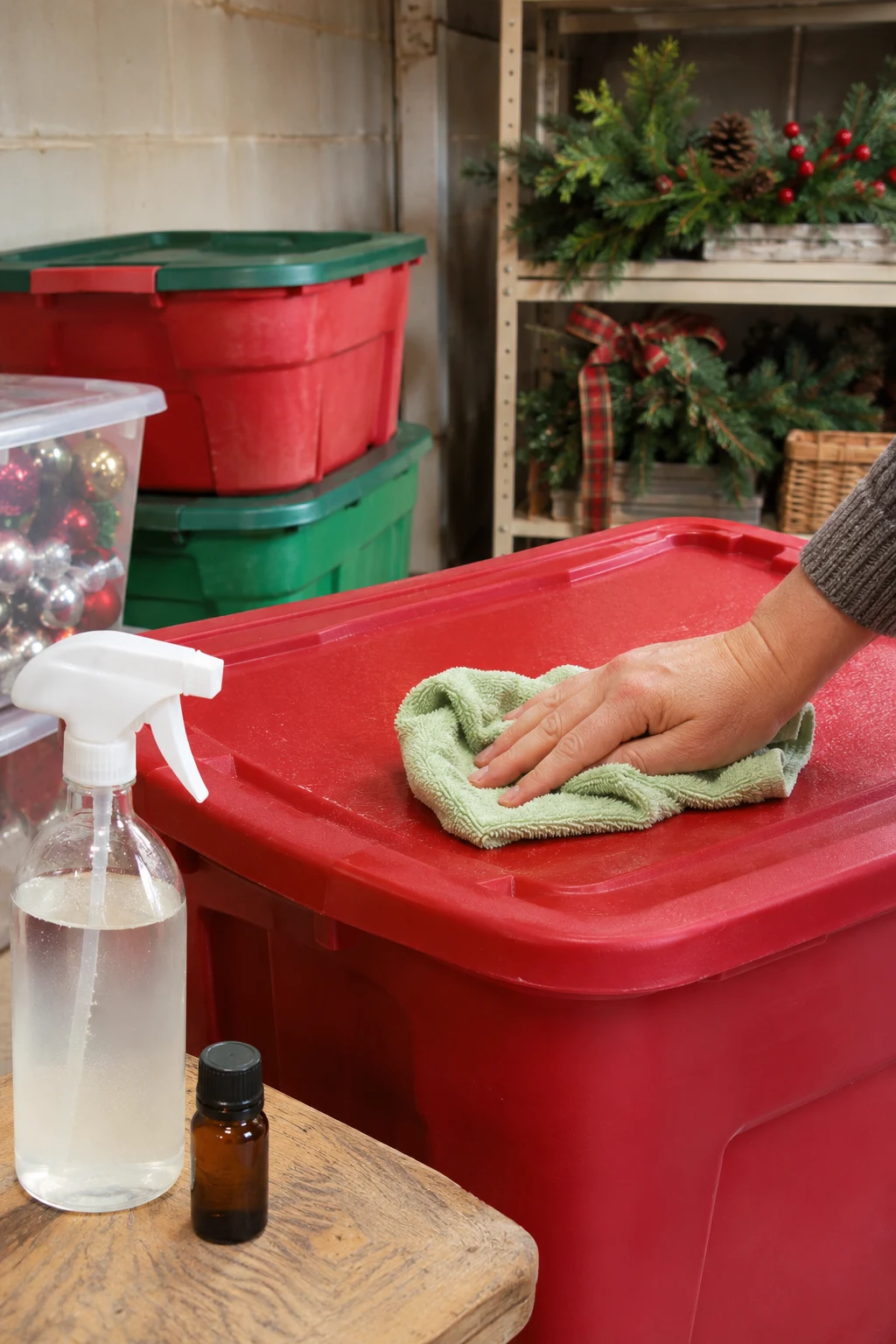
I kept the mixture simple and consistent for all 15 days: 2 cups of white vinegar, 2 cups of warm water, and 12 drops of tea tree oil in a clean spray bottle with a 24-ounce capacity. That gave me a slightly diluted vinegar base with enough tea tree oil to leave a fresh medicinal-herbal note without becoming overpowering.
Before each use, I shook the bottle for 10 to 15 seconds because the oil naturally separated from the vinegar-water mixture. I did not add dish soap, hydrogen peroxide, or any other cleaner. I wanted to know what this specific combination could do on its own. I also mixed a fresh batch once, on day 9, mainly because I had used most of the first bottle and prefer not to leave a homemade spray sitting around too long.
3. How many bins I treated and what they contained
I worked with 8 large storage bins and 3 medium ones, so 11 bins total. The large bins were roughly 27 gallons each, and the medium bins were about 18 gallons. Their contents varied: glass ornaments in cardboard dividers, artificial garlands, a pre-lit wreath, fabric stockings, gift wrap tools, ceramic village pieces, and a bin of extension cords and light clips.
That variety mattered because odor transfer was uneven. The bins holding fabric and faux greenery smelled the strongest. The one with mostly ceramic décor and light hardware had very little odor inside, but the outside of the lid still smelled a bit stale, likely from sitting in the same basement environment all year. I treated all exteriors the same way so I could compare whether some bins improved more quickly than others.
4. My wiping schedule over the 15 days
I started on December 1 and repeated the wipe-down every 3 days: day 1, day 4, day 7, day 10, day 13, and a final evaluation on day 15. That meant 5 full applications over a little more than 2 weeks, with two days of rest between each treatment. I chose that timing because it was realistic. Daily wiping would have been more than I was willing to maintain during the busiest month of the year.
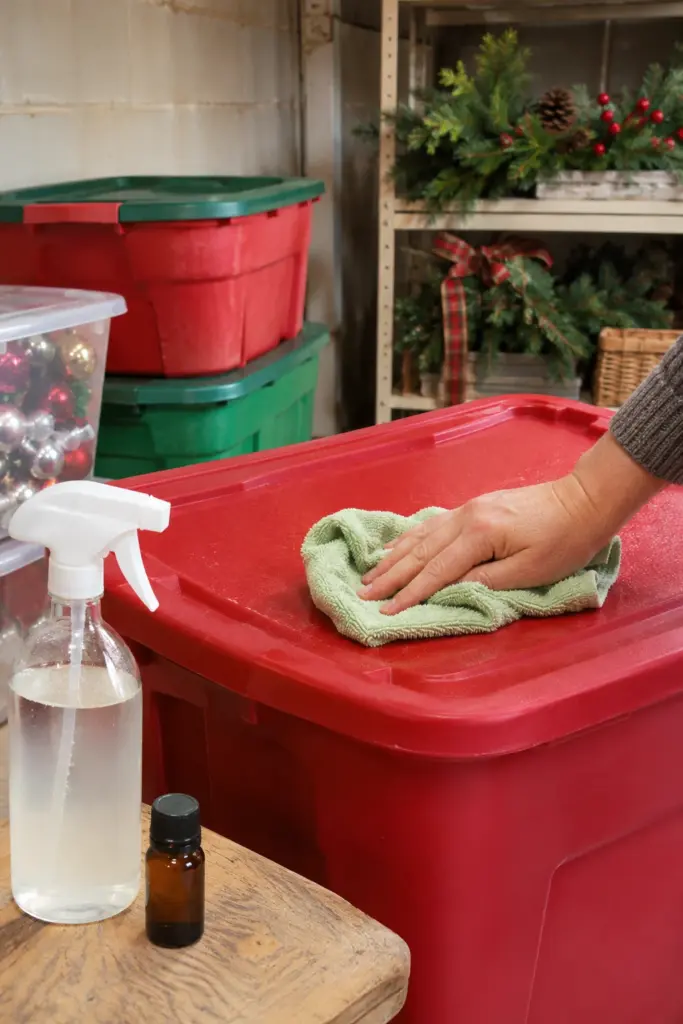
Each session took me about 25 minutes for all 11 bins. I sprayed a microfiber cloth rather than spraying heavily onto the bins themselves, then wiped the lids, handles, side panels, and the bottom lip where dust tends to collect. On the dirtiest bins, I used 2 cloths—one for the first pass and another for a final wipe—because once a cloth starts smelling dusty, it just moves that smell around.
5. What I noticed after the first application
The very first result was immediate but not magical. Right after wiping, the musty odor was noticeably reduced on the exterior surfaces, probably by about 50%. What I smelled instead was mostly vinegar for the first 20 to 30 minutes, with the tea tree oil showing up as a sharper, clean scent underneath. If you dislike vinegar, this stage is not especially charming.
By the 1-hour mark, the vinegar smell had faded a lot. At that point, the bins smelled cleaner, but not completely neutral. The strongest improvement was on the lids and handles, especially where I could see a faint film of basement dust. The bins did not look dramatically shinier, but they did feel less grimy, and that matters more to me than a polished appearance.
6. What happened by day 4 and day 7
By the second wipe-down on day 4, I noticed the stale smell was slower to return between treatments. On day 1, I could still detect a little mustiness by the next morning if I leaned right over a bin lid. By day 4, after the second cleaning, that lingering note was weaker. I’d estimate the overall odor reduction at that point was closer to 65% to 70% compared with where I started.
By day 7, the difference was more convincing. The bins that had held garland and fabric stockings were no longer releasing that wave of stale basement scent when I moved them. They still smelled like stored holiday items if I opened them, but the outsides were much improved. That is an important distinction: wiping the exterior helped the basement-storage smell clinging to the plastic, but it did not fully solve odors coming from contents inside the bins.
7. What happened by day 10, day 13, and day 15
The middle of the experiment was where the results leveled out. By day 10, I had reached what felt like the practical benefit ceiling for an exterior wipe-down. The bins smelled clean on the outside unless I pressed my nose right near the lid seam. At that point, I would call the exterior odor reduction about 75% to 80%.
On day 13 and again on day 15, the improvement held steady rather than dramatically increasing. That told me something useful: repeated wiping every 3 days helped maintain freshness, but once the easy-to-remove odor film was gone, the remaining smell was likely coming from the contents, the air in the basement, or the gasket and seam areas where a simple wipe doesn’t penetrate deeply. In other words, the solution worked, but it had limits.
8. The biggest improvement came from the bin surfaces, not the items inside
This was the clearest takeaway from my little test. The plastic exteriors responded well. Dusty residue came off, the lids smelled fresher, and even the handles felt cleaner in the hand. But when I opened the bins with old ribbon, tree skirts, and artificial greenery, I could still detect some trapped storage odor inside.
That doesn’t mean the experiment failed. It means surface treatment and content treatment are two different jobs. If the smell is truly in fabric, paperboard, or faux pine needles, wiping the tote won’t completely fix it. It will, however, keep you from transferring that musty smell to your hands, your floors, and the air in your living room while you unpack.
9. The tea tree oil helped the experience more than the heavy lifting
I suspect the white vinegar did most of the practical cleaning work simply because it was present in much greater volume. The tea tree oil, at 12 drops in roughly 4 cups of liquid, was there in a modest amount. What it contributed most noticeably was scent character. It softened the sharp edge of vinegar and replaced it with a cleaner, more herbal impression once the bins dried.
That said, I was glad I included it. On plain-vinegar cleaning days, surfaces can smell clean but austere. The tea tree oil made the process feel less harsh. I would not increase it drastically, though. Essential oils can get overpowering fast, and I did not want my ornaments smelling like a medicine cabinet. For me, 10 to 12 drops per batch was enough.
10. What did not happen: no damage, no residue, no dramatic miracle
I did not see discoloration on my fairly standard red and green plastic bins, and I did not notice streaking once the surfaces dried. A couple of lids looked dull for a few minutes while still damp, but they dried evenly. I also did not feel a sticky residue, which can happen with some homemade sprays if too much oil is added.
Just as important, this was not a miracle transformation. The bins did not suddenly smell “new.” The storage room did not turn into a pine forest. And anything porous inside the bins still needed its own attention. The honest result was a meaningful improvement in surface odor and general freshness, not total odor elimination.
11. The unexpected benefit was how much dust and grime came off
What surprised me most was how visibly dirty the cloths became, especially on the lids and around the molded handle indentations. Even bins that looked fine from 3 feet away left gray-beige residue on the microfiber cloth after one pass. That buildup was almost certainly contributing to the stale smell.
As a cook, I’m used to the idea that odor often clings to residue, not just the object itself. Think of a cutting board or spice jar shelf: remove the film, and you remove a lot of the smell. The same principle applied here. Once I cleaned away the basement dust layer, the bins stopped broadcasting that storage-room scent so strongly.
12. What I would do differently next year
Next year, I’ll tackle the problem before December. My best adjustment would be a late-winter or early-spring reset before the bins go into long-term storage. I’d wipe the exteriors, inspect the bottoms for dust, and make sure every textile item is completely dry before packing. If I had 30 extra minutes, I’d also air out fabric items for a few hours before sealing the lids.
I would also add odor absorbers inside selected bins, especially those holding stockings, tree skirts, and garland. Even a small open box of baking soda during a temporary sorting session—or better yet, a sachet designed for storage use, removed before sealing if needed—could help. The main lesson from my experiment is that prevention beats repeated rescue cleaning.
13. My best practical tips if you want to try this yourself
Use two cloths instead of one: a cleaning cloth and a drying or finishing cloth. Wipe the lid edges thoroughly, because that seam is where dust settles and odors seem to concentrate. Don’t forget the underside lip and handles. Those are touch points, and they often smell stronger than the flat surfaces.
Also, let the bins dry with a little airflow before stacking them tightly again. Mine dried in about 15 to 25 minutes in a 68-degree basement room with a fan running on low. If your basement is cooler or more humid, allow closer to 30 or 40 minutes. And if the smell is coming from what’s inside, plan on treating fabrics, paper inserts, or décor separately rather than expecting the bin wipe-down to do it all.
14. My final verdict after 15 days
Yes, wiping my basement holiday decoration storage bins every 3 days for 15 days with a tea tree oil and white vinegar solution helped. The biggest win was a clear reduction in musty odor on the outside of the bins—enough that unpacking felt cleaner, less stale, and less like opening a forgotten corner of the basement. For that alone, I’d do it again.
But the full truth is a little more nuanced: it was an effective maintenance fix, not a complete cure for every holiday-storage smell. If your mustiness is mostly on bin surfaces and tied to dust and basement air, this method is very worthwhile. If the odor lives deep in fabric, cardboard, or aging artificial greenery, you’ll need to pair it with better drying, airing out, and storage habits. In my house, that combination is what will make next December easier.