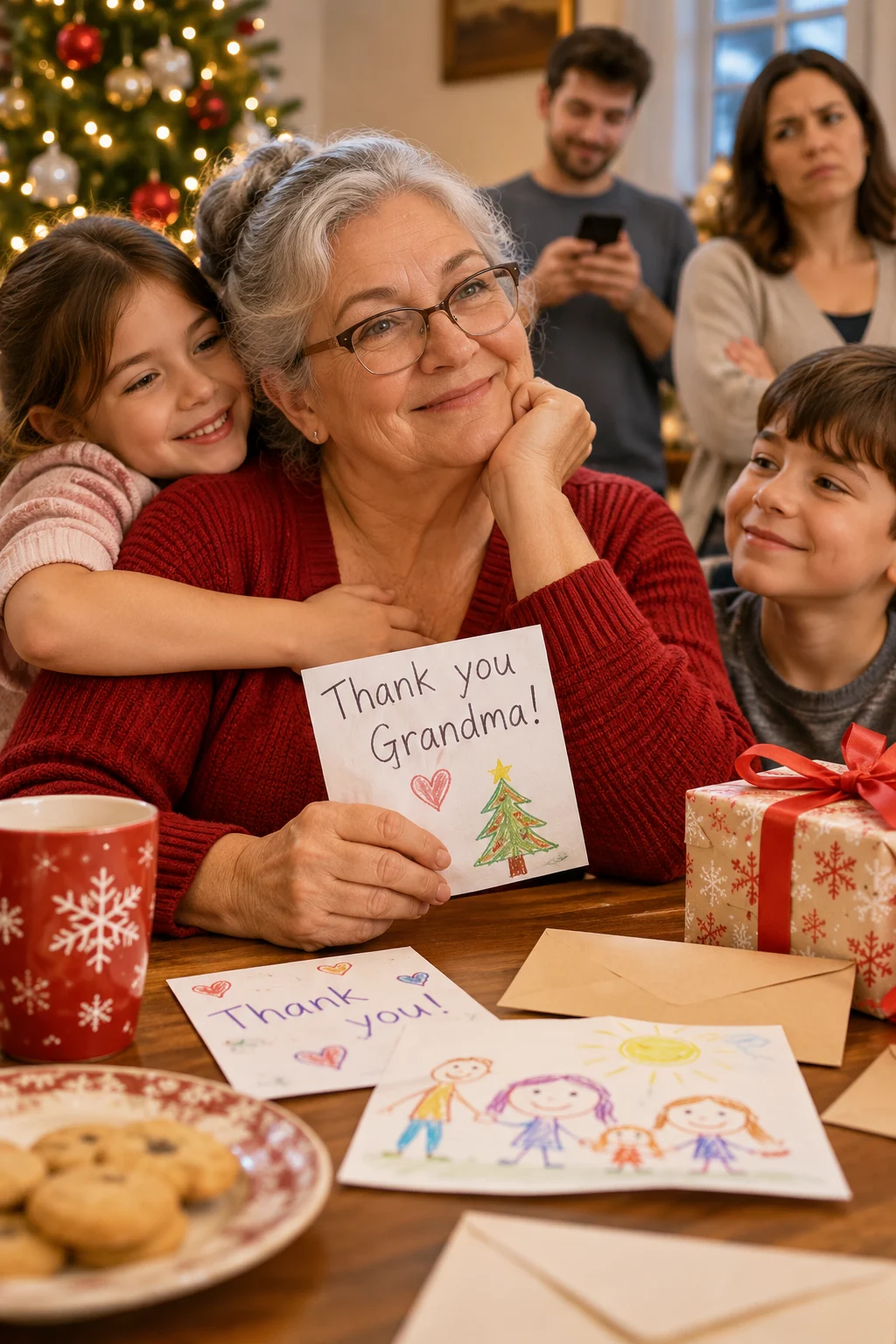
I’ll tell you right up front what happened, because that’s the part everybody wants to know. Within a week of my laying down the rule, three of my grandkids had handwritten thank-you notes in the mail. One nephew sent a two-word text that said, essentially, “Thanks Auntie,” and clearly hoped that would do the job. One of my daughters-in-law called the whole thing petty and told me her children were too young to be scolded by mail. I held firm with the adults, quietly accepted simple drawings from the very youngest grandkids, and by the time Christmas came around, one household had cooled toward me enough that they skipped my open house altogether.
Now, before anybody crowns me the queen of etiquette or the villain of the year, I want to be fair. A lot of families thank people in person. A lot of families do not do formal notes at all. And some of the people involved truly did not know I expected a written thank-you note by November 25 if they wanted a Christmas gift from me this year. What I learned was less about stationery and stamps than about assumptions, resentment, follow-through, and what happens when you finally say out loud a rule you’ve been carrying around in your heart for years.
1. Why I drew a line in the first place
I did not invent this rule out of thin air on a random Tuesday. It had been building for several Christmases. I’m the kind of person who shops early, wraps carefully, and remembers details. If one grandchild loves dinosaurs, I’ll hunt down the good 48-piece floor puzzle, not just any toy off the endcap. If a nephew is starting to cook, I’ll put together an apron, a $15 thermometer, and a little jar of my taco seasoning. I’m not buying diamonds and cars over here, but I am putting thought, time, and money into what I give.
Last year I realized I could still tell you, gift by gift, what I had given nearly everyone, and in too many cases I had no idea whether it was ever opened, liked, used, or even connected back to me. That stings more than the price tag. For me, a thank-you note is not about groveling. It is simply an acknowledgment that another human being made an effort. I finally decided that if I was important enough to buy from, I ought to be important enough to thank.
2. The exact rule I gave my family
I did not leave it vague. I sent a clear message in early November: if I had not received some form of thank-you for last year’s Christmas gift by November 25, I would not be buying that person a Christmas gift this year. I chose November 25 because it was before the thick of holiday shopping, but late enough that nobody could claim I was springing it on them two days before Christmas.
I also tried to be specific about what counted. For school-age kids and adults, I said a handwritten note was best. For little ones who cannot write much, I would gladly accept a short note dictated to a parent, signed in crayon, or a drawing tucked into an envelope. I thought I was being practical. Looking back, I can also see that what felt “clear” to me still carried all sorts of emotional freight for everybody else.
3. The quick responses that surprised me
The fastest replies came from three grandkids. Their notes arrived within the week, each one handwritten, each one imperfect in exactly the sweet way children’s writing should be. One had three words crossed out and “thank you Grandma” squeezed in at the bottom. One included a stick figure of herself in the sweater I had given her. One misspelled half the nouns and still managed to be more gracious than many adults I know.
Those three envelopes honestly made me tear up at my kitchen counter. They did not need expensive stationery. They used notebook paper, folded once, with a Forever stamp. The whole effort probably cost less than $1.00 each including the stamp, and maybe 10 minutes of time. That is part of why the gesture matters to me. Gratitude does not have to be fancy to be meaningful.
4. The two-word text that tested the rule
Then there was my nephew, who sent a text with two words. It was polite enough, but it had all the warmth of confirming a dentist appointment. That was the moment I had to decide whether my rule was a rule or just a dramatic speech.
I did not want to get dragged into a courtroom-style debate over whether a text technically counts as thanks. So I answered kindly and directly. I told him I appreciated hearing from him, but I had asked for a note and was trying to be consistent. If he wanted to pop a card in the mail, wonderful. If not, I understood, but I would be following through this Christmas. That message took me less than 2 minutes to send, and I rewrote it three times to keep it calm instead of prickly.
5. The daughter-in-law who said I was being petty
The hardest response came from one of my daughters-in-law. She called the rule petty and said her children were too young to be scolded by mail. I did not love hearing that, and I especially did not love the phrase “scolded by mail,” because that certainly was not how I saw it. In my mind, I was setting expectations. In hers, I was publicly shaming children over manners.
She was partly reacting to tone and partly to history, I think. In families, we almost never argue about just one index card or one missed note. We argue about old bruises, assumptions, and who gets to define what “respect” looks like. I listened, let her say her piece, and told her I was not trying to punish toddlers. I was asking the adults to help teach appreciation in whatever age-appropriate way made sense.
6. Why I quietly made an exception for the youngest grandkids
With the littlest grandkids, I softened. I did not announce a policy change with trumpets, but I accepted a drawing in place of a full note. One child sent a page with a purple scribble, two circles, and what looked like a dog wearing boots. Another drew our family with giant yellow heads. Those went straight onto my refrigerator with the same pride as a polished thank-you card.
I still believe in teaching manners early, but early can look very simple. A 3-year-old does not need to produce a three-sentence note on monogrammed paper. A drawing, a handprint, or a parent-written sentence that says, “Thank you for my blocks. I like stacking them,” is enough. What mattered to me was not literary excellence. It was some sign that the gift had been received in a spirit of connection.
7. The household that went cold and skipped my open house
There was one real social consequence, and I do think it is important to say that plainly. One household grew noticeably cooler after all this. When I hosted my annual open house in December, with chili in the slow cooker, a ham warming in the oven, sugar cookies on two trays, and a 2-to-5 p.m. come-and-go invitation, they did not come.
No one sent an ugly message. No one slammed a door. But absence can say plenty. In a small family circle, you can feel a skipped gathering like a draft under the door. I will not pretend that did not hurt. If you set a boundary, you have to be honest that sometimes the cost is less holiday warmth, at least for a season.
8. In fairness, not everyone was raised with note-writing expectations
This is the part where I have to be fair to the other side, because fairness matters to me more than being right. Plenty of decent, loving families thank people in person and consider that enough. Plenty of others just do not make a big ritual out of gratitude after gifts. They hug you, they smile, the day moves on, and no one thinks twice. That does not make them ungrateful monsters.
Some of my own relatives truly never knew I was expecting a written note. They may have assumed a verbal thank-you on Christmas Day covered it. They may have meant to follow up and forgotten once school started, sports began, bills piled up, and life did what life does. If you do not grow up in a note-writing culture, the rule can feel less like “basic courtesy” and more like a pop quiz you did not know was scheduled.
9. What I realized about gratitude versus control
I had to sit with an uncomfortable question: was I asking for gratitude, or was I trying to control how it was expressed? That distinction matters. Gratitude is a value. A handwritten note is one form. A sincere phone call can also be gratitude. So can a child running up to show you she is wearing the scarf you gave her.
Where I landed is that I still value the note because it is concrete and intentional. It takes a few minutes of effort and leaves something lasting. But I also had to admit that part of my frustration came from wanting visible proof that my effort had been seen. That is a very human feeling, but it can slide into scorekeeping if you are not careful. I had to ask myself whether my family needed a manners lesson, or whether I needed to release some resentment I had let harden too long.
10. How I handled Christmas gifts after the deadline passed
Once November 25 came and went, I followed through. That was important. If you announce a consequence and then ignore it, all you teach is that your words are emotional weather. For the people who had sent a note, text-plus-note, or an age-appropriate drawing, I bought gifts as planned. For the adults who did nothing, I did not.
I did not make a speech on Christmas morning. I did not hand out presents with a clipboard and say, “You made the cut.” I simply adjusted my list. In practical terms, that meant I spent less money and less time shopping for a few adults. If I usually spend about $25 to $40 per adult and $20 to $35 per child, it was not a huge financial windfall, but it did simplify things. More than anything, it forced me to match my actions to what I said mattered.
11. What the kids actually learned from all this
I think the children learned two different lessons, depending on their age and the way the adults framed it. The school-age grandkids who wrote notes learned that appreciation can be put into words and mailed across town with a stamp. That is not a bad lesson. They also got the pleasant feeling of doing something kind and being noticed for it.
The younger children, I hope, mostly learned that Grandma likes hearing from them. That is why I was glad I bent toward drawings. I never wanted a 4-year-old feeling as if Grandma was running a tiny post office with emotional penalties. Children can learn courtesy without carrying adult tension. Usually that means the adults have to absorb more of the friction instead of passing it downhill.
12. What I would do differently next time
If I had to do it again, I would set the expectation closer to the original gift, not 11 months later. Waiting until the following November turned it into a referendum on old behavior instead of a gentle habit-building moment. A better approach would be to tuck self-addressed stamped cards into packages for the little ones, or send a sweet follow-up in early January saying, “I’d love to hear what you enjoyed about your gift.”
I would also state my reasoning more warmly. Instead of leading with “no note, no gift,” I might say, “It means a lot to me to hear that gifts arrived safely and were enjoyed. This year I’m asking for a quick note, drawing, or message from each household.” Same expectation, softer entry point. Sometimes the first 10 words determine whether a family hears a request or a threat.
13. Better options for families who want gratitude without a showdown
If you are reading this because you are simmering over unacknowledged gifts, there are gentler tools than the one I used. You can text a photo of the present when you send it and ask the parent to snap one back when it is opened. You can include a blank postcard with the child’s name already written on it. You can make thank-you time part of the holiday weekend, with crayons, cards, and 15 minutes at the table before dessert.
For adults, I have become a big believer in directness before resentment. A simple sentence works wonders: “I love giving gifts, and I also really appreciate hearing they arrived.” That is clear without sounding like a collections notice. Most people do better when they know the expectation ahead of time and are not being asked to decode wounded silence.
14. Was I right to do it?
I was not entirely right, and I was not entirely wrong. I was right that gratitude should not be assumed. I was right that gifts are not obligations, and nobody is entitled to keep receiving them automatically year after year. I was also right that very small children deserve a gentler standard than adults.
But I can also see where I made a relational issue more rigid than it needed to be. Rules are tidy; families are not. A November 25 deadline may be efficient, but love does not always move efficiently. If my true goal was to strengthen family connection, then some of my method worked and some of it clearly backfired.
15. Where things stand now
As of now, I am still glad I said something instead of stewing in private. The three grandkids’ notes are tucked in my recipe box, and I still smile when I come across them looking for my pumpkin bread card. The nephew learned that a two-word text was not quite enough with me, and at least now he knows. The daughter-in-law and I are cordial, though I would not pretend there is no lingering edge there.
Next year, I plan to handle it earlier, softer, and more personally. I still believe thank-yous matter. I still think children benefit from learning them. But I also believe family peace is worth protecting where we can. My hope is to keep the heart of the lesson—notice the effort, acknowledge the kindness, say thank you—without turning Christmas into a manners standoff played out one envelope at a time.