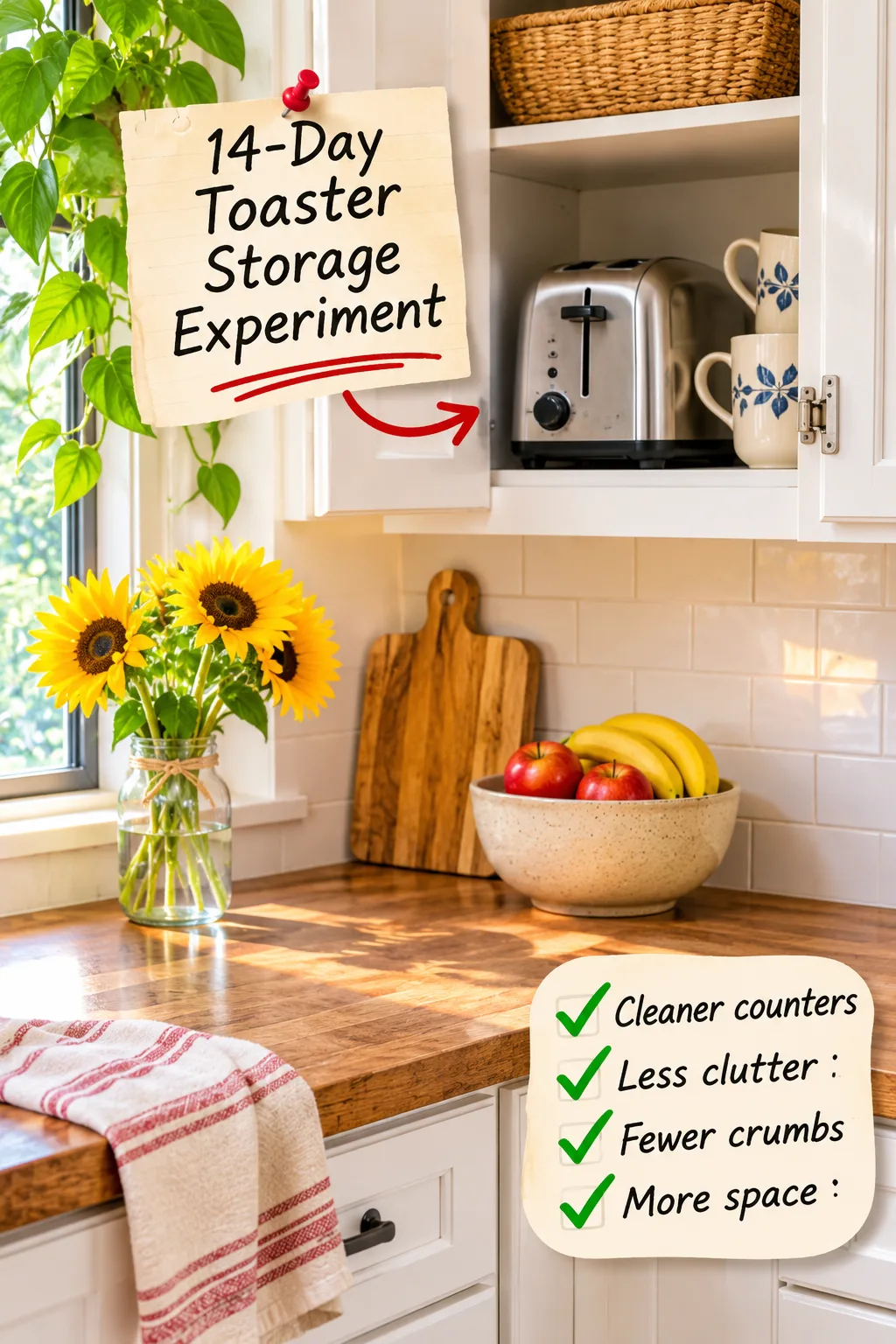
For 14 days this August, I ran a tiny kitchen experiment that felt almost absurdly small at first: I stopped leaving my toaster out on the counter. Instead, after every use, I unplugged it, let it cool, wrapped the cord loosely, and tucked it into a closed upper cabinet above my coffee mugs. I expected almost nothing beyond a slightly emptier countertop. What I got was a surprisingly detailed lesson in crumbs, visual clutter, cleaning habits, and how much one squat little appliance can shape the feel of a kitchen.
I’m the sort of person who notices when a room feels “busy” before I can explain why, and I’ve spent enough August afternoons wiping down warm kitchen surfaces to know that dust, grease, and humidity team up fast. So I tracked what changed: how often I used the toaster, how long it took to put away and take back out, whether breakfast became more annoying, how much cleaner the counter stayed, and whether the habit was actually worth it. Here’s what happened, in plain terms.
1. The counter looked bigger immediately
My toaster is a standard two-slice model, about 10 inches wide, 7 inches deep, and 7 1/2 inches tall. On paper, that footprint sounds minor. In real life, reclaiming roughly 70 square inches of counter made a visible difference the same day I moved it.
That freed-up patch sat near the outlet between my bread box and the fruit bowl, which meant it had been interrupting one of the most-used stretches of prep space in the kitchen. Once the toaster was gone, I had room to set down a cutting board, line up coffee things, or unload a few dishwasher items without playing countertop Tetris. The kitchen didn’t become larger, of course, but it felt calmer and more usable.
2. I noticed how much visual clutter the cord added
I’d always assumed the toaster itself was the issue, but the dangling black cord turned out to be half the visual mess. Even when I tried to loop it neatly, it still read as “stuff out.” Once the appliance was unplugged and stored away, that dark line vanishing from the backsplash area made the whole corner look more intentional.
This is one of those details you don’t register until it changes. The outlet looked cleaner. The backsplash looked less busy. The coffee maker, which stayed out, suddenly looked like a deliberate choice instead of one more object in an appliance crowd.
3. The countertop stayed cleaner for longer
By day 3, I realized I was wiping that section of counter less often. Normally, the toaster area gathered a mix of crumbs, fine dust, and a slightly sticky film that shows up in summer kitchens, especially near cooking zones. In August, with the air feeling heavier and the windows opening and closing, surfaces seem to collect everything faster.
Without the toaster sitting there full-time, there were fewer crumb strays and fewer edges to clean around. My usual evening wipe-down of that stretch went from about 45 seconds of lifting, wiping, and nudging things around to about 10 seconds with a damp cloth. Over 14 days, that’s not life-changing time savings, but it is friction removed.
4. The toaster itself stayed noticeably less grimy
When a toaster lives on the counter, it catches more than bread crumbs. It catches airborne grease, dust, and whatever fine particles float around during stovetop cooking. Even though my toaster sits about 3 feet from the range, it still develops that dull, slightly tacky exterior film if I’m not careful.
Stored in a closed cabinet, it stayed cleaner. At the end of the 14 days, I ran my finger over the top and sides and found mostly a dry, clean surface instead of that familiar kitchen haze. I still had crumbs inside the crumb tray, obviously, but the outside required much less scrubbing. That alone made me more inclined to keep it in decent shape.
5. Putting it away took less effort than I expected
I timed myself a few times because I know habits feel more annoying when they’re vague. From the last toast popping up to the toaster being cool enough to move safely took around 12 to 20 minutes, depending on whether I made one cycle or two. The actual putting-away part took about 15 seconds: unplug, wait until cool, wrap the cord loosely once or twice, lift, store.
Taking it back out in the morning took roughly 20 seconds. Open cabinet, set toaster down, plug in, toast. So the active labor was under a minute per use. The bigger issue wasn’t effort; it was remembering to follow through later if I dashed off after breakfast. On 4 of the 14 days, I left it out until mid-morning because I was in a hurry.
6. It made me more aware of how often I actually use a toaster
I had a vague sense that we used the toaster “all the time.” The experiment corrected that. In 14 days, I used it 9 times. Six of those were breakfast, two were lunchtime sandwiches, and one was for reheating a toaster waffle situation that I’m not especially proud of but will defend.
That means for 5 days out of 14, the toaster would have been occupying prime counter real estate for absolutely no reason. This is the part that changed my thinking most. Appliances we use daily may deserve the counter. Appliances we use several times a week but not every day probably need to justify themselves a bit more.
7. Breakfast became very slightly less convenient
I won’t pretend otherwise: there is a convenience cost. On sleepy mornings, even a 20-second setup can feel like a personal insult. If I wanted toast while the kettle boiled, I had to add one more step instead of just dropping bread into a waiting toaster.
But the inconvenience stayed small. It never made me skip using the toaster when I truly wanted it. What changed was impulsive toasting. I became less likely to toast a single frozen waffle or one random slice of bread just because the toaster was sitting there. In that sense, storing it away introduced a useful pause.
8. I became much more careful about heat and safety
Unplugging it after each use forced me to pay attention to when the appliance was still warm. That’s not a bad habit. A toaster may not stay dangerously hot for ages, but the metal top and sides can definitely hold warmth long enough that I wouldn’t want to slide it immediately into a tight cabinet beside paper goods.
My rule became simple: never store it hot, never wrap the cord tightly around a warm appliance, and never put it near dish towels or unopened bread bags until it had cooled completely. I also emptied the crumb tray before the experiment started and once again on day 10. That made the whole process feel safer and cleaner, especially because crumb buildup is one of those easy-to-ignore things until it’s embarrassingly obvious.
9. The cabinet choice mattered more than I thought
My first instinct was to put the toaster in a lower cabinet, but bending down and reaching behind a Dutch oven got old instantly. By day 2, I moved it to an upper cabinet at shoulder height, about 18 inches above the counter, and that fixed most of the annoyance.
The best cabinet turned out to be one with three things: enough width that I didn’t have to wedge the toaster in diagonally, a shelf height that cleared it by at least 2 inches, and no avalanche risk from bowls or pans. If you’re going to try this, bad storage placement will ruin the experiment faster than the toaster itself. Easy access is the whole game.
10. It reduced the “drop zone” effect in my kitchen
Appliances left on counters tend to attract other things. When the toaster was out, I’d set mail near it, rest a grocery list against it, or balance a bag of buns beside it. It had quietly become part appliance, part boundary marker, part clutter magnet.
Once that corner was clear, I was less likely to pile anything there. The area became usable workspace again instead of a semi-storage zone. This was one of the most unexpected benefits because it had nothing to do with toast and everything to do with household behavior.
11. Cleaning the toaster before storing it became a worthwhile mini-routine
Because I knew I’d be putting the toaster into a cabinet, I became less tolerant of visible crumbs. On three occasions, I turned it upside down over the sink and gently shook out loose bits after it had cooled and been unplugged. Twice during the 14 days, I wiped the exterior with a barely damp microfiber cloth and dried it immediately.
That sounds fussy, but the task was tiny—maybe 2 minutes total each time—and it prevented the cabinet shelf from becoming a crumb field. If an appliance is going into enclosed storage, I think this step matters. Otherwise, you’re not really removing mess; you’re just relocating it.
12. August humidity made the closed-cabinet idea feel smarter
Summer kitchens have their own texture. In August, mine gets slightly tacky near the stove by late afternoon, especially on days when I’m cooking pasta or sautéing anything with oil. Even clean appliances can start to feel dusty and greasy more quickly in that environment.
Keeping the toaster in a closed cabinet protected it from that daily layer. After two weeks, the difference between the stored toaster and the always-out coffee maker was obvious. The coffee maker needed a wipe around the base and buttons. The toaster, tucked away, looked like I’d cleaned it yesterday.
13. It made me reassess which appliances deserve permanent counter space
This small experiment turned into a bigger kitchen audit. My coffee maker stays because I use it at least twice a day. My electric kettle also earns its spot, especially in cooler months. The toaster? I’m now on the fence.
I started asking a simple question: if an appliance vanished from the counter tonight, would tomorrow morning become meaningfully harder or just slightly less automatic? For me, the toaster landed in the second category. It’s useful, but not sacred. That’s helpful to know if you have a small kitchen and every square inch matters.
14. The habit was easiest to keep when I paired it with another task
The days I succeeded most smoothly were the days I linked toaster storage to another routine. After breakfast, I’d empty my mug, rinse a plate, wipe the counter, and then, once the toaster cooled, put it away before lunch prep or before I started work. When I treated it as a standalone task, I forgot.
Habit stacking is an annoyingly effective concept. By the second week, “clear the breakfast zone” had become the cue, and the toaster simply became one more piece of that reset. Without that cue, I suspect the appliance would have drifted right back into permanent countertop residency.
15. So was it worth it? Yes, with one condition
At the end of 14 days, I decided the experiment was worth continuing, but only because I found a cabinet that makes retrieval easy. If I had to crouch, shuffle cookware, or move three other items every time I wanted toast, I’d abandon this within 48 hours.
The benefits were real: cleaner counters, less visible clutter, a toaster that stayed less greasy, and a kitchen that felt more open. The downsides were also real, but modest: one extra step before breakfast and a need to wait for the toaster to cool before storing it. For my kitchen, the trade-off worked.
16. My honest takeaway after 14 days
I didn’t discover a miracle organizing secret. I discovered that one small appliance, used 9 times in 14 days, didn’t need to dominate a key section of my counter 24 hours a day. That sounds obvious, but living with the change made it concrete.
If your counters always feel crowded, I’d absolutely recommend trying this for two weeks, especially with a toaster, sandwich press, rice cooker, or any appliance you use often but not constantly. Time yourself. Notice whether your kitchen feels easier to clean. See if the visual quiet changes how the room feels. My guess is that you’ll learn what I did: the object itself matters less than the space and calm you get back when it’s gone.