
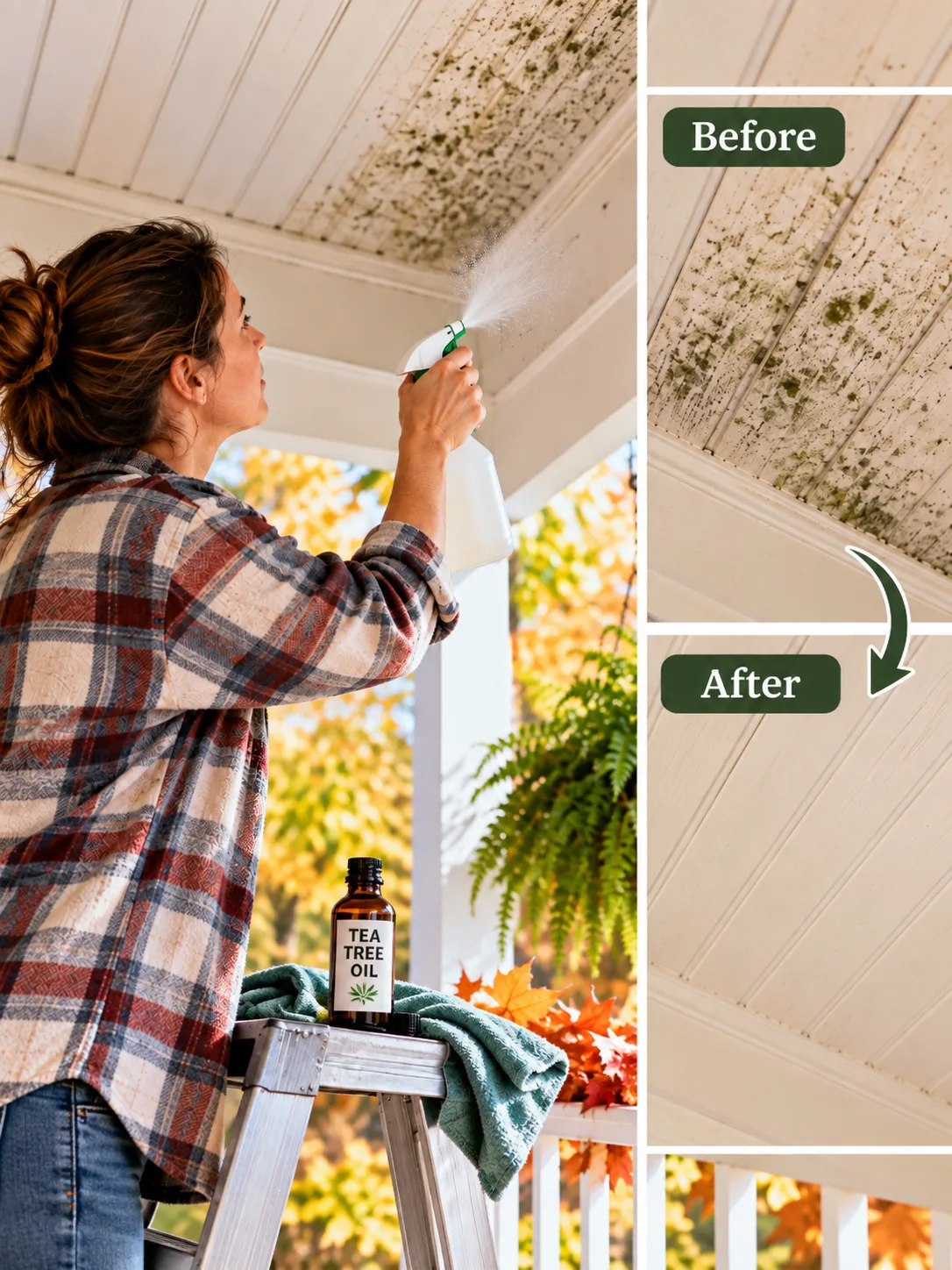
By the second week of October, I started noticing that unmistakable damp smell every time I stepped onto my back porch in the morning. We’d had a run of cool nights, a few light rains, and more maple and oak leaves than I could keep up with, and some of that debris had worked its way into the gap above my porch ceiling boards. The result was trapped moisture overhead, patchy discoloration on painted wood, and the kind of nagging worry that makes a homeowner look up every single time she walks outside. I decided to try a simple experiment: diluted tea tree oil, sprayed onto the affected ceiling boards every 3 days for 15 days, and carefully observed.
I’m a cook by nature, so I tend to approach household experiments the same way I approach a new recipe: measure carefully, change one variable at a time, and pay attention to what actually happens rather than what I hope will happen. What follows is exactly that—what I used, how I mixed it, what changed by day 3, day 9, and day 15, what did not improve, and where I think tea tree oil helped versus where basic cleanup and drying did the real heavy lifting.
1. Why I tried tea tree oil in the first place
The issue wasn’t dramatic black rot or dripping water. It was subtler: a film of moisture-prone grime, a few gray-green speckles on the porch ceiling boards, and a musty smell strongest in the morning when temperatures sat around 42°F to 50°F. My porch ceiling is painted beadboard-style wood, and while it’s covered, wind had pushed damp leaf bits into the edge where the roofline and trim meet. That trapped organic matter stayed wet longer than it should have.
I chose tea tree oil because it’s commonly discussed for odor control and light mildew-related cleaning. I did not treat it as a miracle fix or as a substitute for repairing leaks. In my case, I wasn’t seeing structural failure. I was dealing with surface-level dampness, mild spotting, and odor tied to decomposing leaf debris and slow drying conditions.
2. The exact mixture I used
I mixed the spray in a clean 16-ounce bottle. My ratio was 1 teaspoon of tea tree oil to 2 cups of water, plus about 1 teaspoon of unscented liquid castile soap to help disperse the oil. Tea tree oil and water separate quickly, so that small amount of soap made the mixture far more usable. Before each application, I shook the bottle vigorously for 15 to 20 seconds.
If you like precise kitchen-style measurements, that worked out to roughly 5 milliliters of tea tree oil in about 475 milliliters of water. I made fresh solution halfway through the test so I wasn’t relying on a bottle that had been sitting too long. The aroma was strong but not unbearable outdoors—medicinal, fresh, and unmistakably herbal.
3. How I prepared the porch ceiling before the first spray
Before I sprayed anything, I dealt with the obvious culprit: the leaf debris. Using a small hand brush, a vacuum with a hose attachment, and a step ladder, I removed as much trapped material as I could safely reach from the porch edge. I collected about 3 loosely packed cups of damp leaf fragments, seed fluff, and dark grit. That alone made an immediate difference in airflow.
I did not scrub the entire ceiling clean first because I wanted to see whether repeated light applications would noticeably affect the odor and surface spotting. I did, however, wipe one 12-inch-by-12-inch corner with a damp cloth to create a comparison point. That detail ended up mattering more than I expected.
4. My spraying schedule over the 15 days
I sprayed on day 1, day 4, day 7, day 10, and day 13—so five total applications over a 15-day span. I applied the spray in the late morning, usually between 10:30 a.m. and 11:30 a.m., after dew had dried but before the colder evening air rolled in. Outdoor temperatures during the test ranged from 46°F on the coolest spray day to 63°F on the warmest.
Each time, I lightly misted the same affected 18-square-foot section of ceiling until the boards were damp but not dripping. I used roughly 3 to 4 ounces of solution per session. I didn’t want runoff in my face, and I certainly didn’t want to over-wet wood that was already slow to dry.
5. What I noticed after the first application
The most obvious change after the first spray was the smell. Within an hour, the musty odor had been replaced by the scent of tea tree oil, which lingered strongly for the rest of the day and faintly into the next morning. That did not mean the moisture problem was solved, but it did make the porch feel cleaner right away.
Visually, nothing dramatic happened on day 1. The gray-green speckling looked slightly darker while wet, then returned to about the same appearance once dry. I did notice that the boards dried in about 2 hours and 15 minutes that day, which told me I was applying a light enough coat not to create a new moisture burden.
6. What changed by day 4 and day 7
By the second and third applications, the musty odor was genuinely less pronounced even before I sprayed again. That was my first sign that something useful was happening. The porch no longer had that stale, compost-bin-adjacent note when I opened the back door at 7 a.m. The smell wasn’t gone entirely, but I would estimate it had dropped by more than half by day 7.
The surface spotting also began to look a little flatter and less obvious, especially on the smoother painted sections between grooves. I want to be careful here: the spray did not “erase” stains. What I saw was a modest improvement in patchy discoloration and a more even-looking surface, likely helped by both the repeated application and the prior debris removal.
7. What happened by day 10 and day 13
By day 10, the biggest benefit was stability. The odor was staying low instead of bouncing back after chilly, damp nights. We had one rainy day during the experiment, and I half expected the porch to smell sour again the next morning, but it really didn’t. That told me the area was drying more effectively now that the trapped leaves were gone and the boards were being monitored regularly.
After the fifth spray on day 13, I could still see a few stubborn marks clustered along one seam where two boards met. Those did not respond much at all. Seams and grooves tend to hold grime, and once discoloration settles into textured paint, a mist-on treatment only goes so far. At that point I was convinced the spray had helped with freshness and mild spotting, but it wasn’t a replacement for targeted cleaning in the grooves.
8. What the ceiling looked and smelled like on day 15
On day 15, the area looked cleaner but not newly painted. That’s the honest version. The faint gray-green speckles were reduced enough that I had to stand directly beneath them to notice them, whereas on day 1 I could spot them from the porch steps about 8 feet away. The musty odor, which had been the thing bothering me most, was nearly gone.
If I had to summarize the result in practical homeowner terms, I’d say this: the treatment improved the symptom level from “I need to deal with this now” to “this area is under control, but I should still deep-clean and inspect it before winter sets in.” That is a worthwhile result, just not a magical one.
9. What actually helped most: the spray, the cleanup, or the drying
In my opinion, the biggest improvement came from a combination of all three, with debris removal doing the most important foundational work. Organic matter holds water like a sponge. As long as those leaf fragments were tucked overhead, no spray was going to create a lasting fix. Removing the debris improved airflow immediately.
The tea tree oil spray seemed most helpful for odor reduction and for discouraging that “damp left-behind” feeling on the surface. The weather also cooperated enough to allow gradual drying between applications. If I had sprayed faithfully but left the leaves in place, I doubt I would have seen much success at all.
10. The one comparison spot that taught me the most
Remember that 12-inch square I wiped at the beginning? By day 15, that little cleaned patch still looked better than the surrounding boards that only got sprayed. Not by a huge margin, but enough to prove an old kitchen lesson I’ve relearned a hundred times in home care too: contact and removal matter. A cleaner can loosen grime, but physically lifting it away often makes the difference.
If I were doing this again, I would spray first, wait 10 minutes, then gently wipe or scrub a test section with a soft cloth or soft-bristle brush. That extra step likely would have improved the visible results by another 20% to 30%, especially in the grooves.
11. Downsides and cautions I ran into
The smell of tea tree oil is not subtle. I happen to tolerate it well, but if you’re sensitive to strong scents, even a diluted mixture can feel intense at close range. I wore gloves and safety glasses because overhead spraying is awkward, and I strongly recommend both. I also made sure not to saturate the ceiling, because adding excess moisture to a moisture problem is exactly the kind of mistake that sounds obvious after the fact.
I also spot-tested first in an inconspicuous area. Painted porch ceilings can vary a lot—flat paint, satin paint, older repaint jobs, patched boards—and anything oily should be tested for finish compatibility. I did not see staining, peeling, or sheen changes on my painted boards, but I would never assume every surface will respond the same way.
12. When this approach is worth trying
I think this sort of tea tree oil spray routine is worth trying when you’re dealing with mild mustiness, light surface spotting, and damp conditions caused by seasonal debris rather than a true roof leak or major mold problem. It’s especially sensible for a small area—say 10 to 25 square feet—where you can monitor changes closely over 1 to 2 weeks.
It is not, in my view, the right answer for soft wood, persistent wetness, peeling paint caused by water intrusion, or widespread dark staining that returns quickly after cleaning. In those cases, I would move straight to a more thorough inspection, moisture-source correction, and possibly a dedicated exterior cleaner appropriate for the surface.
13. What I would do differently next time
Next time, I’d start one step earlier in the season. Early October would be better than mid-October, before the debris layer has had time to compact and stay damp through repeated cool nights. I would also pair the spray schedule with a small detail brush or microfiber cloth on every other treatment day.
I’d probably reduce the treated area into two clearly marked sections too—one sprayed only and one sprayed plus wiped—so the comparison is more controlled. That’s the part of me that still thinks like a recipe tester. If you’re going to experiment, you may as well gather useful information.
14. My final verdict after 15 days
Yes, something happened—and enough happened that I’d call the test successful, with limits. Spraying diluted tea tree oil on my porch ceiling boards every 3 days for 15 days noticeably reduced the musty smell, modestly improved light surface spotting, and made the area feel fresher and more maintained. It did not fully remove embedded discoloration, and it did not replace the need to clear out the damp leaf debris that caused the problem in the first place.
If you’re looking for a realistic expectation, here’s mine: tea tree oil can be a helpful support step for a mildly damp, slightly musty porch ceiling in fall weather, but the real solution is still cleanup, airflow, and catching moisture issues before they settle in. In other words, it behaved less like a miracle cure and more like a useful kitchen assistant—good at helping, but not the one doing all the work.