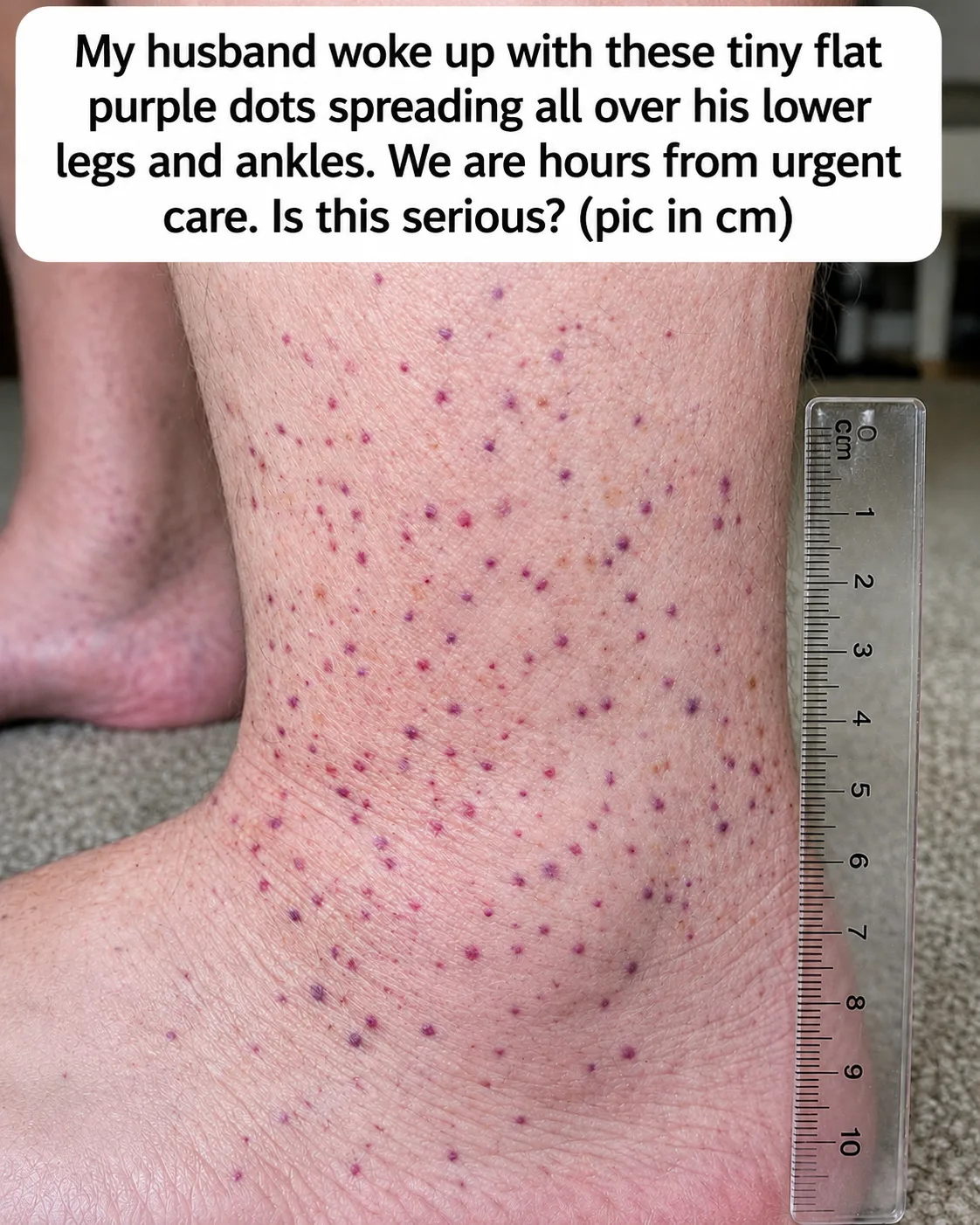
Imagine waking up in the morning and noticing dozens of tiny purple or reddish dots scattered around your husband’s ankles and lower legs.
They’re flat.
They don’t look like mosquito bites.
They aren’t obviously raised or irritated.
And worse, there seem to be more of them than there were a short time ago.
That is not the kind of skin change I would casually cover with lotion and forget about.
Tiny, flat, non-blanching purple spots can sometimes be petechiae, which are small areas of bleeding beneath the skin. Petechiae are not a disease by themselves. They are a physical sign that can have causes ranging from pressure or straining to platelet disorders, medication effects, blood-vessel inflammation, or serious infection. :contentReference[oaicite:0]{index=0}
The important question isn’t simply, “What are these dots?”
It’s whether other symptoms suggest that the person needs emergency care.
If the spots are new, numerous, or actively spreading—especially when accompanied by fever or illness—prompt medical assessment matters.
Here’s what to look for and what I would do next.
First: What Do Petechiae Look Like?
Petechiae are tiny spots caused by bleeding from very small blood vessels beneath the skin.
They may appear:
- Red
- Purple
- Reddish-brown
- Pinpoint-sized
- Flat rather than raised
- Individually or in clusters
They are commonly around 1 to 2 millimeters across, although multiple spots close together can make the skin look more broadly discolored. :contentReference[oaicite:1]{index=1}
One important characteristic is that true petechiae generally do not blanch.
That means the color remains visible when pressure is applied.
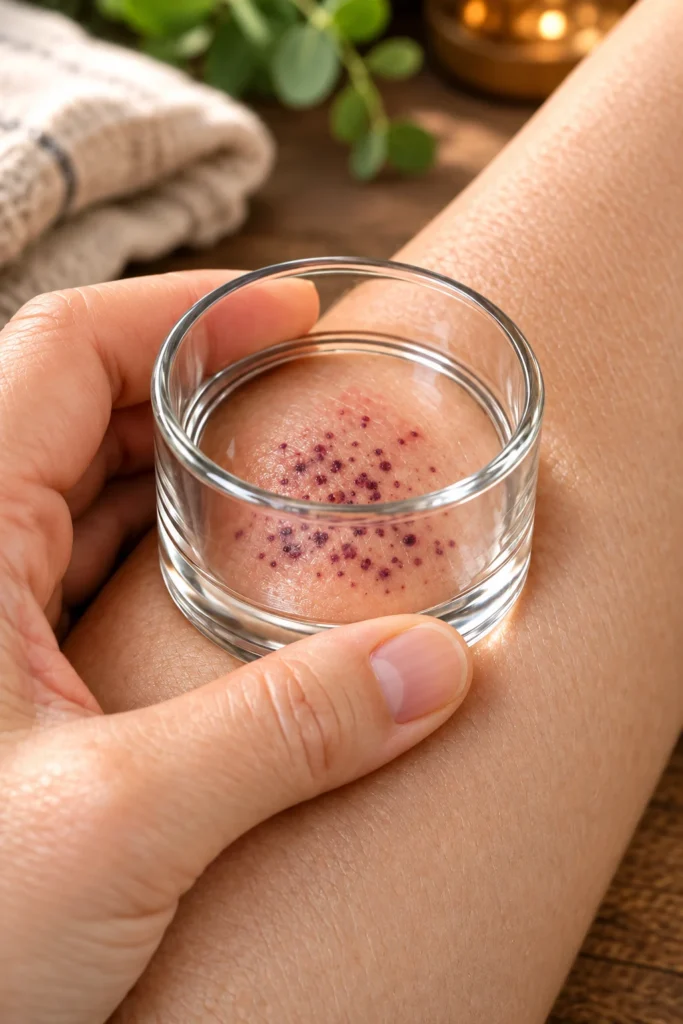
What Does “Non-Blanching” Mean?
Many ordinary red rashes become temporarily lighter when you press them.
Petechiae and purpura behave differently because the color comes from blood outside the vessels beneath the skin.
You can gently press a finger against the area and watch whether the spots fade.
A clear drinking glass can also make the change—or lack of change—easier to see.
If the purple or red spots remain visible under pressure, they are considered non-blanching.
That finding doesn’t tell you the cause.
It does mean the spots deserve more attention, particularly when they appeared suddenly or are spreading.
Why Petechiae May Show Up Around the Ankles
The lower legs and ankles can be a noticeable location for small blood-vessel changes.
Gravity increases pressure in vessels in the lower extremities, particularly after long periods of standing or walking.
Pressure from tight socks, boots, or other clothing may also contribute to localized spots in some circumstances. :contentReference[oaicite:2]{index=2}
A small patch directly around a pressure point is very different from hundreds of new spots appearing across both legs.
Distribution matters.
So does how quickly the spots are changing.
Some Causes Can Be Relatively Minor
Seeing petechiae doesn’t automatically mean someone has a life-threatening illness.
Small blood vessels can sometimes break after intense physical pressure or straining.
Possible triggers can include:
Heavy coughing.
Repeated vomiting.
Heavy lifting.
Significant straining.
Pressure from clothing or equipment.
Intense physical activity.
Certain medications can also contribute to bleeding or bruising tendencies. The source material specifically notes aspirin, ibuprofen, blood thinners, some antibiotics, and steroids as examples worth discussing with a clinician. :contentReference[oaicite:3]{index=3}
But here’s the important part:
You shouldn’t assume that a new widespread outbreak is caused by pressure simply because pressure can cause petechiae.
The overall situation matters.
Other Causes Can Be Much More Serious
Petechiae can appear when the body has problems involving platelets, clotting, blood vessels, or infection.
Possible causes described in the supplied material include:
Low platelet counts.
Immune thrombocytopenia.
Some viral illnesses.
Vasculitis.
Liver disease.
Medication reactions.
Certain vitamin deficiencies.
Blood-related disorders.
Serious infections. :contentReference[oaicite:4]{index=4}
You cannot reliably tell these possibilities apart by looking at the skin at home.
That is one reason a sudden unexplained eruption may require blood tests and a physical examination.
The Biggest Warning Sign: Petechiae With Fever
A fever combined with a new non-blanching purple rash deserves urgent medical attention.
Certain serious infections can produce petechiae or larger areas of purpura and can progress quickly.
Do not wait for the person to become dramatically ill before seeking help.
Someone can appear relatively stable early in a serious illness.
If there is fever and a rapidly spreading non-blanching rash, emergency assessment is the safer course.
Other Emergency Warning Signs
Seek emergency medical help when new petechiae or purple spots occur with symptoms such as:
- Confusion
- Fainting
- Severe weakness
- Trouble breathing
- Chest pain
- Severe headache
- Stiff neck
- Rapidly spreading purple areas
- Larger unexplained purple patches
- Significant or unexplained bleeding
- A person behaving noticeably unlike themselves
The supplied material also flags bleeding from the gums or nose, blood in the urine or stool, and sudden unusual bruising as reasons for greater concern. :contentReference[oaicite:5]{index=5}
If severe symptoms are developing, call emergency services rather than attempting a long drive without medical guidance.
What If There Is No Fever?
No fever doesn’t automatically make widespread petechiae harmless.
Same-day medical evaluation can still be appropriate when the spots are:
New.
Numerous.
Increasing quickly.
Appearing on both legs.
Spreading into additional areas.
Accompanied by unexplained bruising.
The supplied material also identifies leg swelling, joint pain, abdominal pain, dark urine, unusual fatigue, recent illness, and recent medication changes as information that should raise concern and be reported to a clinician. :contentReference[oaicite:6]{index=6}
If you can clearly see that new spots are appearing over a short period, don’t plan on simply watching them for several days.
Call a medical professional for prompt triage.
What to Do in the Next 10 Minutes
When you’re far from medical care, gathering useful information can help the clinician who answers your call.
1. Take an Actual Temperature
Use a thermometer.
Don’t rely on touching the forehead.
Write down the temperature and the time you measured it.
If there’s a fever together with a new spreading non-blanching rash, treat that combination seriously.
2. Check Whether the Spots Blanch
Gently apply pressure.
Watch whether the spots temporarily disappear or remain visible.
Don’t repeatedly press hard enough to injure the skin.
You’re simply checking whether the color fades with normal pressure.
3. Take Clear Photographs
Take several pictures in good lighting.
Get one close-up showing individual dots.
Then take another picture showing the entire ankle or lower leg.
Photographs can document how the rash changes while you’re arranging care.
4. Check the Rest of the Body
Look for additional spots.
Check the other leg.
Look for unexpected bruising.
Notice whether spots have appeared somewhere completely different.
Tell the clinician exactly where they are.
5. Ask About Bleeding
Check for unusual:
Nosebleeds.
Bleeding gums.
Blood in urine.
Blood in stool.
Black stool.
New large bruises.
Don’t dismiss those symptoms as unrelated.
They may help a clinician understand what is happening.
6. Ask How He Actually Feels
Skin isn’t the only thing that matters.
Ask about:
Headache.
Dizziness.
Weakness.
Shortness of breath.
Chest discomfort.
Abdominal pain.
Joint pain.
Neck stiffness.
Recent illness.
A person feeling dramatically unwell along with spreading purple spots is much more concerning than an isolated stable patch after obvious pressure.
7. Make a Medication List
Write down every medication and supplement taken recently.
Pay special attention to newly started medications.
Include prescription drugs and over-the-counter products.
Don’t assume something doesn’t matter because it came from the drugstore rather than a prescription bottle.
Don’t Stop Prescription Medication on Your Own
This point is important.
Some medicines affect platelets or bleeding, but suddenly stopping a prescribed medication can also create serious risks.
For example, people may take aspirin or anticoagulants because they have significant cardiovascular or clotting risks.
If a medication has been prescribed, contact the prescribing clinician or emergency medical professional for instructions rather than independently changing treatment.
Bring the complete medication list when seeking care.
Document Whether the Spots Are Spreading
The supplied material suggests lightly marking the outside edge of a visible cluster and writing down the time, then checking again after approximately 15 to 30 minutes. :contentReference[oaicite:7]{index=7}
This isn’t a diagnostic test.
It’s simply a way to document rapid change while you’re calling for help or preparing to leave.
Photos can serve a similar purpose.
If new clusters are appearing or spots are moving noticeably beyond the original area, tell the clinician.
And don’t spend hours repeatedly monitoring an obviously worsening rash.
Documentation should not delay care.
When Distance From the Hospital Changes the Decision
Living hours from urgent care makes these situations harder.
You don’t want to make a long trip unnecessarily.
At the same time, waiting until severe symptoms appear can create a much bigger problem.
If the spots are rapidly spreading or accompanied by fever, confusion, fainting, breathing problems, major bleeding, severe weakness, severe headache, or other significant symptoms, contact emergency services.
If you’re unsure whether the situation meets that threshold, call the nearest emergency department, medical triage service, or other appropriate local medical service immediately.
Be specific.
Instead of saying:
“He has a rash.”
Say something closer to:
“He developed new flat purple spots over both lower legs. They don’t fade when pressed, and they appear to be spreading.”
That gives the clinician much more useful information.
Don’t Assume It’s an Allergy
Allergic skin reactions commonly cause itching, raised welts, redness, or swelling.
Petechiae are different.
They represent bleeding beneath the skin.
That means antihistamines or anti-itch creams won’t address the underlying reason petechiae formed.
If the spots are genuinely non-blanching, don’t let the absence of itching convince you that nothing serious is happening.
Don’t Cover the Spots With Cream Before Evaluation
Avoid smearing several different creams across the area while trying to figure out what’s happening.
Creams can change the appearance of the skin and won’t correct bleeding underneath it.
Keep the area clean.
Take photographs.
Let a clinician see the spots as clearly as possible.
What Doctors May Check
A medical professional will first look at the spots themselves.
They may examine:
Size.
Color.
Distribution.
Whether they blanch.
Whether larger areas of purpura are present.
Whether unexplained bruising exists elsewhere.
They’ll also want a detailed history.
Expect questions about recent illnesses, medications, bleeding, medical conditions, and other recent changes.
Blood Tests May Be Needed
The source material says evaluation may include a complete blood count, which can provide information about platelets and hemoglobin. :contentReference[oaicite:8]{index=8}
Depending on the clinical situation, doctors may also order tests related to:
Blood clotting.
Kidney function.
Liver function.
Urine.
Inflammation.
Infection.
The exact tests depend on the symptoms and examination.
This is why diagnosing widespread petechiae from a photograph alone isn’t enough.
The skin may be showing the clue.
The cause may be happening elsewhere in the body.
Why Platelets Matter
Platelets help the blood form clots after blood vessels are damaged.
When platelet numbers become very low—or platelet function is impaired—small areas of bleeding can appear beneath the skin.
Petechiae may therefore be one visible clue of a platelet problem.
Other clues can include easy bruising or unusual bleeding.
But petechiae don’t automatically mean low platelets.
Blood testing is needed to determine whether platelet abnormalities are actually present.
Petechiae vs. Purpura
People sometimes use these terms interchangeably, but size helps distinguish them.
Petechiae are generally tiny pinpoint spots.
Purpura are larger areas of bleeding beneath the skin.
Much larger bruiselike areas are sometimes described differently again.
From a practical at-home perspective, the appearance of increasingly large purple areas alongside tiny spots is a reason to take the situation more seriously rather than trying to find the perfect terminology.
Tell the clinician what you’re seeing.
Let them classify it.
Petechiae vs. Bug Bites
Bug bites are commonly raised.
They may itch.
There may be a visible central bite point.
Petechiae are generally flat and don’t disappear under pressure.
That distinction isn’t perfect, though.
Don’t diagnose a widespread new rash based solely on whether you remember seeing mosquitoes.
If you’re unsure, medical evaluation is the better answer.
Petechiae vs. Ordinary Bruises
Bruises are usually much larger than petechiae.
They may change color over several days.
Petechiae look more like tiny dots.
When tiny spots and unexplained large bruises suddenly appear together, that combination deserves particular attention because it can suggest a broader bleeding problem.
Could Tight Socks Cause Purple Dots?
Pressure can sometimes contribute to localized petechiae.
If the dots appear exactly where a tight band pressed against the skin and the person otherwise feels completely well, pressure may be one possibility.
But don’t use that explanation for a rash that’s clearly spreading across large portions of both legs.
A small pressure-related cluster and hundreds of unexplained new spots are very different situations.
Could Exercise Cause Petechiae?
Intense exercise, heavy lifting, or significant straining can sometimes contribute to small broken capillaries.
Again, context matters.
A few stable spots after an obvious physical trigger in an otherwise well person may be less concerning.
A rapidly spreading non-blanching rash without a clear explanation needs a different response.
When in doubt, contact a clinician.
Could a Recent Infection Matter?
Yes.
Recent infections are relevant information for the doctor.
The source specifically recommends reporting a recent cold, flu-like illness, stomach illness, or sore throat when evaluating new petechiae. :contentReference[oaicite:9]{index=9}
Write down approximately when the illness started and when it ended.
Don’t assume the two events are unrelated simply because the earlier symptoms improved.
Could a New Medication Matter?
Yes.
A new medication can be an important clue.
Tell the clinician about anything started recently, including:
Prescription medications.
Antibiotics.
Pain relievers.
Supplements.
Herbal products.
Again, don’t independently stop important prescribed medication unless a medical professional tells you to do so.
The medication history helps the clinician decide what comes next.
Can Someone Have Serious Petechiae and Still Feel Fine?
Yes, and that’s one reason appearance and progression matter.
The supplied source notes that a person can initially feel relatively normal even when the underlying problem requires medical attention. :contentReference[oaicite:10]{index=10}
Not every serious medical problem begins with dramatic symptoms.
Likewise, not every case of petechiae turns out to be dangerous.
Those two facts can exist at the same time.
That’s why sudden widespread or spreading petechiae deserve professional assessment rather than reassurance based only on how the person feels at one moment.
A Simple Decision Guide
Call Emergency Services Now
Seek emergency help for rapidly spreading non-blanching purple spots accompanied by serious symptoms such as fever with significant illness, confusion, fainting, breathing difficulty, severe weakness, severe headache or stiff neck, major bleeding, or rapidly worsening purple areas.
Seek Prompt Same-Day Medical Assessment
Even without fever, new widespread or clearly spreading petechiae should receive prompt medical attention, particularly when accompanied by unexplained bruising, bleeding, swelling, joint pain, abdominal pain, dark urine, unusual fatigue, recent illness, or medication changes.
Limited Observation May Sometimes Be Appropriate
A clinician may sometimes recommend observation for a few isolated spots with an obvious pressure or straining trigger in a person who otherwise feels completely well.
But that decision should not be stretched to cover a new rash that’s actively spreading across both lower legs.
What to Bring With You
If you’re leaving for urgent care or an emergency department, bring:
- Medication and supplement list
- Recent medication changes
- Photos of the spots
- Time the rash was first noticed
- Temperature readings
- Recent illness history
- Relevant medical history
- Information about unusual bleeding or bruising
- Identification and insurance information where applicable
- Phone charger for a long wait
If you’re several hours from care, bring necessary travel supplies—but don’t delay departure to pack the perfect bag when symptoms are escalating.
Frequently Asked Questions
Are tiny purple dots on the legs always petechiae?
No. Several skin conditions can produce red or purple spots. Petechiae are one possibility, especially when the spots are tiny, flat, and non-blanching. A clinician can assess the appearance and determine whether further testing is needed.
Do petechiae disappear when pressed?
Typically, petechiae do not blanch, meaning they remain visible when pressure is applied.
Are petechiae always an emergency?
No. Causes range from relatively minor pressure or straining to serious blood disorders and infections. New widespread, rapidly spreading, or symptomatic petechiae require more urgent assessment.
Should I worry about petechiae with fever?
Yes. A new non-blanching rash accompanied by fever can be a medical emergency and warrants urgent professional assessment.
What if there is no fever?
The absence of fever doesn’t rule out an important underlying condition. New numerous or spreading spots still deserve prompt medical advice.
Can tight socks cause petechiae around the ankles?
Pressure can sometimes contribute to localized spots. However, extensive or spreading purple dots shouldn’t automatically be blamed on socks.
Can medications cause petechiae?
Some medications can affect platelets, clotting, or bleeding risk. Tell the clinician about all prescription medicines, over-the-counter drugs, and supplements.
Should I stop blood thinners if petechiae appear?
Do not independently stop a prescribed anticoagulant or other important medication. Contact a medical professional immediately for instructions.
Can petechiae itch?
They often don’t. The absence of itching does not prove the spots are harmless.
Can I treat petechiae with steroid cream?
Petechiae represent bleeding beneath the skin, so topical creams don’t address the underlying cause. Treatment depends on why the spots developed.
What tests might doctors order?
Depending on the situation, evaluation may include a complete blood count, platelet count, clotting studies, kidney or liver tests, urinalysis, and tests for infection or inflammation. :contentReference[oaicite:11]{index=11}
Should I photograph the rash?
Yes. Clear photographs can help document how quickly the spots are changing while you arrange medical assessment.
Final Thoughts
Tiny flat purple dots across the ankles and lower legs can look surprisingly harmless.
Sometimes the explanation really is relatively minor.
But sudden spreading non-blanching purple spots should not automatically be treated like an ordinary rash.
Petechiae are a sign, not a diagnosis.
The most important clues are how quickly they appeared, whether they’re spreading, whether they blanch, whether unexplained bleeding or bruising is happening elsewhere, and whether the person has fever or other symptoms.
If the spots are rapidly spreading or accompanied by fever, confusion, severe weakness, breathing difficulty, fainting, severe headache, stiff neck, major bleeding, or rapidly worsening illness, seek emergency medical help.
If there are no severe symptoms but the spots are new, widespread, numerous, or clearly increasing, contact a medical professional for prompt same-day assessment.
When you’re hours from medical care, calling ahead can be especially useful.
Describe exactly what you see:
New, flat, purple, non-blanching spots that are spreading.
That’s much more useful than simply saying, “He has a rash.”
And when the choice is between having a clinician tell you everything looks okay and spending hours at home hoping a spreading purple rash isn’t important, this is one situation where getting professional medical guidance sooner makes sense.