You know that sad little moment when you open the refrigerator and find the lettuce you bought five days ago looking like it has completely given up on life?
Yep. Been there.
Then there’s the bag of spinach with wet leaves stuck together, the cucumber developing a suspicious soft spot, and the cilantro that somehow went from gorgeous to mushy overnight.
Fresh produce isn’t cheap, so throwing it away hurts twice.
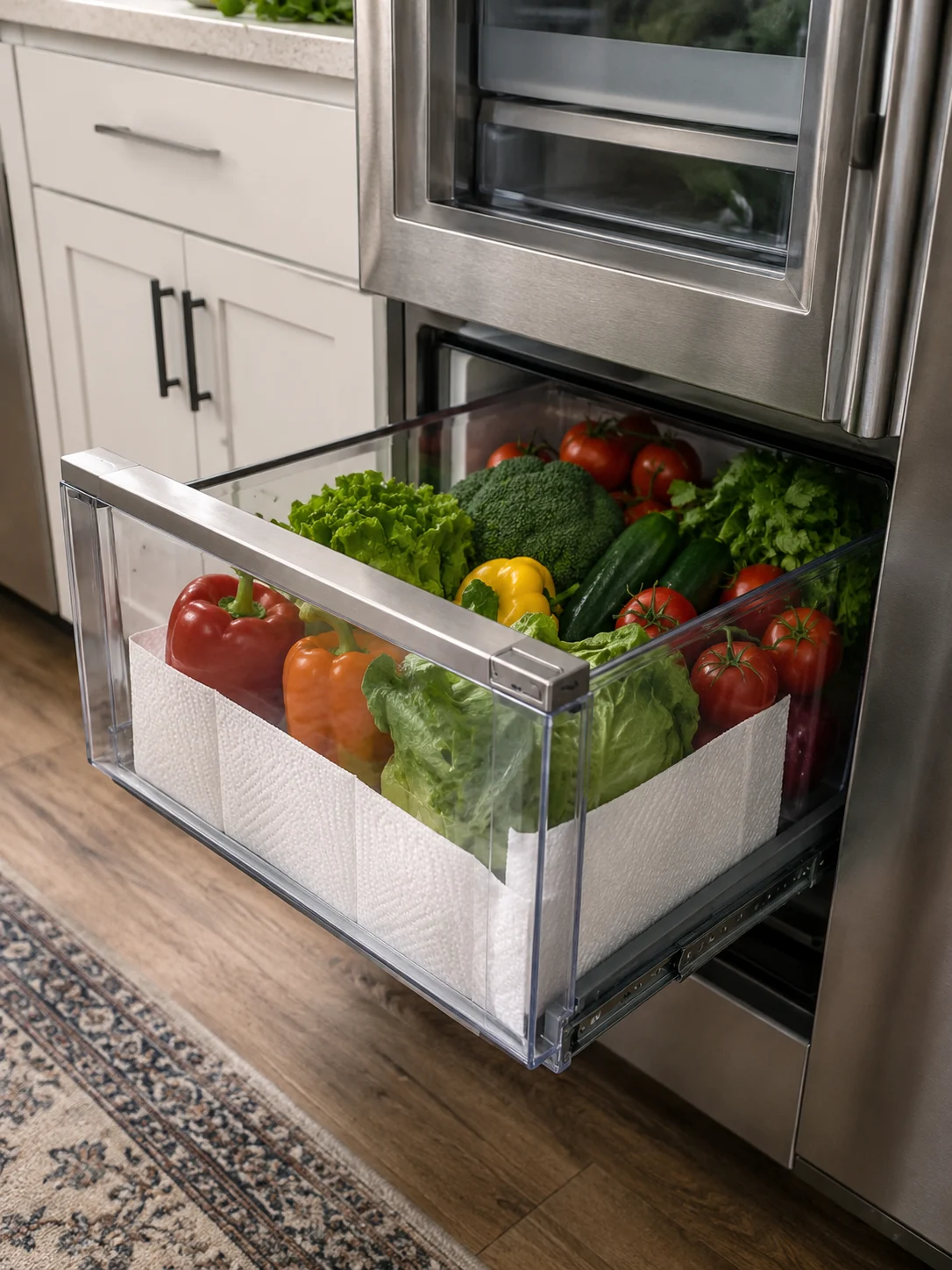
That’s why this simple crisper drawer paper towel trick caught my attention: close the humidity vents, line the bottom of the refrigerator drawer with plain paper towels, and store moisture-loving vegetables inside.
The idea sounds almost too simple.
However, there’s actual logic behind part of it. Many refrigerator crisper drawers let you control humidity. A closed vent generally traps more moisture, while an open vent allows more moisture to escape. High humidity tends to suit leafy vegetables that wilt easily, while lower humidity works better for many fruits that release ethylene gas. :contentReference[oaicite:0]{index=0}
The paper towels add another layer to the setup by catching excess moisture that settles at the bottom.
So, does combining these two tricks actually keep vegetables fresh longer?
I gave the idea a closer look, and there’s a lot more to it than simply shutting a vent.
What Does the Crisper Drawer Vent Actually Do?
I used to think that little slider on the crisper drawer was basically decorative.
Turns out, it has a real job.
The control changes how easily moist air can leave the drawer.
Move the setting toward high humidity or closed, and more moisture remains inside.
Move it toward low humidity or open, and moisture escapes more easily.
That difference matters because fruits and vegetables don’t all want the same storage conditions.
Leafy vegetables lose water easily.
When they lose too much, they wilt.
A higher-humidity environment slows that moisture loss and can help them remain crisp. Refrigerator guidance commonly recommends a high or closed setting for leafy greens and a low or open setting for many fruits. :contentReference[oaicite:1]{index=1}
Simple enough, right?
Well, mostly.
Why Closing the Crisper Vent Can Help Leafy Greens
Think about lettuce.
Most of its appeal comes from water.
Fresh lettuce is crisp, juicy, and snappy.
As it loses moisture, the leaves become limp.
Spinach, herbs, broccoli, cucumbers, and other tender vegetables can have similar problems.
Closing the crisper vent helps trap humidity around these foods.
That humid environment slows moisture loss.
The result can be vegetables that stay firm and fresh-looking longer.
This is exactly why refrigerator manufacturers commonly recommend higher humidity for leafy greens and other vegetables prone to wilting. :contentReference[oaicite:2]{index=2}
But there’s a catch.
Too much moisture sitting directly on the food can cause a completely different problem.
Hello, slime.
Why I Added Paper Towels
This is where the paper towel idea gets interesting.
High humidity is useful.
Standing water isn’t.
Vegetables can release moisture while stored, and condensation may also collect inside the drawer.
If that moisture settles underneath produce, delicate leaves can end up sitting against a wet surface.
That’s when things can get gross pretty quickly.
A layer of plain paper towels at the bottom can absorb some loose moisture.
Think of the towels as a little buffer.
You still get the humid environment created by the closed vent, but the vegetables aren’t necessarily sitting directly in every drop of condensation that reaches the drawer bottom.
And honestly, anything that prevents that mysterious vegetable puddle is already getting my attention.
How I’d Set Up the Crisper Drawer
First, empty the drawer completely.
Remove old leaves, stems, dirt, and forgotten produce.
Then clean the drawer according to your refrigerator manufacturer’s instructions.
Dry it thoroughly.
Don’t start a moisture-control experiment with a soaking-wet drawer.
Once dry, place a layer of plain, unscented paper towels across the bottom.
You don’t need half a roll.
A couple of sheets may be enough depending on the size of the drawer.
Then set the humidity control appropriately for the produce you’re storing.
For leafy vegetables, that generally means the high-humidity or closed position. :contentReference[oaicite:3]{index=3}
The First Thing I’d Put Inside: Lettuce
Lettuce is basically the poster child for a high-humidity crisper.
Romaine, leaf lettuce, and similar greens can lose moisture quickly in dry refrigerator air.
That’s why they can go from crisp to floppy faster than expected.
A high-humidity drawer helps reduce that moisture loss.
Still, don’t put soaking-wet lettuce directly into the drawer.
Surface water and humid air aren’t the same thing.
If you’ve washed the leaves, drain and dry them appropriately before storage.
The goal is crisp lettuce.
Not lettuce soup.
Spinach Can Benefit Too
Spinach is another vegetable that can be frustrating.
One day it’s gorgeous.
The next day there are three suspiciously dark leaves hiding at the bottom of the container.
Moisture management matters here.
Higher humidity can help prevent spinach from drying out, but excessive liquid trapped against the leaves can encourage rapid deterioration.
That’s why an absorbent layer can be handy when moisture collects beneath stored greens.
Check the spinach regularly.
Remove damaged leaves before they affect the rest.
One slimy leaf has an annoying habit of finding friends.
What About Fresh Herbs?
Tender herbs can also lose moisture rapidly.
Parsley and cilantro are two classic examples.
They can go limp long before you finish the bunch.
A humid environment may help reduce wilting, but herbs shouldn’t be shoved into the drawer dripping wet.
If you’ve washed them, remove excess surface moisture before storage.
Then check them every few days.
Herbs are a little dramatic.
Too dry?
They wilt.
Too wet?
They deteriorate.
Apparently cilantro has standards.
Cucumbers Like Moisture Too
Cucumbers contain a lot of water, which is exactly why they’re so refreshing.
It’s also why dehydration changes their texture.
As cucumbers lose moisture, they may soften and wrinkle.
A higher-humidity storage environment can help reduce that water loss.
Keep them dry on the outside before placing them in the drawer, and avoid crushing them underneath heavier vegetables.
If you notice condensation collecting heavily, check the paper towel.
That little sheet can tell you quite a lot about what’s happening inside the drawer.
Broccoli Can Go in the High-Humidity Drawer
Broccoli can also benefit from humid refrigerator storage.
Without enough moisture, the stalk and florets can lose freshness.
However, that doesn’t mean broccoli should sit wet.
Again, there’s a difference between humidity in the air and liquid water sitting against the vegetable.
Keep an eye on condensation and remove any deteriorating produce quickly.
Also avoid packing the drawer so tightly that nothing can breathe.
Your crisper shouldn’t look like you’re playing vegetable Tetris at championship level.
Carrots Are Another Good Candidate
Carrots can lose moisture and become rubbery over time.
A humid crisper environment can help limit that dehydration.
They can therefore fit nicely with vegetables that prefer higher humidity.
The same basic rule applies:
Keep the produce in good condition when it enters the drawer.
Storage tricks can slow deterioration.
They can’t reverse it.
A carrot already halfway to retirement isn’t becoming farm-fresh again because you changed a slider.
The Paper Towels Tell You When Moisture Is Getting Too High
Here’s one of my favorite things about this trick.
The paper towel becomes a simple moisture indicator.
Open the drawer after a few days and touch it.
Still mostly dry?
Great.
Slightly damp?
Keep checking.
Wet?
Replace it.
If the towels repeatedly become soaked, the drawer may have too much moisture for the way you’re currently using it.
You might need more airflow, drier produce, less overcrowding, or a different storage setup.
Don’t leave a saturated paper towel underneath your vegetables.
At that point, it’s doing the opposite of what you wanted.
Don’t Store Wet Produce and Expect the Towel to Fix Everything
This is probably the biggest mistake.
You wash a bunch of vegetables.
They’re still covered in water.
Then you toss them into a closed high-humidity drawer and assume the paper towel will handle it.
Eh… not ideal.
Paper towels can catch some excess moisture.
They aren’t tiny kitchen miracles.
Remove excess water before storage when appropriate.
That gives the drawer a much better chance of maintaining humidity without becoming excessively wet.
Don’t Pack the Drawer Too Tightly
I know how this happens.
You come home from the grocery store feeling wildly responsible because you bought enough vegetables to feed a small village.
Then you cram everything into one drawer.
The problem is that overcrowding can interfere with airflow around the produce.
It also creates pressure points where vegetables press against each other.
Moisture can collect in those tight spaces.
Keep enough room for the produce to sit comfortably.
Manufacturer guidance also recommends avoiding overfilling crisper drawers so air can move around the food. :contentReference[oaicite:4]{index=4}
Your kale doesn’t need a private suite.
Just don’t make it share a studio apartment with seventeen cucumbers.
Here’s Where the Trick Goes Wrong: Fruit
This is the part people often miss.
Fully closing the crisper vent isn’t automatically the best setting for everything.
Many fruits release ethylene, a natural plant hormone associated with ripening.
Apples, pears, avocados, and several other fruits can release significant amounts.
A low-humidity drawer with a more open vent allows moisture and ethylene to escape more readily.
That’s why many refrigerator recommendations place these foods in the low-humidity drawer. :contentReference[oaicite:5]{index=5}
So don’t simply close every crisper vent in the refrigerator and declare victory.
Match the setting to the food.
Apples Usually Belong on the Low-Humidity Side
Apples can produce ethylene.
If that gas becomes trapped with ethylene-sensitive vegetables, it can speed deterioration.
That’s not what you want when you’re trying to keep greens fresh.
If your refrigerator has two crisper drawers, you’ve got a handy setup.
Use one for higher-humidity vegetables.
Use the other for lower-humidity fruits.
It’s basically roommate matching for produce.
And some fruits and vegetables make terrible roommates.
Pears and Avocados Need Different Thinking Too
Pears and avocados can also release ethylene as they ripen.
For produce like this, allowing more airflow can be useful.
That means an open or lower-humidity crisper setting may make more sense than a fully closed one. :contentReference[oaicite:6]{index=6}
Also remember that ripening and refrigerated storage aren’t always the same thing.
Some fruits are commonly ripened at room temperature before being moved into the refrigerator.
Storage recommendations can vary by produce type.
The important point is that the “closed vent plus paper towel” method isn’t universal.
Keep Ethylene-Sensitive Vegetables Away From Major Ethylene Producers
This is one of the easiest refrigerator habits to adopt.
Don’t automatically mix every fruit and vegetable in one giant produce drawer.
Ethylene-sensitive foods can deteriorate faster when stored with strong ethylene producers.
Leafy greens, cucumbers, broccoli, and some other vegetables can be sensitive.
Meanwhile, apples, pears, avocados, and similar fruits may release more ethylene as they ripen. :contentReference[oaicite:7]{index=7}
Separate them when practical.
That one change can be more useful than buying another fancy refrigerator organizer you’ll forget about by next month.
High Humidity Does Not Mean Wet
This distinction is worth remembering.
High humidity means the air contains more moisture.
It doesn’t mean your vegetables should be visibly wet.
Think about fresh produce at the grocery store.
Leafy vegetables often benefit from moisture, but nobody wants lettuce sitting in a puddle for a week.
That’s why this crisper setup can make sense.
The closed vent helps retain humidity.
The paper towel deals with some excess liquid reaching the drawer bottom.
Those two jobs aren’t contradictory.
They’re balancing two different forms of moisture.
When Should You Replace the Paper Towels?
Don’t follow a rigid schedule.
Look at them.
If they’re still clean and dry, there’s little reason to replace them immediately.
If they’re damp, dirty, stained, or carrying food residue, swap them out.
If spoiled produce leaks onto them, replace them right away and clean the affected area.
I wouldn’t keep damp paper towels sitting under fresh vegetables for weeks just because somebody online said “change them every Friday.”
Your refrigerator will tell you what it needs.
Well, sort of.
The soggy paper towel will.
What If Condensation Forms on the Drawer Walls?
A small amount of moisture isn’t automatically alarming in a high-humidity crisper.
That’s kind of the point.
But heavy condensation, standing water, or persistently soaked towels can signal that the environment has become excessively wet.
First, check the produce.
Was it stored wet?
Is something leaking?
Is anything spoiled?
Is the drawer overpacked?
If the problem continues, adjusting the vent slightly more open may help.
You want humidity.
You don’t want a miniature rainforest with bell peppers.
Can Paper Towels Make Produce Last Twice as Long?
I’d be careful with claims like that.
Produce life depends on many factors.
Freshness when purchased matters.
Refrigerator temperature matters.
Humidity matters.
Produce type matters.
Handling matters.
Ethylene exposure matters.
Surface moisture matters.
Even the condition of one neighboring vegetable can matter.
Paper towels can help manage loose moisture, but they don’t stop biological aging.
Think of this as a practical storage habit rather than a magic produce-preservation hack.
Refrigerator Temperature Still Matters More
No paper towel can compensate for a refrigerator that’s running too warm.
Food storage starts with proper refrigeration.
If produce and other refrigerated foods seem to spoil unusually quickly, check whether the refrigerator is maintaining the proper temperature.
Also avoid leaving the door open while deciding what to eat.
I’m guilty of this one.
Standing there staring into the refrigerator does not make a snack magically appear.
Apparently.
Don’t Block Refrigerator Air Vents
Your crisper vent isn’t the same thing as the refrigerator’s main airflow system.
Don’t cover or block internal refrigerator vents with food, containers, paper, or liners.
Cold air needs to circulate as the appliance was designed.
Line only the appropriate bottom surface of the drawer, and don’t interfere with mechanical parts or airflow openings.
If you’re uncertain about the drawer design, check the refrigerator manual.
Different models can work differently.
Clean the Crisper Regularly
Paper towels make cleanup easier, but they don’t eliminate cleaning.
Periodically empty the drawer.
Discard spoiled food.
Remove loose leaves.
Clean the drawer according to your refrigerator manufacturer’s instructions.
Dry everything before returning produce.
Honestly, an empty crisper drawer can reveal things you never wanted to know.
One tiny spinach leaf somehow becomes an entire archaeological layer.
What I’d Store in a Closed High-Humidity Crisper
For a typical adjustable crisper, I’d reserve the high-humidity drawer mainly for produce that wilts easily.
That can include leafy greens, lettuce, broccoli, cucumbers, herbs, peppers, and similar vegetables, depending on manufacturer guidance and the specific produce. :contentReference[oaicite:8]{index=8}
I’d keep major ethylene-producing fruits separate whenever practical.
This makes the whole system much easier.
One drawer for moisture-loving vegetables.
Another storage area for produce that benefits from lower humidity.
Suddenly that little slider finally earns its place in the refrigerator.
My Simple Crisper Drawer Routine
Here’s the routine I’d actually stick with.
Start with a clean, dry drawer.
Set the vent according to the type of produce you’re storing.
For leafy greens and vegetables prone to wilting, use the high-humidity setting when appropriate for your refrigerator.
Add plain paper towels to the bottom if loose moisture tends to collect there.
Put produce away reasonably dry.
Don’t overcrowd the drawer.
Separate strong ethylene producers from sensitive vegetables.
Check the drawer every few days.
Replace damp or dirty paper towels.
Remove deteriorating food promptly.
That’s it.
No expensive produce gadget required.
Frequently Asked Questions
Should crisper drawer vents be open or closed?
It depends on the produce. A closed or high-humidity setting generally works well for leafy vegetables and foods prone to wilting. An open or low-humidity setting is commonly recommended for many fruits that release ethylene. :contentReference[oaicite:9]{index=9}
Does putting paper towels in a crisper drawer help?
Paper towels can absorb loose moisture and condensation that reaches the bottom of the drawer. Replace them when they become damp or dirty.
Should lettuce go in a high-humidity drawer?
Leafy vegetables generally benefit from higher humidity because it helps reduce moisture loss and wilting. :contentReference[oaicite:10]{index=10}
Should fruit go in a high-humidity crisper?
Many fruits do better in a low-humidity drawer because the open vent allows moisture and ethylene gas to escape. Apples, pears, avocados, and several stone fruits are common examples. :contentReference[oaicite:11]{index=11}
Why does my crisper drawer get wet?
Moisture can come from produce, condensation, wet vegetables placed into storage, or a very humid drawer environment. Overpacking can make moisture management harder too.
Should I wash vegetables before putting them in the crisper?
Storage advice varies by produce. If you wash something before refrigeration, remove excess surface moisture when appropriate. Some foods, including berries, are commonly better left unwashed until you’re ready to use them. :contentReference[oaicite:12]{index=12}
How often should I replace paper towels in the vegetable drawer?
Replace them when they become noticeably damp, dirty, stained, or contaminated by spoiled food rather than following a fixed schedule.
Can I put apples and lettuce in the same crisper?
It’s generally better to separate strong ethylene-producing fruits from ethylene-sensitive vegetables when practical.
Why does lettuce get slimy in the refrigerator?
Excess surface moisture, damaged leaves, age, storage conditions, and contact with deteriorating produce can contribute to breakdown. High humidity can help with wilting, but wet leaves sitting in liquid are another matter.
Can I close both crisper vents?
You can adjust each drawer according to what you’re storing, but fully closed isn’t the right setting for every type of produce. Check your refrigerator manual because drawer designs can differ.
Final Thoughts
The crisper drawer paper towel trick is one of those kitchen ideas that actually makes sense—as long as you don’t treat it like a universal rule.
Closing the vent creates a higher-humidity environment that can help lettuce, leafy greens, cucumbers, herbs, and other moisture-sensitive vegetables resist wilting. That’s consistent with guidance for adjustable refrigerator crispers. :contentReference[oaicite:13]{index=13}
The paper towels can handle another problem: loose moisture collecting at the bottom.
Together, the setup can create a nice balance.
Humid air above.
Less free water underneath.
But the food still matters.
Don’t throw wet produce into an overcrowded drawer.
Don’t leave soaked paper towels sitting underneath vegetables.
And don’t put every apple, pear, avocado, lettuce head, and cucumber together with the vent fully closed.
Use the humidity control for what it was actually designed to do.
And seriously, check that paper towel once in a while.
If it’s wet enough to wring out, your vegetables are basically telling you, “Hey buddy, we’ve got enough humidity now.”