Okay, boiling cabbage in soda sounds a little weird.
Actually, scratch that. It sounds very weird.
The first time I heard about 7UP boiled cabbage, my immediate thought was, “Why would anybody pour perfectly good soda into a pot of cabbage?”
Then curiosity kicked in.
Traditional Southern-style cabbage already works beautifully with ingredients that balance its earthy flavor—butter, bacon, onion, salt, black pepper, and sometimes a tiny touch of sweetness. So using a lemon-lime soda as part of the cooking liquid isn’t completely out of left field.
Still, an entire pot of cabbage cooked in 7UP?
I had questions.
Would it taste like candy?
Would the cabbage become mushy?
Would the lemon-lime flavor take over?
And would I actually want a second helping?
So, here’s how I’d make 7UP boiled cabbage, what the soda brings to the pot, and one very important reason I wouldn’t automatically cook it for the full 30 minutes.
What Is 7UP Boiled Cabbage?
The basic idea couldn’t be much simpler.
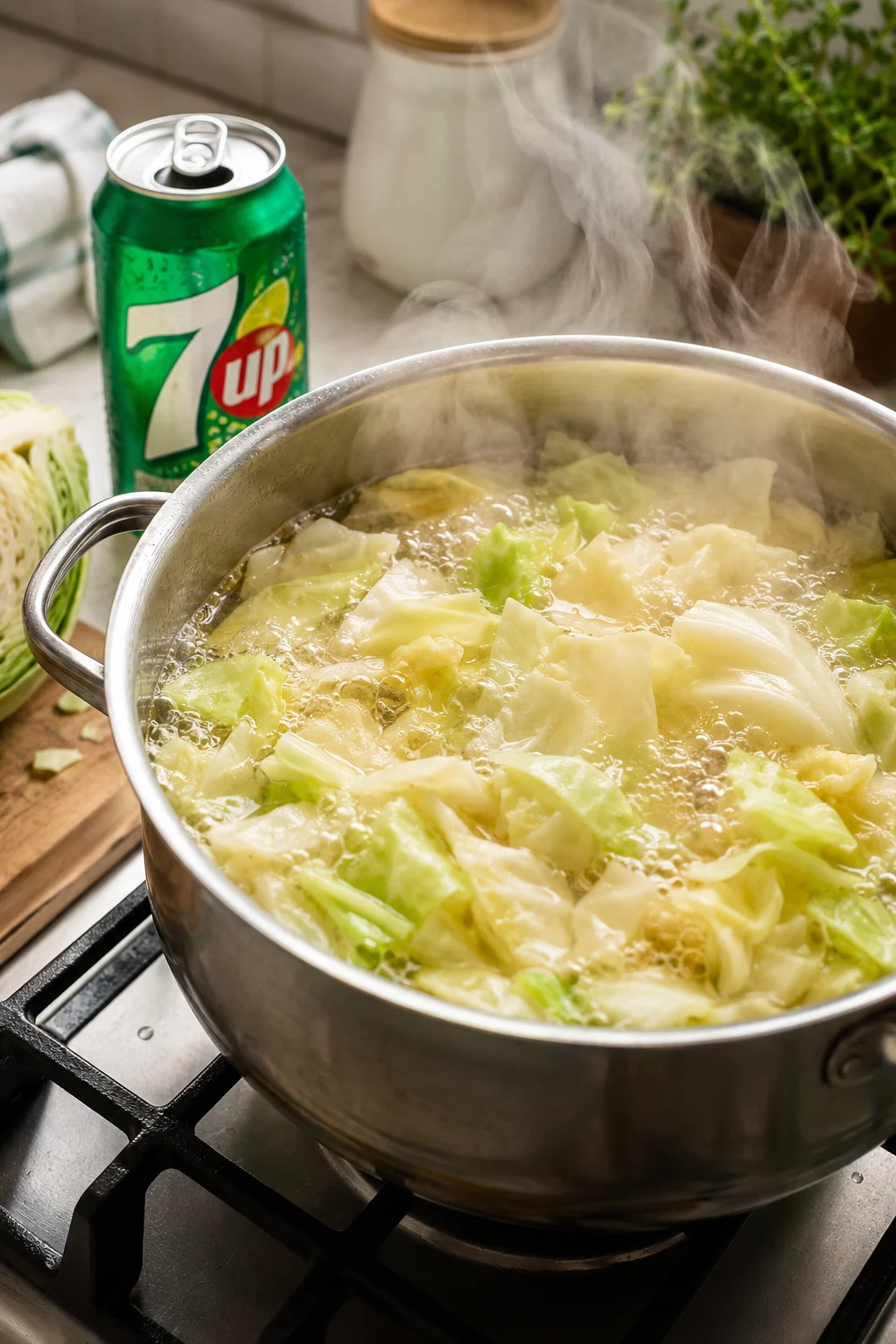
Instead of cooking chopped cabbage only in water or broth, you add 7UP as part of the cooking liquid.
The soda contributes sweetness and lemon-lime flavor.
Meanwhile, cabbage softens as it cooks and takes on some of the flavor of the liquid around it.
Add butter, onion, black pepper, and a little salt, and you’ve got a sweet-savory cabbage side dish that’s very different from plain boiled cabbage.
Bacon?
Oh yeah.
We’ll get there.
Does Cabbage Actually Taste Good Cooked in 7UP?
It can—but balance matters.
Cabbage has a naturally earthy, slightly sweet flavor. Cooking softens its stronger raw character and brings forward more sweetness.
Lemon-lime soda pushes that sweetness further.
Butter adds richness.
Salt provides contrast.
Black pepper adds a little bite.
Onion brings savory flavor.
Put those together correctly and you can get cabbage that’s sweet, buttery, tangy, and savory at the same time.
Use too much soda, though, and the cabbage can become sweeter than you expected.
That’s why I prefer using 7UP as an ingredient rather than treating it like the only liquid allowed anywhere near the pot.
Why 7UP Changes the Flavor
Regular 7UP contains sweeteners and lemon-lime flavoring, so you’re replacing neutral water with a flavored cooking liquid.
That immediately changes the final dish.
As the cabbage cooks, it releases water of its own while absorbing and becoming coated with flavors from the cooking liquid.
The result isn’t necessarily going to taste like drinking a glass of soda alongside cabbage.
Instead, you’ll notice sweetness first, followed by a light citrus character.
The exact result depends heavily on how much soda you use and how far you reduce the cooking liquid.
More soda and more reduction generally mean a stronger sweet flavor.
So yeah, maybe don’t dump in the entire two-liter bottle.
We’re making dinner, not cabbage punch.
Easy 7UP Boiled Cabbage Recipe
Ingredients
Serves: About 6
Prep Time: 10 minutes
Cook Time: 15–25 minutes
Total Time: About 35 minutes
- 1 medium green cabbage, about 2 pounds
- 1 medium yellow onion, sliced or chopped
- 1 1/2 cups 7UP
- 1/2 cup water or low-sodium chicken broth
- 3 tablespoons butter
- 1/2 teaspoon kosher salt, plus more to taste
- 1/2 teaspoon freshly ground black pepper
- 1/4 teaspoon garlic powder, optional
- Pinch of red pepper flakes, optional
If you’re adding bacon, use about 4 to 6 slices and reduce the added salt until you’ve tasted the finished cabbage.
Step 1: Prepare the Cabbage
Remove any damaged outer leaves.
Rinse the cabbage under cool running water.
Cut it into quarters and remove the tough core.
Then chop the leaves into fairly large pieces.
Don’t make them too small.
Cabbage shrinks considerably as it cooks, and tiny pieces can become overly soft much faster.
I like pieces that still have some presence on the fork.
Nobody gets excited about cabbage mush.
Step 2: Prepare the Onion
Peel and slice one medium yellow onion.
You can chop it if you prefer smaller pieces.
I like thin slices because they soften into the cabbage while still adding little pockets of savory sweetness.
Onion is especially useful in this recipe because it keeps the lemon-lime soda from becoming the only noticeable flavor.
Without enough savory ingredients, the dish can start wandering dangerously close to dessert territory.
And cabbage dessert is where I draw the line.
Step 3: Melt the Butter
Place a large Dutch oven or heavy pot over medium heat.
Add the butter.
Once melted, add the onion.
Cook for about 3 to 5 minutes, stirring occasionally, until the onion begins to soften.
You don’t need deep caramelization.
We’re simply giving the onion a head start before the cabbage enters the pot.
Already, butter and onion smell like somebody knows what they’re doing.
Even if that somebody is about to pour soda over a vegetable.
Step 4: Add the Cabbage
Pile the chopped cabbage into the pot.
It may look like way too much.
Don’t panic.
Fresh cabbage takes up a ton of room, but it quickly collapses as heat pulls moisture from the leaves.
If your pot feels extremely crowded, add the cabbage in batches.
Let the first handful soften slightly before adding more.
Stir gently so the cabbage picks up some of that buttery onion mixture.
Step 5: Pour in the 7UP
Now comes the strange part.
Pour 1 1/2 cups of 7UP over the cabbage.
Then add 1/2 cup water or low-sodium chicken broth.
The liquid doesn’t need to completely cover the cabbage.
We’re not trying to make cabbage soup.
As the cabbage cooks, it releases additional moisture.
Starting with a moderate amount of soda also gives you better control over sweetness.
You can always adjust a recipe next time.
Removing excessive sweetness after the cabbage is cooked?
Yeah, considerably harder.
Step 6: Add the Seasonings
Add salt, black pepper, and garlic powder if you’re using it.
For a little heat, toss in a pinch of crushed red pepper flakes.
Go easy on salt initially, especially if you’re using chicken broth or planning to add bacon.
You can taste and add more later.
This dish needs enough salt to counter the sweetness, but there’s no prize for getting there in one giant shake.
Step 7: Bring the Liquid to a Gentle Simmer
Increase the heat enough to bring the liquid to a gentle simmer.
Then lower the heat and partially cover the pot.
Avoid an aggressive rolling boil.
Cabbage doesn’t need that kind of drama.
A steady simmer gives the leaves time to soften while allowing you to monitor their texture.
Stir occasionally so different pieces spend some time near the cooking liquid.
Step 8: Start Checking Before 30 Minutes
Here’s where I’d change the “cook it for 30 minutes” idea.
Start checking the cabbage after about 12 to 15 minutes.
If you like cabbage with a little structure, it may be ready fairly quickly.
For softer Southern-style cabbage, continue cooking and check every few minutes.
Around 20 to 25 minutes may give you a very tender result, depending on the size of your pieces and the heat level.
Thirty minutes isn’t automatically wrong.
But it can be longer than necessary.
Your fork gets the final vote.
What Happens If You Cook It for 30 Minutes?
Expect very soft cabbage.
After a long simmer, the leaves lose much of their initial structure.
The flavor of the cooking liquid also becomes more noticeable as everything cooks together.
For people who grew up eating very tender cooked cabbage, that may be exactly what they want.
If you prefer cabbage with some bite, 30 minutes will probably feel excessive.
This is why I wouldn’t set a timer and blindly walk away.
Check it.
Taste it.
Dinner doesn’t care what the timer says.
What Does 7UP Cabbage Taste Like?
The first difference is sweetness.
Traditional cabbage cooked in salted water has a relatively straightforward vegetable flavor.
With 7UP, you get a noticeably sweeter background.
Then there’s a light citrus note.
Butter and onion pull the dish back toward savory territory, while black pepper adds contrast.
The finished result can remind you of sweet-and-savory Southern vegetable dishes more than plain boiled cabbage.
The soda shouldn’t completely dominate.
If your first thought is, “Wow, this tastes exactly like 7UP,” I’d use less next time.
7UP Cabbage vs. Traditional Boiled Cabbage
Traditional boiled cabbage is simple.
Cabbage.
Water.
Salt.
Maybe butter afterward.
Its flavor stays relatively neutral, which makes it easy to serve beside corned beef, sausage, ham, or other strongly seasoned foods.
7UP cabbage is different.
It’s sweeter.
It has a mild citrus note.
It works especially well when paired with salty or smoky ingredients.
Think bacon.
Ham.
Smoked sausage.
Roast pork.
Those stronger savory flavors can balance the sweetness beautifully.
Basically, traditional cabbage quietly sits beside dinner.
7UP cabbage shows up wearing sunglasses and has opinions.
How to Keep 7UP Cabbage From Getting Too Sweet
This is probably the most important tip.
Don’t automatically use soda as 100% of the cooking liquid.
Mixing 7UP with water or broth gives you more control.
For my version, 1 1/2 cups soda plus 1/2 cup water or broth provides noticeable sweetness without going completely overboard.
Want it less sweet?
Try equal amounts of soda and broth.
You can also increase the savory elements with onion, black pepper, garlic, bacon, or smoked meat.
Taste before adding any additional sweet ingredients.
This cabbage already brought its own sugar to dinner.
Can You Use Diet 7UP?
You can experiment with a zero-sugar version, but don’t expect an identical result.
Alternative sweeteners behave and taste differently from sugar or corn-syrup-sweetened soda, particularly when heated.
The final sweetness may also taste different.
If reducing added sugar is important to you, another option is to use a smaller amount of regular soda mixed with more broth.
That still gives you some lemon-lime character without making soda the majority of the cooking liquid.
Add Bacon for a Salty, Smoky Version
Okay, now we’re talking.
Bacon makes a lot of sense here because salt and smoke contrast beautifully with sweet cabbage.
Start with 4 to 6 slices of bacon.
Cut them into small pieces.
Cook the bacon in the pot until crisp.
Remove it and set it aside.
Leave a small amount of rendered fat in the pot.
Cook the onion in that fat, then add the cabbage and continue with the recipe.
Stir some bacon back in before serving and scatter the rest over the top.
The combination of smoky bacon, sweet cabbage, butter, and citrus?
That’s the version I’d bring to the cookout.
Make a Butter-Heavy Southern-Style Version
If you’re skipping bacon, butter can become the star.
Increase the butter from 3 tablespoons to 4 tablespoons.
Cook the onion gently in the butter.
Add plenty of black pepper.
Then cook the cabbage in the 7UP mixture until tender.
Finish with another small pat of butter if desired.
It’s rich, sweet, peppery, and comforting.
Serve it alongside baked chicken, pork chops, meatloaf, or sausage.
Is it light?
Not particularly.
Is anybody eating buttery cabbage because they wanted their plate to feel emotionally distant?
Exactly.
Add More Onion
Onion deserves more attention in this recipe.
If you love it, use one large onion or even two smaller ones.
Yellow onion becomes sweeter as it cooks and adds depth that works beautifully with cabbage.
For stronger onion flavor, don’t cook it completely soft before adding the cabbage.
For a sweeter, mellow flavor, let it cook a little longer in the butter first.
Either way, onion helps make the dish taste like an actual side dish rather than an internet experiment.
Which is always a nice development.
Try Smoked Sausage
Want to turn the cabbage into something closer to a meal?
Add sliced smoked sausage.
Brown the sausage first.
Remove it temporarily.
Cook the onion and cabbage.
Then return the sausage during the later part of cooking.
The smoky, salty sausage balances the sweet lemon-lime liquid nicely.
Just watch the salt.
Sausage can bring plenty on its own.
Taste before adding more seasoning.
Your salt shaker doesn’t need to be involved in every decision.
Ham Works Too
Leftover cooked ham can also pair nicely with sweet cabbage.
Cut the ham into bite-size pieces and add it toward the later part of cooking so it heats through without becoming unnecessarily dry.
This variation is especially handy after a holiday meal when the refrigerator contains enough leftover ham to feed half the neighborhood.
The cabbage gives it somewhere useful to go.
And suddenly leftovers don’t feel like leftovers.
That’s always a win.
Add a Little Heat
Sweetness loves heat.
A pinch of crushed red pepper flakes can change the whole dish.
You could also add a small amount of cayenne.
Don’t go crazy at first.
The goal is a gentle warmth behind the sweet cabbage, not a competition between your dinner and your taste buds.
Start small.
Taste.
Add more if needed.
Hot sauce can also be served at the table so everyone controls their own level.
This is especially helpful in families where one person thinks black pepper is “spicy.”
We all know somebody.
Don’t Add Extra Sugar Before Tasting
Traditional cabbage recipes sometimes include a pinch of sugar.
Don’t automatically do that here.
7UP already contributes plenty of sweetness.
Cook the cabbage first.
Taste it.
Then decide.
There’s a good chance you won’t need additional sugar at all.
In fact, you may find yourself adding more black pepper or salt instead.
Recipes are guidelines.
Your tongue is quality control.
How to Prevent Mushy Cabbage
Cut the cabbage into larger pieces.
Use a gentle simmer.
And start checking early.
That’s really the secret.
The longer cabbage cooks, the softer it becomes.
If you want tender cabbage that still has some texture, don’t wait for an arbitrary 30-minute mark.
Start tasting around 12 to 15 minutes.
Remove the pot from the heat when the cabbage is slightly firmer than your ideal texture.
It will remain hot and continue softening briefly.
And please don’t boil the living daylights out of it on high heat.
The cabbage has already been chopped.
It has suffered enough.
Don’t Use Too Much Cooking Liquid
Another common mistake is filling the pot until the cabbage is swimming.
Cabbage contains a lot of water.
As it cooks, it releases moisture and shrinks.
You need enough liquid to create steam and flavor the vegetables, but not necessarily enough to completely submerge everything.
Too much soda can also make the finished dish unnecessarily sweet.
Start modestly.
Stir during cooking.
Add a splash of liquid only if the pot genuinely needs it.
Should You Drain 7UP Cabbage?
That depends on how much liquid remains.
If there’s a large amount at the bottom when the cabbage reaches your preferred texture, you can remove the cabbage with a slotted spoon.
Another option is to cook uncovered briefly so some liquid reduces.
Be careful with reduction, though.
As water evaporates, sweetness and seasoning become more concentrated.
So if the liquid is already very sweet, aggressively reducing it isn’t necessarily your best move.
Sometimes the simplest answer is just leaving excess liquid behind.
What to Serve With 7UP Boiled Cabbage
This cabbage works best beside savory foods.
I’d serve it with:
- Pork chops
- Baked chicken
- Fried chicken
- Meatloaf
- Smoked sausage
- Ham
- Corned beef
- Roast pork
- Grilled sausage
- Black-eyed peas
- Cornbread
- Mashed potatoes
Cornbread is especially good because it can soak up a little of that buttery cooking liquid.
And if bacon happens to be involved?
Buddy, we’re having dinner.
Can You Make It Ahead?
Yes, but cabbage is at its best when you don’t cook it into oblivion the first time.
If you’re making it ahead, consider stopping while the cabbage still has a little structure.
Cool it promptly and refrigerate it in a shallow covered container.
Then reheat only the portion you need.
Repeated heating can make cabbage softer each time.
So if you’re planning tomorrow’s lunch, don’t turn tonight’s batch into mush before it even reaches the refrigerator.
Future you deserves decent cabbage too.
How Long Does Cooked Cabbage Last in the Refrigerator?
For food safety, refrigerate cooked cabbage within two hours of cooking—within one hour if the surrounding temperature is above 90°F.
Store leftovers in shallow, covered containers at 40°F or below.
As a practical rule, use refrigerated cooked leftovers within 3 to 4 days.
If you’re not going to eat them within that period, freezing is a better option.
And don’t depend entirely on smell or appearance to determine whether an old leftover is safe.
When the safe storage window has passed, throwing it away is cheaper than gambling with food poisoning.
The Best Way to Reheat 7UP Cabbage
For the stovetop, place the cabbage in a skillet or saucepan over medium-low heat.
Add a small splash of water or broth if it seems dry.
Heat until steaming hot, stirring occasionally.
You can also use the microwave.
Place a portion in a microwave-safe dish, cover appropriately, and heat in short intervals while stirring between them.
Avoid repeatedly reheating the entire batch if you only need one serving.
Take out what you’re eating.
Leave the rest cold.
Easy.
Can You Freeze Cooked Cabbage?
Yes, cooked cabbage can be frozen, though the texture may become softer after thawing.
Cool it promptly.
Pack portions into freezer-safe containers or bags.
Leave appropriate space if using rigid containers.
Label and date everything.
Thaw safely in the refrigerator when possible, then reheat thoroughly.
If you’re someone who dislikes very soft cabbage, freezing may not be your favorite storage method.
The flavor can still be good.
The texture simply won’t be exactly like a freshly cooked batch.
Common Mistakes to Avoid
The first mistake is using too much 7UP.
More isn’t automatically better.
The second is cooking the cabbage for 30 minutes without checking it.
Texture changes quickly.
Another mistake is forgetting the savory balance. Butter, onion, pepper, salt, bacon, ham, or sausage can keep the sweetness in check.
Don’t overcrowd an undersized pot.
Don’t drown the cabbage in liquid.
Don’t add extra sugar before tasting.
Don’t aggressively reduce already-sweet cooking liquid.
And don’t leave cooked cabbage sitting at room temperature all afternoon.
The picnic table is not a refrigerator.
Is This Better Than Regular Cabbage?
That depends completely on what you like.
If you prefer clean, savory cabbage, stick with water or broth.
If you enjoy sweet-and-savory Southern-style vegetables, the 7UP version is much more interesting.
I wouldn’t cook cabbage this way every single time.
But beside smoky sausage or salty bacon?
Oh, absolutely.
The trick is treating the soda like seasoning.
You want it to contribute something.
You don’t want it running the entire show.
Frequently Asked Questions
Can you really boil cabbage in 7UP?
Yes. Lemon-lime soda can be used as part of the cooking liquid for cabbage. It adds sweetness and citrus flavor, creating a noticeably different result from cabbage cooked only in salted water.
Does 7UP boiled cabbage taste like soda?
It can have noticeable lemon-lime sweetness, but butter, onion, salt, pepper, and savory additions can balance the flavor. Using soda together with broth or water also keeps the taste from becoming too strong.
How much 7UP should I use for one head of cabbage?
For one medium cabbage, I like starting with about 1 1/2 cups of 7UP plus 1/2 cup water or low-sodium broth. You can adjust the ratio based on how sweet you want the finished dish.
Should cabbage really cook for 30 minutes?
It can, but it will become very soft. Start checking after about 12 to 15 minutes and continue cooking until it reaches the texture you like.
How do I keep 7UP cabbage from becoming too sweet?
Use a mixture of soda and water or broth rather than soda alone. Add savory ingredients such as onion, butter, black pepper, bacon, ham, or smoked sausage.
Can I use Sprite instead of 7UP?
Another lemon-lime soda can create a similar general sweet-citrus effect, though sweetness and flavor vary by brand.
Can I use Diet 7UP or 7UP Zero Sugar?
You can experiment with it, but alternative sweeteners may taste different after heating. Another option is using less regular soda and more broth.
Is bacon good in 7UP cabbage?
Very. Bacon adds salt, fat, and smoky flavor, all of which contrast nicely with sweet lemon-lime cabbage.
Can I add onion to soda-cooked cabbage?
Yes. Onion is one of my favorite additions because it brings a savory-sweet flavor that makes the dish feel more balanced.
What meat goes well with 7UP cabbage?
Smoked sausage, ham, pork chops, meatloaf, baked chicken, fried chicken, roast pork, and corned beef can all work well.
How long can leftover cooked cabbage stay refrigerated?
Keep cooked leftovers refrigerated at 40°F or below and use them within 3 to 4 days.
Can 7UP cabbage be frozen?
Yes, although freezing and thawing can make the cabbage softer. Freeze it in suitable portions after cooling promptly.
Final Thoughts
So, would I boil cabbage in 7UP again?
Yep—with one adjustment.
I wouldn’t blindly give it 30 minutes.
The idea behind 7UP boiled cabbage is surprisingly solid if you already enjoy sweet-and-savory vegetables. Lemon-lime soda adds sweetness and a mild citrus note, while butter, onion, pepper, and salty additions pull everything back toward savory territory.
For my version, the sweet spot is using 7UP alongside a little water or broth rather than completely replacing every drop of cooking liquid with soda.
Then I’d start checking the cabbage around 15 minutes.
Want it firmer?
Stop early.
Want that super-soft, old-school Southern texture?
Keep going.
And if you’re still skeptical about soda touching your cabbage, add bacon.
Honestly, bacon has settled stranger arguments than this.