Every December, my kitchen turns into mission control. I’m simmering stock, roasting pans of vegetables, baking cookies in relays, and keeping two burners going for one holiday project or another. What I started noticing a few winters ago, though, was that all that warm, fragrant cooking steam never seemed to stay politely upstairs. It drifted downward into the basement stairwell, and by the time I was done with a long weekend of holiday cooking, the basement had a faint food-heavy, slightly damp smell I didn’t love.
This year, I decided to run a simple household experiment: I set open boxes of baking soda near my basement rim joists for 14 days in December and paid close attention to odor, moisture feel, and any visible changes. I wasn’t expecting miracles, and I certainly wasn’t treating baking soda as a substitute for ventilation or moisture control. But I was curious about what it could realistically do in a real Midwestern house during a busy cooking season. Here’s exactly how I set it up, what I noticed day by day, and what I’d tell anyone thinking of trying the same thing.
1. Why I chose the rim joists in the first place
If you’ve spent any time in an older or even middle-aged Midwestern home, you know the basement perimeter has a personality all its own. The rim joist area—where the floor framing meets the foundation wall—is one of those places where temperature differences, air leakage, and seasonal odors seem to collect. In my basement, the rim joists run around most of the exterior wall line, and the section nearest the basement stairs is where I notice smells settling first.
My thinking was simple: if warm, humid cooking air was migrating downward from the main floor and then cooling in the basement, the perimeter area was a logical place for odors to linger. I placed the boxes within about 6 to 12 inches of the rim joist line, mostly on top of stable surfaces along the wall, rather than directly on bare concrete.
2. The exact setup I used for 14 days
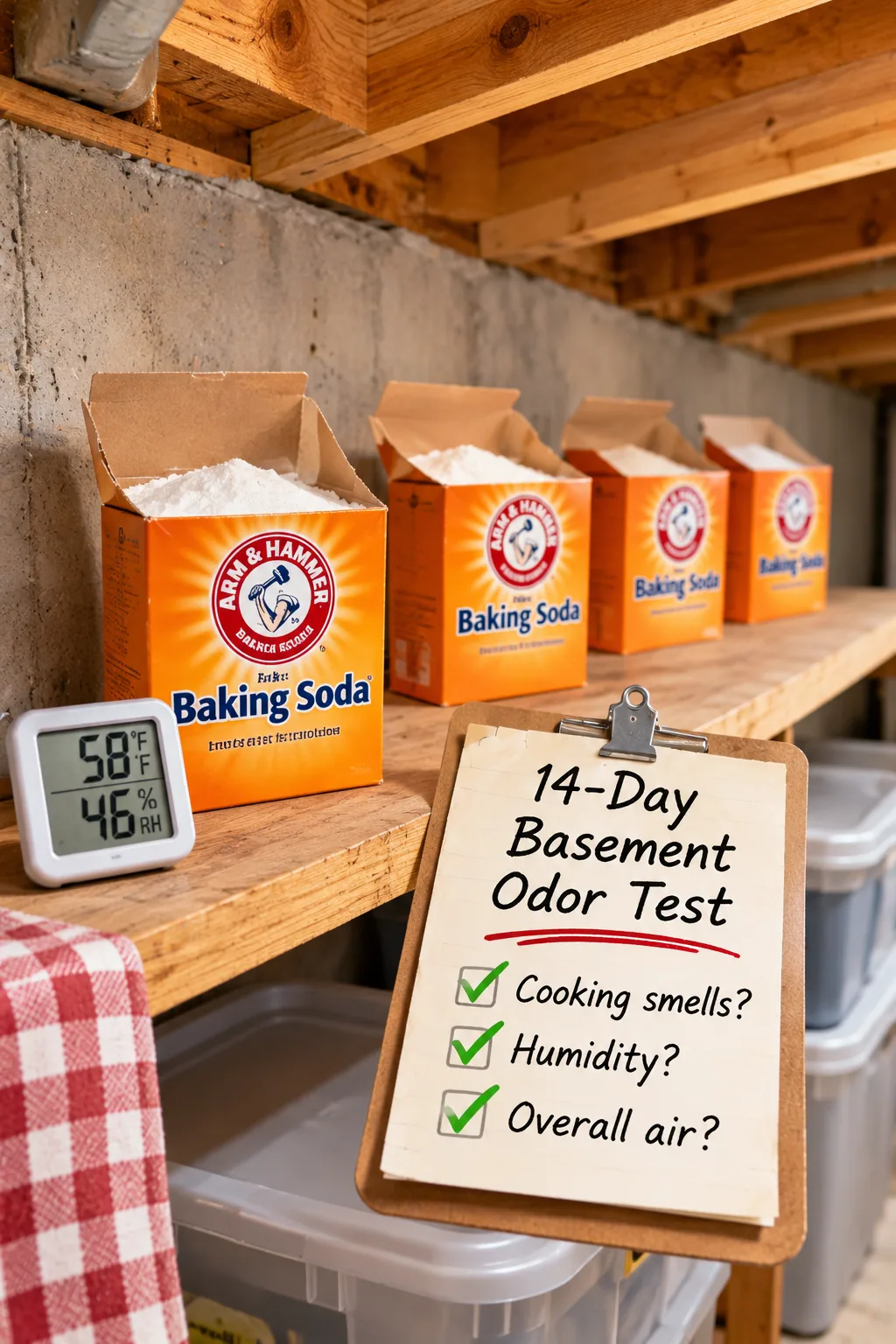
I used four standard 1-pound boxes of baking soda. I opened all four fully by removing the perforated top panel so the powder had maximum exposure to air. Two boxes went along the wall nearest the basement stair landing, one went on a shelf along the north wall, and one went near a utility-side rim joist section about 18 feet away from the stairs.
The basement itself is unfinished in that area, with exposed joists overhead, concrete walls, and average December temperatures around 58 to 62 degrees Fahrenheit. Relative humidity in winter usually sits between 42% and 52% down there in my house, based on a small digital hygrometer I keep near the stairs. During the test period, outdoor temperatures swung from about 19 degrees to 41 degrees, which is fairly typical for my area.
3. What “holiday cooking steam” actually meant in my house
This wasn’t one pot of soup on a quiet Tuesday. Over the 14-day period, I had several heavy cooking days: two days of cookie baking, one day of braising and stock-making, one afternoon of candy work, and a weekend stretch with a glazed ham, scalloped potatoes, and multiple rounds of dishwashing. On the busiest day, the oven ran for close to 7 hours total, not continuously at one temperature, but in cycles between 325 and 400 degrees Fahrenheit.
Steam-producing tasks included boiling potatoes, simmering stock for 4 hours, blanching vegetables, and washing sheet pans and mixing bowls in hot water over and over again. Anyone who cooks like this knows that humidity gets generated not just from food, but from cleanup. Even with the range hood on, some moisture escapes into the house air. That was the real-world condition I wanted to test.
4. What I noticed in the basement before starting
Before placing the boxes, I spent two days paying attention to the baseline. The basement did not smell moldy or flooded, which is important to say. This was not a water-intrusion situation. The smell was subtler than that: a mix of cooled cooking aromas, cardboard, stored wood, and that mineral note unfinished basements often have.
Near the stairs, I could detect the strongest food carryover—onion, cinnamon, roasted fat, and a kind of stale-warm air smell by late evening after a lot of cooking. The rim joist area itself didn’t feel wet, but some surfaces felt cooler and slightly clammy to the touch compared with the center of the basement. My hygrometer read 46% relative humidity at the start.
5. The first 48 hours: a modest but real change
Within the first 2 days, the biggest difference was odor, not moisture. The basement still smelled like a basement, but the lingering food note seemed softer. I wouldn’t call it eliminated. I’d call it less concentrated, especially near the basement stairs where the cooking smells had been most obvious.
What surprised me was how localized the effect seemed. If I stood within 2 or 3 feet of the boxes nearest the stair area, the air smelled a bit flatter and less “occupied,” if that makes sense. But farther along the basement, where the utility area has its own normal house smells, the change was less noticeable. That told me baking soda might be helping with odor adsorption in its immediate area, but it wasn’t transforming the entire basement atmosphere.
6. Days 3 through 7: where baking soda helped and where it clearly did not
By the end of the first week, I had cooked enough to give the experiment a fair test. After a major cookie day—three batches of gingerbread, two of butter cookies, and a double batch of caramel corn—the upstairs smelled wonderful and the basement definitely received some of that aromatic traffic. Yet the stair-adjacent basement air was less food-scented than in past Decembers.
Baking soda did seem to reduce odor persistence. In prior years, I might notice cooked-onion and spice smells hanging around downstairs into the next morning. During this test, those odors seemed to fade faster, often by overnight or by midday the next day.
What it did not do was lower humidity in any meaningful way. My hygrometer ranged from 45% to 50% during the week, which is normal fluctuation in my house when cooking, showering, and outdoor weather all vary. The boxes did not make the basement feel drier. They did not stop cool surfaces from feeling cool. And they certainly did not replace a dehumidifier, exhaust fan, or air sealing.
7. What happened to the baking soda itself after 14 days
Physically, the baking soda didn’t undergo some dramatic transformation. None of the boxes became rock hard, soaked, or visibly saturated. The powder remained mostly loose, though the top surface in two boxes developed a slightly more compacted look, especially the one closest to the basement stair path.
I also noticed a faint crusting along one exposed top edge where the box had likely absorbed a bit of ambient moisture over time. But we’re talking subtle texture change, not clumping you’d mistake for a spill getting wet. If you’re expecting open baking soda to visibly “pull water” from the air in a dry winter basement, that was not my experience.
8. The odor results, honestly rated
If I had to give the odor-control performance a number, I’d put it at about 4 out of 10 for whole-basement impact and 6 out of 10 for small-zone odor softening near the boxes. That may sound lukewarm, but I actually think it’s a fair and useful result. Baking soda helped take the edge off absorbed kitchen smells. It did not deodorize a large unfinished space in a comprehensive way.
In practical terms, when I walked downstairs the morning after heavy holiday cooking, I noticed less stale spice-and-savory buildup. The air felt less crowded by food smells. But if I was expecting the basement to smell freshly neutral, that did not happen. The normal basement character was still there, and so were traces of whatever I’d been cooking the day before.
9. Why baking soda behaved this way
Baking soda is often excellent at dealing with certain odors in enclosed or semi-enclosed spaces, especially when the source is nearby and the air volume is limited. A refrigerator box works because the space is relatively small. A basement perimeter is another story. Even a modest basement may contain 6,000 to 10,000 cubic feet of air, depending on ceiling height and layout.
In my case, four 1-pound boxes were simply not enough to act on that much moving air in a dramatic way. Add in the fact that basements exchange air slowly and unevenly, and you get patchy results. The baking soda could interact with some odor-bearing compounds passing over it, but it wasn’t mechanically circulating air, removing water vapor, or stopping steam migration at the source.
10. The biggest surprise: the stairwell mattered more than the rim joists
If I learned one thing from this little experiment, it’s that the route of the air mattered more than the wall location I had fixated on. The most noticeable smell reduction happened where the upstairs air seemed to enter the basement path—near the stairs and immediate landing—not necessarily at the coldest rim joist sections farther away.
That was a good reminder that air movement beats theory every time. We can talk all day about where odors “should” collect, but houses have their own logic. In mine, the stairwell acts like a delivery corridor for warm kitchen air. Once I noticed that, it made sense that the boxes placed closest to that route seemed most useful.
11. What worked better than baking soda during the same period
The biggest improvements came from habits, not boxes. Running my range hood the entire time I was boiling or simmering made a bigger difference than anything else. Cracking a kitchen window for even 10 to 15 minutes during the steamiest cooking tasks also helped, especially when outdoor temperatures were above 25 degrees Fahrenheit and it was tolerable to do so.
I also found that closing the basement door at the top of the stairs for several hours during and after major cooking sessions reduced odor migration more effectively than baking soda alone. On days when I did that, the basement smelled noticeably less like dinner. In other words, controlling the path of the air beat trying to passively treat the air after it got downstairs.
12. What I would do differently next time
If I repeat this experiment, I’d change three things. First, I’d use more than four boxes—probably eight to ten—and concentrate at least half of them near the basement stair path rather than distributing them evenly. Second, I’d pair the setup with a small fan on low speed to gently move air through that zone. Third, I’d log humidity and odor notes at the same time each day, morning and evening, for cleaner comparisons.
I would also test activated charcoal side by side with baking soda. In my experience, charcoal often has a stronger effect on musty or persistent household odors, though it costs more. A 4-pack of baking soda boxes may run around $4 to $6, while charcoal odor absorbers can easily cost $15 to $30 depending on size and brand.
13. When baking soda is worth trying—and when it isn’t
I think baking soda is worth trying if your issue is mild, seasonal, and primarily odor-related. If your basement gets temporarily food-scented after holiday cooking, and you want an inexpensive, low-effort way to soften that effect, open boxes can help a bit. They’re easy to place, easy to replace, and low risk as long as they’re kept dry and away from pets and children.
But if you have active dampness, condensation, mold smell, water staining, or relative humidity consistently above 55% to 60%, baking soda is not the answer. At that point, I’d look at ventilation, insulation, air sealing around rim joists, a dehumidifier sized for the square footage, and any possible bulk water intrusion. Odor is often the symptom; moisture control is the real job.
14. My final verdict after 14 days
After two weeks, my conclusion was pretty straightforward: the baking soda boxes helped a little with lingering holiday cooking odors, especially near the basement stairs, but they did not meaningfully manage moisture and they did not freshen the entire basement. The result was subtle, not dramatic.
Still, I don’t consider the test a failure. Sometimes the value of a household experiment is learning the scale of a solution. Baking soda turned out to be a light-touch tool—useful for trimming the edges off seasonal odor drift, not for solving basement air problems wholesale. In my kitchen-and-basement reality, that’s still worth knowing.
15. The practical takeaway I’d give another homeowner
If you want the shortest version from a cook who spends a lot of December making steam: place the boxes near the air pathway, not just the perimeter; don’t expect humidity control; and combine them with source control upstairs. Run the hood, cover simmering pots when appropriate, close the basement door, and ventilate during major cooking sessions.
Would I use baking soda again? Yes, but with realistic expectations. I’d treat it as a $5 supporting player, not the star. And honestly, that’s true of a lot of kitchen-adjacent home fixes: the humble solution can help, but only when we ask it to do the job it’s actually capable of doing.