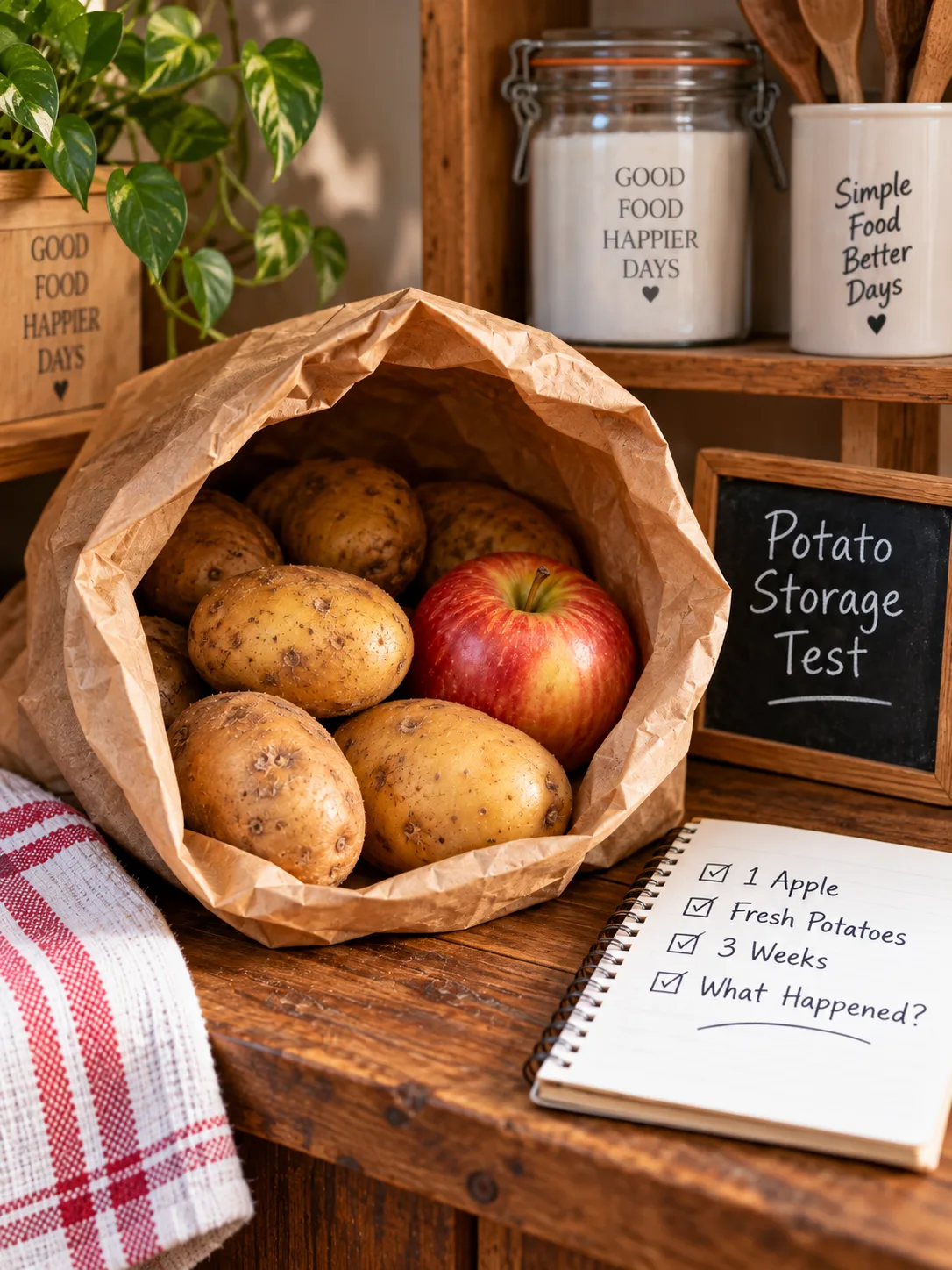
I’ve stored potatoes a dozen different ways over the years—paper sacks in the pantry, crates in the mudroom, baskets on the floor of a cool closet—and I’ve heard just as many home-storage tricks passed around as kitchen wisdom. One of the most repeated is the apple trick: put an apple in with fresh potatoes, and supposedly something changes. So I tried it myself with a small batch of just-dug potatoes, left them alone for 3 weeks, and paid close attention to what actually happened day by day.
If you’ve ever bought 5 or 10 pounds of potatoes and wondered how to keep them firm, smooth, and usable for as long as possible, this little experiment is worth understanding. I’ll walk you through exactly how I stored them, what I saw after 21 days, why the apple may have affected them, what surprised me, and what I’d do differently next time if my goal were long storage rather than curiosity.
1. Why I decided to test the apple trick
I’d heard two versions of this advice for years. In one version, the apple helps keep potatoes from sprouting. In another, it seems to do the opposite and changes how fast they age. When the same tip gets repeated in both directions, I get suspicious. So rather than relying on vague memory or secondhand advice, I set up a simple side-by-side test in my own house.
I used fresh potatoes because they show changes quickly and clearly. These weren’t dehydrated, months-old supermarket potatoes that had already gone through commercial handling. They were recently purchased, firm, dry, and unblemished, with tight skins and no visible eyes breaking. That made them a good baseline for spotting small changes over 3 weeks.
2. Exactly what I stored together
I used about 4 pounds of potatoes, a mix of medium-size round white and yellow potatoes, each roughly 2 1/2 to 3 1/2 inches across. I chose one medium apple that weighed about 6 ounces. It was firm, ripe, and unbruised—not overripe, not soft, and not damaged.
I placed the potatoes and the apple in a brown paper bag with the top loosely folded, not sealed. That part matters. I wasn’t trying to create a humid little chamber; I wanted a fairly normal home-storage setup with a bit of airflow. The bag sat in a dark pantry corner that stayed between 56 and 61 degrees Fahrenheit most days.
3. The storage conditions mattered as much as the apple
Potatoes keep best in a cool, dark, well-ventilated spot, ideally around 45 to 50 degrees Fahrenheit. Most homes are warmer than that, and mine is no exception unless I use a basement shelf in winter. The pantry where I ran this test was convenient, but slightly warm for long-term potato storage.
Humidity also plays a role. If the air is too dry, potatoes shrivel. If the space is too damp or airless, rot becomes more likely. My pantry averaged moderate household humidity—not desert dry, not cellar damp. So whatever happened over those 3 weeks wasn’t just because I tossed them into a terrible environment. It was a realistic setup that plenty of people actually use.
4. What I noticed during the first week
For the first 7 days, almost nothing dramatic happened. The potatoes stayed firm, their skins remained smooth, and there was no sour smell, moisture buildup, or visible mold. The apple still looked perfectly normal too.
What I did notice was a stronger “earthy produce” smell when I opened the bag around day 5 or 6. It wasn’t bad or rotten, just more active somehow. Potatoes usually smell faintly starchy and dusty. With the apple in there, the bag smelled sweeter and fruitier, which told me the shared air inside the bag was changing even before the potatoes visibly did.
5. What changed by the second week
By day 14, the potatoes still weren’t spoiled, but they were no longer exactly as they started. Two of them had tiny pale sprouts forming at the eyes—just 1/8 to 1/4 inch long. A third potato had slight softening at one end, though not enough to call it bad.
The apple had begun to lose a little crispness. It wasn’t collapsing, but it was no longer at peak freshness. There was also a trace of condensation-like softness inside the paper bag, not visible droplets, but a sense that the enclosed produce was breathing and trading moisture. That’s a normal process, but in storage, “normal” can still speed deterioration.
6. What I found after 3 full weeks
At day 21, the potatoes were still usable, but they had definitely aged faster than I’d want for storage. Several had visible sprouts between 1/4 and 1/2 inch long. None had become a horror-show science project, but they were clearly moving out of that fresh, newly bought stage.
Texture had changed too. About half remained nicely firm. The others had a subtle loss of density—still fine for mashing, roasting, or soup, but not as hard and crisp as fresh potatoes. One potato had developed a small soft patch about the size of a nickel. There was no widespread rot, but the batch had crossed from “freshly stored” into “use these soon.”
7. So what actually happened?
The short answer is this: storing the fresh potatoes with an apple did not preserve them better in my setup. If anything, it seemed to encourage earlier sprouting and general aging over the 3-week period. The potatoes didn’t instantly spoil, but they also didn’t stay in top condition.
If I were grading the result practically, I’d say the potatoes lost maybe 20 to 30 percent of their ideal storage quality compared with how they began. They were still edible, but no longer at their best. For someone hoping the apple would act like a magic freshness extender, that’s not what I observed.
8. The science behind the result: ethylene gas
Apples naturally release ethylene gas as they ripen. Ethylene is a plant hormone that affects nearby produce. In some fruits and vegetables, that means faster ripening. In potatoes, ethylene can influence sprouting behavior, sugar development, and overall storage quality depending on variety, temperature, and exposure time.
That’s why produce-storage charts often separate apples from potatoes. In a commercial setting, handlers are careful about shared storage for exactly this reason. A single apple in a big open room won’t create drama, but one apple tucked into a bag or bin with a few pounds of potatoes can make a noticeable difference over 2 to 3 weeks.
9. The biggest surprise to me
I expected either nothing at all or a dramatic failure. Instead, the result was subtle but meaningful. The potatoes didn’t turn green overnight, liquefy, or smell foul. If you glanced at them quickly, you might even say they looked fine. But when you handle potatoes often, you notice the small signs: loosening skin texture, tiny sprout points, a little less heft, a little less snap.
That matters in everyday cooking. A potato that’s just slightly older may still bake well, but it won’t hold exactly the same way in a skillet hash or potato salad. I’ve learned over the years that storage quality shows up on the cutting board before it shows up as full spoilage.
10. Whether all potatoes would react the same way
No, and this is important. Russets, Yukon Golds, reds, fingerlings, and very fresh new potatoes don’t all behave identically. Some sprout faster. Some lose moisture sooner. Some are more forgiving in a 60-degree pantry than others.
Commercially cured storage potatoes can also outlast just-harvested potatoes by a wide margin. If someone else runs the same apple test with older russets in a cooler basement at 48 degrees Fahrenheit, they may see slower changes than I did. But the basic caution still stands: apples are not ideal potato companions if your goal is maximizing storage life.
11. What I’d do instead for better potato storage
If I wanted potatoes to last 4 to 8 weeks in good shape, I’d skip the apple completely and focus on the fundamentals. I’d store them in a breathable container such as a paper bag, cardboard box, slatted wooden crate, or basket lined with newspaper. I’d keep them in darkness to reduce greening and in the coolest room available, preferably under 50 degrees Fahrenheit.
I also wouldn’t wash them before storage. Any dirt clinging to the skin is less of a problem than added moisture. I’d check the batch once a week, remove any soft or damaged potatoes immediately, and avoid crowding them deeper than about 6 to 8 inches in a small container so air can still move around them.
12. What not to store with potatoes
Besides apples, I avoid storing potatoes near onions. People often pair them because both like cool, dark conditions, but onions and potatoes each release moisture and gases that can shorten the other’s shelf life. In my kitchen, keeping them at least a few feet apart works better than sharing a bin.
I also keep potatoes away from direct sunlight, dishwashers, ovens, and the top of the refrigerator. Heat swings do more damage than people realize. A basket that looks charming on a bright counter can age potatoes faster in 5 days than a plain paper sack in a dark closet does in 2 weeks.
13. Signs your stored potatoes are still safe to use
Small sprouts don’t automatically mean a potato is unusable. If the potato is still firm and only has short sprouts, I usually snap them off and cook the potato soon. If there are a few green patches, I cut those away generously because green areas can indicate solanine development, which you don’t want to eat in quantity.
I throw potatoes out when they become deeply wrinkled, extensively green, slimy, moldy, strongly bitter-smelling, or soft enough to sink under finger pressure. A little aging is manageable; active decay is not. After my 3-week test, most of the potatoes were still salvageable, but they were entering the stage where I’d prioritize using them within a few days.
14. How I used the potatoes after the test
I didn’t waste them. The firmer ones I cut into 1-inch chunks and roasted at 425 degrees Fahrenheit for about 35 minutes with olive oil, salt, black pepper, and rosemary. The slightly softer ones went into a rustic soup, where texture matters less and flavor still comes through beautifully.
That’s another practical lesson: even when storage isn’t ideal, potatoes often remain useful if you catch them in time. I just wouldn’t choose apple-assisted storage if I were stocking up intentionally for the month.
15. My honest conclusion after 3 weeks
Here’s the plain answer: after storing my fresh potatoes with an apple for 3 weeks, the potatoes were still edible, but they sprouted sooner and seemed to age faster than I’d prefer. The apple did not improve storage in any way I’d recommend repeating.
If your goal is to keep potatoes at their best, separate them from apples and concentrate on temperature, darkness, airflow, and weekly checks. Kitchen folklore is fun to test—I’m glad I did—but in this case, the old trick didn’t outperform simple, boring, proper storage.