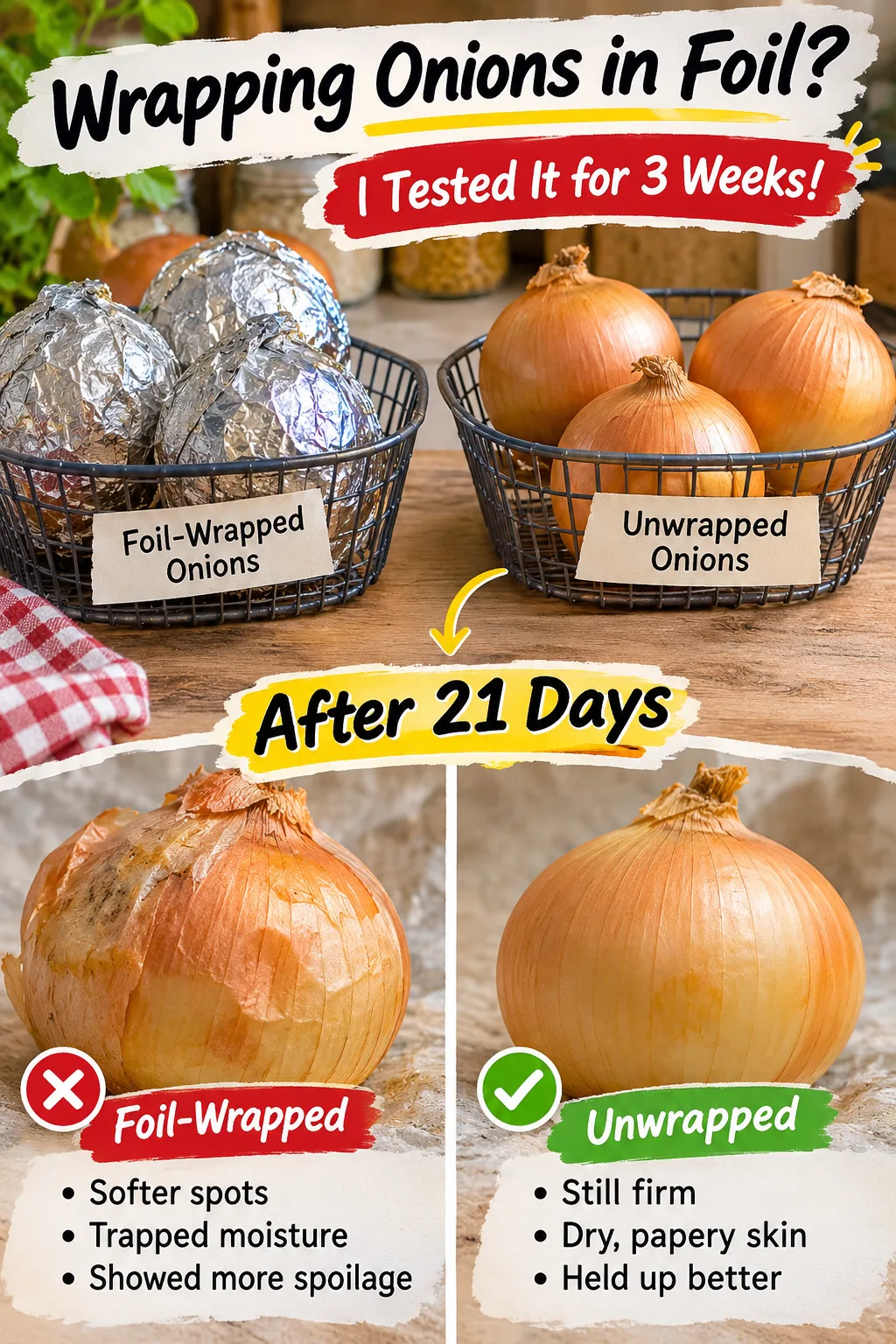
I’m the kind of person who hates wasting produce, especially onions. They’re one of those kitchen staples I buy almost without thinking, usually in a 3-pound bag, and then somehow I end up with two or three left rolling around in the pantry by the end of the week. So when I heard the idea of wrapping fresh onions in foil before storing them, I was curious enough to try it myself and patient enough to wait the full 3 weeks to see whether it actually made any difference.
What happened was interesting, but not in the magical, miracle-hack way some storage tips promise. In this article, I’ll walk you through exactly how I stored the onions, what they looked and felt like after 21 days, what foil did and didn’t do, why onions behave the way they do in storage, and what I’d personally recommend if you want them to stay firm, dry, and usable as long as possible.
1. Why I decided to test the foil method
I cook with onions at least 4 nights a week, so I’m always looking for simple storage tricks that might buy me a little extra time. The claim behind foil sounded plausible on the surface: wrap each onion individually, protect it from air and moisture swings, and maybe it stays fresher longer.
My skepticism kicked in right away because whole onions already have a papery outer layer designed to protect them. Still, home-kitchen experiments are often the best way to cut through vague advice. I had six fresh yellow onions on hand, each medium-sized, roughly 7 to 9 ounces, with dry skins and no visible bruising, so I set up a side-by-side test.
2. How I set up the experiment
I divided the six onions into two groups of three. The first group I wrapped individually in standard aluminum foil, using enough to cover each onion completely with a loose but sealed wrap. The second group I left unwrapped as my control.
All six onions were stored in the same pantry cabinet in my kitchen. The cabinet stayed dark most of the time, with a temperature that hovered between 64°F and 69°F. I placed both groups on separate wire baskets so they had similar positioning and weren’t touching potatoes, garlic, or fruit, all of which can affect onion storage.
3. What the onions looked like on day 1
At the start, all six onions were in good shape. The outer skins were dry and crisp, the necks were tight, and there were no soft spots. They had that familiar sharp, clean onion smell, but nothing sour or overly pungent.
This starting condition matters more than people realize. An onion that already has a tiny bruise, a damp patch, or a nick near the root won’t age the same way as a perfectly sound one. Storage experiments only tell you something useful if the produce begins in roughly equal condition.
4. What happened after the first week
After 7 days, there was almost no meaningful difference between the foil-wrapped onions and the unwrapped ones. All six were still firm, dry, and visually normal. If I had stopped the test there, I would have said the foil made no difference at all.
The only slight change I noticed was that the foil-wrapped onions felt a bit less airy on the outside, simply because the skins weren’t exposed to moving air. But that wasn’t necessarily a good sign. Onions generally store best when there is decent ventilation around them, not when they’re sealed up.
5. What happened by the second week
At around day 14, the differences started to show. The unwrapped onions were still dry to the touch. One had slightly looser skin, which is perfectly normal, but it remained firm and heavy for its size.
The foil-wrapped onions, though, had started to collect a faint bit of interior moisture. When I opened one piece of foil to check, the onion itself wasn’t wet, but the environment felt less dry than I’d want for long-term storage. That’s the key problem: foil doesn’t breathe. Any trace moisture from the onion or surrounding air can get trapped instead of dispersing.
6. What I found after 3 full weeks
At the 21-day mark, the results were clear. The unwrapped onions had held up better overall. They were still usable, still firm, and only a little more papery than when I started. One had begun a tiny green sprout in the center, but it was minor.
The foil-wrapped onions were more mixed. One looked mostly fine from the outside, but once unwrapped it had a slightly softened outer layer. Another had a damp-feeling patch between the skin and flesh. The third had the most noticeable decline: not rotten, but definitely heading that way, with a softer neck area and a stronger, slightly stale onion odor.
So the short version is this: after 3 weeks, wrapping fresh onions in foil did not help them stay fresher. If anything, it created a less ideal storage environment and made spoilage more likely in at least some of them.
7. Why foil worked against the onions instead of helping them
Whole onions like cool, dry, dark, well-ventilated conditions. The sweet spot is usually around 45°F to 55°F with low humidity, though most of us are working with pantry conditions closer to the mid-60s. What onions do not like is trapped moisture.
Foil acts as a barrier. That can be useful for some foods, but onions are living plant tissue with natural moisture inside. Even a small amount of condensation or humidity around the onion can soften outer layers and encourage mold or bacterial breakdown over time. In my test, the foil didn’t preserve freshness; it reduced airflow.
8. The texture changes told the real story
When onions start to decline, texture usually gives it away before appearance does. A good storage onion should feel dense and firm when you press gently with your thumb. It shouldn’t give much at the neck or around the sides.
The foil-wrapped onions lost that firmness first. Not dramatically, and not all at once, but enough that I could tell they were aging less gracefully. The unwrapped onions stayed crisper and drier. That’s what I want from an onion I’m about to slice into a stew, roast pan, or salad dressing base.
9. Smell was another clue
Fresh whole onions don’t usually smell very strong until you cut them. If an uncut onion starts giving off a noticeably intense, sour, or stale odor, that’s often a warning sign that breakdown has started inside.
By the end of the test, the foil-wrapped onions had the stronger smell. It wasn’t horrible, and they weren’t liquefied or mold-covered, but they definitely had more of that “use me right now” scent. The unwrapped ones smelled much cleaner and more neutral.
10. Would the result have been different in the fridge?
For whole onions, probably not in a helpful way. Refrigerators are humid environments, often around 35°F to 40°F, and that humidity is exactly what whole onions dislike. Cold plus trapped moisture is usually a bad combination for keeping skins dry and protective.
If you’re dealing with a cut onion, refrigeration is the right move, but that’s a different situation. A halved onion should be wrapped or sealed and refrigerated, ideally used within 7 to 10 days. Whole onions are better kept out of the fridge unless your home is unusually warm and you truly have no cooler storage option.
11. The best way I store whole onions now
After trying plenty of methods over the years, I keep whole onions in a dark, dry, ventilated spot. A mesh bag, open basket, or slotted bin works better than a sealed container. I also avoid stacking them too tightly because pressure points can lead to bruising.
If I buy a 3-pound bag, I take 30 seconds to inspect each onion before storing it. Any onion with a soft spot, split skin, or damp area gets used first. The good ones go into the pantry with space around them. Stored that way, yellow onions often last me 3 to 5 weeks easily, and sometimes longer if the house stays cool.
12. Mistakes that shorten onion shelf life fast
The biggest mistake is storing onions next to potatoes. It’s convenient, and I know a lot of us do it, but potatoes release moisture and gases that can speed onion spoilage. In my kitchen, I keep them in separate cabinets at least several feet apart.
Another common problem is using plastic bags without ventilation. Plastic traps moisture even more aggressively than foil. I’ve had onions go from perfectly good to soft and spotty in less than 10 days when left in a tightly closed produce bag. Warm countertops, sunlight, and damp cellars also cut storage life short.
13. What I’d do instead if I needed onions to last longer
If I knew I wouldn’t use my onions within 2 to 4 weeks, I wouldn’t reach for foil. I’d either improve the storage setup or preserve them in a more practical way. For example, chopped onions freeze well for cooked dishes. I dice them, spread them on a tray for about 1 hour, then transfer them to freezer bags in 1- or 2-cup portions.
I also sometimes cook them down in advance. Caramelized onions keep in the fridge for about 4 days and in the freezer for a couple of months. That’s far more useful to me than hoping a wrapping method will stretch the life of fresh whole onions beyond what their natural storage conditions support.
14. My honest verdict on the foil onion trick
I gave it a fair try, and I wouldn’t do it again for whole fresh onions. Three weeks later, the foil-wrapped onions were not fresher, firmer, or better preserved than the onions I simply left alone in a dark pantry. In fact, the foil group showed more softness and more signs of trapped moisture.
If you’re hoping for a simple storage upgrade, my advice is wonderfully boring: skip the foil, choose good onions to begin with, keep them cool and dry, and let them breathe. In my experience, that basic method beats clever wrapping hacks almost every time.