You grab a package from the porch, bring it inside, and then notice something odd.
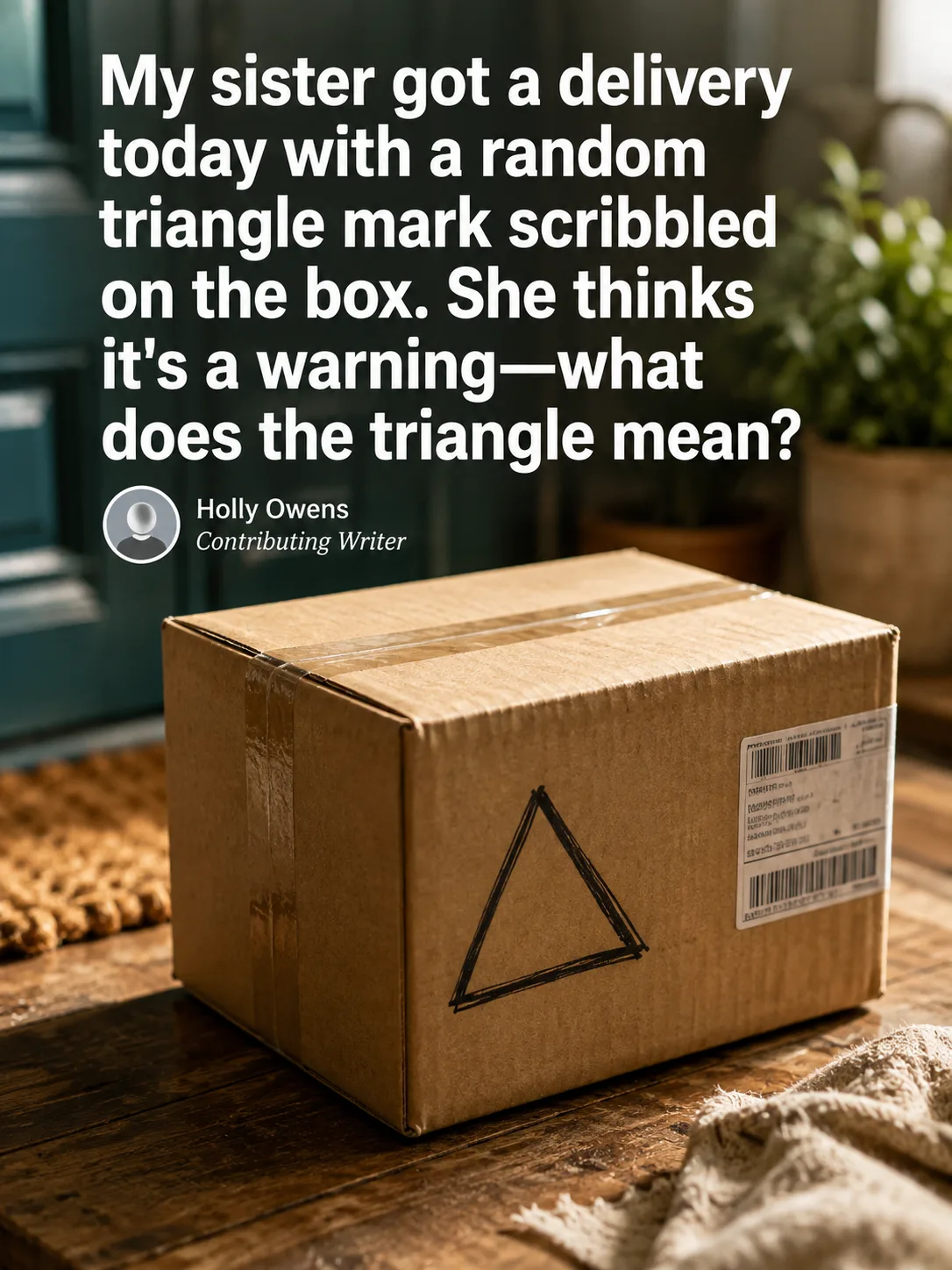
There’s a triangle scribbled on the cardboard.
No explanation.
No matching symbol on the shipping label.
Just a random-looking triangle drawn in marker.
Yeah, I can see why that would get your attention.
A strange symbol on a delivery box can feel unsettling, especially when you don’t remember seeing anything like it before. Your brain immediately starts filling in the blanks.
Is it a warning?
Did the driver mark the house?
Does it mean something about the package?
Is somebody using a secret delivery code?
Most of the time, the answer is much less dramatic.
A triangle mark on a package can come from warehouse handling, sorting, quality checks, a quick employee note, previous packaging use, or nothing more than an accidental pen mark. A triangle by itself does not have one universal meaning across delivery companies.
Still, there are a few smart things you can check before tossing the box into recycling.
Here’s what a mysterious triangle on a package may mean, what it probably does not mean, and what I would check if one showed up on my own doorstep.
Is a Triangle on a Package a Warning?
Not automatically.
This is probably the most important thing to know.
There is no single universal rule stating that a hand-drawn triangle on a cardboard delivery box means danger, theft risk, surveillance, or a warning about the person receiving it.
Official shipping warnings usually look much more standardized.
Think printed labels such as:
- Fragile
- This Side Up
- Keep Dry
- Hazardous Material
- Lithium Battery
- Heavy Package
- Temperature Sensitive
Those markings normally use recognizable text, icons, colors, or regulated labels.
A random triangle drawn with a pen or marker is very different.
It may have been added somewhere along a long shipping route without having anything to do with you or your home.
Why Packages Pick Up Random Marks
A package can pass through a surprising number of hands and locations before reaching your porch.
It may move through:
A fulfillment center.
A regional sorting facility.
A delivery hub.
A truck.
Another transfer point.
A final delivery vehicle.
Along the way, workers may write temporary notes, route identifiers, position marks, or other quick reminders.
Cardboard boxes can also be reused before entering a delivery network.
That means the triangle you see today may have been drawn before your order was even packed.
This is why the timing matters.
Seeing a mysterious mark doesn’t automatically mean the final delivery driver put it there.
1. It Could Be a Warehouse Sorting Mark
One simple explanation is that the triangle came from a warehouse or fulfillment center.
Workers sometimes need fast visual cues while moving large numbers of boxes.
A simple shape can be quicker to notice than a long written note.
The mark might have helped identify:
A specific batch.
A sorting lane.
A pallet.
A packing station.
A temporary processing group.
A box that needed another check.
That doesn’t mean every warehouse uses triangles.
The important point is that informal marks can appear during normal package handling.
2. It May Be an Internal Delivery Note
Delivery workers often deal with dozens or even hundreds of packages during a shift.
Temporary marks can sometimes help with organization.
A driver or handler might mark a box while arranging deliveries inside a vehicle.
For example, a mark could help distinguish one stop from another or separate packages during loading.
Again, there is no universal triangle language shared by every delivery company.
One triangle could mean something to one employee and absolutely nothing to another.
Without context, the shape alone doesn’t tell you much.
3. The Box May Have Been Reused
This explanation gets overlooked all the time.
Cardboard shipping boxes frequently get reused.
Small businesses reuse them.
Individuals reuse them.
Warehouses sometimes work with previously marked cartons.
Someone may have drawn that triangle weeks or months before your current shipment existed.
Look closely at the box.
Does it have:
Old tape marks?
Removed labels?
Writing under newer tape?
Faded marker lines?
Scratched-out addresses?
If so, the triangle may simply belong to the box’s previous life.
Mystery solved—and far less exciting than the internet version.
4. It Could Be a Quality-Control Mark
Some packing operations use handwritten marks during inspection.
A worker may check that:
The correct item is inside.
The quantity is right.
The packaging is closed properly.
A fragile item has padding.
A shipment is ready to move.
A quick symbol can act as an internal confirmation.
The mark may make perfect sense inside that particular workplace while meaning nothing to the customer receiving the package.
Think of it like the initials sometimes found on restaurant takeout bags.
Useful to the workers.
Mostly meaningless once the order reaches you.
5. It Could Simply Be an Accidental Scribble
Sometimes a triangle is just a triangle.
I know. Very disappointing.
A marker can slip.
Someone can test a pen.
A box can get drawn on while sitting near a packing station.
A child may even have doodled on a reused box before it entered shipping.
Humans are incredibly good at assigning meaning to patterns.
Give us three lines on cardboard and five minutes online, and suddenly somebody has a theory involving burglars, secret codes, and neighborhood surveillance.
Real life is usually more boring.
And in this case, boring is good.
Why Does a Triangle Feel Like a Warning Symbol?
Because triangles really are used for warnings in many places.
Road signs often use triangular shapes.
Safety symbols may use triangles around hazards.
Electrical warnings sometimes appear inside triangular icons.
So when we see a triangle somewhere unexpected, our brains can connect it with caution.
But context matters.
An official warning symbol usually contains more information.
For example, you might see:
An exclamation mark.
A lightning bolt.
A flame.
A specific safety pictogram.
Text explaining the hazard.
A plain hand-drawn triangle without supporting information doesn’t automatically carry the same meaning.
Does the Direction of the Triangle Matter?
Usually not without some known system attached to it.
An upward triangle, downward triangle, outlined triangle, or filled-in triangle can have meanings in mathematics, electronics, road signage, clothing labels, and many other fields.
But those meanings do not automatically carry over to a delivery box.
A triangle on packaging only becomes meaningful when you know who drew it and what system they were using.
Without that context, interpreting the direction is mostly guesswork.
Could the Triangle Mean “Fragile”?
Not by itself.
Fragile shipments normally have clearer markings.
You may see:
“FRAGILE.”
“HANDLE WITH CARE.”
A broken-glass symbol.
Directional arrows.
Special carrier stickers.
A random triangle alone isn’t a standard substitute for those labels.
If the contents are fragile, the seller may have used its own internal shorthand, but you shouldn’t assume the triangle means fragile unless the company confirms it.
Could It Mean “This Side Up”?
Again, probably not by itself.
Packages that must remain upright usually show arrows pointing upward.
Those arrows are much clearer than a triangle.
A single triangle could theoretically be part of a local packing system, but there’s no reason to treat it as an official orientation mark without additional information.
Could It Mean the Package Was Inspected?
Possibly.
Some warehouses use marks after manual checks.
But inspection markings can vary widely.
The triangle alone cannot prove the package was opened or inspected.
Instead, check the packaging itself.
Look for:
Cut tape.
Replacement tape.
A resealed seam.
Damaged cardboard.
Missing contents.
Unexpected paperwork.
If everything looks normal and the shipment matches your order, the mark is much more likely to be harmless.
Could It Mean the House Was “Marked”?
This is where social media stories can get wild.
Posts sometimes claim that criminals use symbols on packages, mailboxes, sidewalks, gates, or houses to identify future targets.
A random mark can quickly get turned into a supposed burglary code.
The problem is that a symbol by itself does not prove any of that.
A package passes through multiple locations before delivery, so you usually don’t even know where the mark was added.
If the only unusual thing is a triangle drawn on the box, there’s little reason to assume your home has been specifically targeted.
Look at the full situation instead.
When a Mark Deserves More Attention
A triangle alone usually isn’t very informative.
But other details may justify taking a closer look.
Pay more attention if:
The package was opened.
Contents are missing.
The shipping label appears altered.
The package doesn’t belong to anyone in the household.
You didn’t order anything.
There are repeated unexplained marks on several deliveries.
Someone appears to be tampering with packages.
You notice suspicious activity around your home.
Those are concrete details.
A single doodle is not.
What If You Didn’t Order the Package?
This is different from simply receiving your normal order with a triangle on it.
First, check the recipient name and address.
Make sure the package wasn’t intended for:
A family member.
A roommate.
A former resident.
A neighbor.
A gift recipient.
If the package truly arrived unexpectedly but has your name and address, check your recent orders and financial accounts.
It may be:
A gift.
A delayed shipment.
A replacement item.
A subscription order.
An order placed by another household member.
If you still can’t identify it, contact the retailer or delivery company using official contact information.
Be Careful With QR Codes and Messages
A random triangle isn’t usually a big concern.
A suspicious QR code or printed message asking you to take action deserves more caution.
Don’t scan unknown codes simply because a package tells you to.
Don’t call phone numbers printed on suspicious inserts without checking them independently.
Don’t enter passwords or payment information through links you weren’t expecting.
Instead, open the retailer or carrier’s official app or website yourself.
That way you aren’t relying on instructions that may have been added by someone else.
Check the Shipping Label First
Before building a whole theory around the triangle, start with the boring stuff.
Read the shipping label.
Check:
Your name.
Your address.
Tracking number.
Sender.
Retailer.
Carrier.
Package weight, if shown.
Compare those details with your order confirmation.
If everything matches, that’s reassuring.
Check the Tracking History
Your tracking information may tell you how many facilities handled the package.
If it moved through several hubs, that’s another reminder that the mark could have been added at almost any point.
Tracking may also show:
Delays.
Rerouting.
Delivery exceptions.
Address corrections.
Multiple delivery attempts.
Those events can sometimes explain unusual handling.
Take a Photo Before Opening It
If the mark truly worries you, take a quick photo.
Photograph:
The triangle.
The full box.
The shipping label.
Any damaged areas.
Any unusual tape.
Then open the package normally if there is no safety reason not to.
The photos give you something to show customer service if you later find missing or damaged items.
When You Should Not Open a Package
A random marker triangle isn’t enough by itself to make a package dangerous.
However, don’t casually handle or open a package if it has genuinely concerning features such as:
Unknown powder.
Leaking liquid.
Strong chemical odor.
Exposed wires.
Unusual oily stains.
Threatening messages.
Unexpected electronic components.
Bulging or severely damaged packaging.
If something about the package suggests a real physical hazard, move away from it and contact appropriate local emergency authorities for guidance.
Don’t poke it, shake it, sniff it closely, or carry it around the house.
That’s a very different situation from a harmless-looking cardboard box with a marker triangle.
Should You Contact the Delivery Company?
You certainly can.
If the box looks normal but curiosity is driving you nuts, contact customer service.
Provide:
The tracking number.
Delivery date.
Photo of the mark.
Carrier name.
Basic description.
Ask whether the mark matches any known handling or warehouse notation.
They may recognize it.
They may not.
And that’s okay.
Not every handwritten warehouse mark is documented for customer-facing staff.
What If Customer Service Has No Idea?
Don’t panic.
Customer service not recognizing the mark does not suddenly make it suspicious.
The symbol may have been created by:
A retailer.
A fulfillment center.
A subcontractor.
A sorting worker.
The sender.
A previous user of the box.
It may never have been part of the delivery company’s own system.
Sometimes “we don’t know” really does mean the mark has no useful meaning outside the place where it was drawn.
Why Social Media Makes These Marks Seem Scarier
Mysterious symbols make fantastic social media content.
A photo of a normal package isn’t very exciting.
A photo captioned:
“HELP! WHAT DOES THIS TRIANGLE MEAN?!”
Well, now people are clicking.
Comments pile up.
One person says it’s a warehouse mark.
Another says it means fragile.
Somebody’s cousin supposedly worked for a carrier.
Then someone confidently says criminals use it to identify houses.
Within three hours, the cardboard box has its own mythology.
That’s why viral explanations deserve caution.
A confident comment isn’t the same thing as evidence.
Don’t Assume Every Similar Triangle Means the Same Thing
Suppose five people online post photos of triangles on boxes.
They may look similar.
But those packages could have come from:
Five different retailers.
Five different fulfillment centers.
Several delivery companies.
Different states.
Different countries.
Different packaging suppliers.
One triangle might be a packing mark.
Another might be accidental.
Another might come from a reused box.
Their similar appearance does not prove a shared code.
Humans Love Finding Patterns
There is actually a term for our tendency to perceive meaningful connections in unrelated or random things: apophenia.
In everyday life, it shows up all the time.
We see faces in clouds.
Patterns in random numbers.
Meaning in coincidences.
And sometimes secret messages in marker scribbles on cardboard.
That doesn’t mean you’re silly for noticing the triangle.
Noticing unusual details is useful.
The trick is separating observation from assumption.
You observed a triangle.
That’s real.
“Someone marked my house for a crime” is an interpretation.
You need evidence before jumping from one to the other.
A Simple Package Safety Check
When I get a delivery that looks unusual, I like this quick routine.
Check the Address
Make sure it belongs at your home.
Check the Sender
Confirm you recognize the retailer or sender.
Check Your Orders
Match it with something you actually purchased.
Check the Box
Look for damage, tampering, leaks, unusual odors, or strange contents.
Photograph Anything Odd
Take pictures before opening if necessary.
Check the Contents
Confirm everything you ordered is there.
Contact the Carrier if Needed
Use official customer-service contact information.
That’s much more useful than staring at the triangle for an hour.
Does Marker Color Matter?
Probably not on its own.
Black, blue, red, green, or another marker color could simply reflect whichever pen somebody had nearby.
Certain warehouses may use colors for internal sorting, but those systems aren’t universal.
A red triangle isn’t automatically more dangerous than a black one.
Color only becomes meaningful when there is a known system behind it.
What About Circles, X Marks, and Numbers?
The same basic rule applies.
You might find:
A circle.
An X.
A checkmark.
Numbers.
Letters.
Arrows.
Lines.
Dots.
Initials.
Any of these could have been added during packing, storage, shipping, inspection, routing, or previous use.
Without knowing the system, the symbol’s meaning is uncertain.
The more standardized the mark looks, the more likely it may have an operational purpose.
The more casual and scribbled it looks, the more likely it may be a temporary note or ordinary pen mark.
Can Drivers Mark Packages to Remember Stops?
It’s possible for workers to use quick personal organization methods, although carrier policies and worker practices differ.
A delivery route can involve a huge volume of packages.
Visual shorthand can sometimes make sorting inside the vehicle faster.
That still doesn’t mean a triangle relates to anything about the customer.
It may simply help the worker recognize a delivery group or loading order.
Why a Package Mark Usually Isn’t About You
This is worth remembering.
From your perspective, the box belongs to your house.
From the delivery network’s perspective, it was one cardboard rectangle among thousands.
Most marks added during transit are more likely to relate to the package than the person receiving it.
That distinction can make the whole thing feel much less creepy.
What If the Same Triangle Appears Repeatedly?
Repeated symbols are more interesting than a one-time doodle.
Start documenting them.
Take photos.
Write down:
The retailer.
Carrier.
Delivery date.
Tracking number.
Where the mark appears.
Whether the symbol looks identical.
Then compare the shipments.
If all the packages came from the same retailer or fulfillment center, you may have found a normal internal packing mark.
If they all came from the same carrier, customer service may be able to offer an explanation.
Patterns become useful when you have real data—not just one box.
Should You Report It to Police?
A triangle on a package by itself is generally not evidence of a crime.
There is usually no reason to contact police simply because you found a hand-drawn geometric shape on ordinary packaging.
That changes if you have additional signs of criminal activity, such as:
Threatening messages.
Repeated package tampering.
Attempted break-ins.
Someone following deliveries.
Stolen packages.
Damage to your property.
Suspicious people repeatedly approaching the home.
Then you’re reporting the actual suspicious behavior, not the triangle.
What About Porch Pirates?
Porch theft is real.
But a triangle scribbled on a box isn’t proof that someone plans to steal it.
If package theft worries you, practical steps help more.
Try:
Prompt delivery notifications.
A video doorbell or security camera.
Signature-required delivery for valuable items.
Secure package lockers.
Pickup locations.
Delivery instructions that place packages out of obvious street view.
Those measures address the real risk without needing to decode mysterious cardboard hieroglyphics.
Could It Be a Retailer’s Packing Code?
Yes.
Retailers often have internal processes customers never see.
Boxes may move through different packing stations.
A worker could mark a carton during:
Order verification.
Returns processing.
Manual inspection.
Inventory handling.
Special packing.
Bulk order preparation.
The symbol may never appear in public instructions because customers aren’t meant to interpret it.
Could the Triangle Have Come From the Manufacturer?
Also possible.
Sometimes boxes already contain marks before a retailer ever puts an item inside them.
Packaging manufacturers, warehouse staff, wholesalers, or product suppliers may write on cartons during storage and transport.
By the time the package reaches your porch, tracing one little marker symbol backward can be practically impossible.
Does a Triangle Have a Universal Shipping Meaning?
No single hand-drawn triangle has one universal meaning across every package carrier and retailer.
Official transportation and handling symbols rely on recognizable standards and usually appear in a consistent printed format.
A casual triangle scribbled in marker lacks enough context to interpret with confidence.
That’s really the heart of the answer.
Frequently Asked Questions
What does a triangle drawn on a delivery box mean?
There is no single universal meaning. It may be an internal warehouse mark, sorting note, quality-control symbol, previous marking on a reused box, or an accidental scribble.
Is a triangle on a package a warning sign?
Not necessarily. Official warning labels usually contain standardized symbols, colors, or text. A plain hand-drawn triangle does not automatically indicate danger.
Does a triangle mean my house has been marked?
A triangle on one package alone does not prove anyone has marked your home. The box may have been marked anywhere during packing or shipping.
Should I worry if I see a triangle on my package?
If the package otherwise looks normal, matches an order you placed, and has no signs of tampering or hazardous contents, the mark alone is usually not a reason for alarm.
Can delivery drivers use symbols on boxes?
Workers may sometimes use informal notes or markings while sorting and organizing packages, but practices vary and there is no universal triangle code.
Could the triangle mean the box was inspected?
It could be an internal check mark, but the symbol by itself cannot confirm that. Look for other evidence, such as resealed tape or inspection documentation.
What should I do if my package looks tampered with?
Photograph the package before opening, check the contents, save the packaging, and contact the retailer or carrier through official customer-service channels.
What if the package has a strange smell or leaking substance?
Do not handle it unnecessarily. Move away from it and contact appropriate local emergency authorities if the package appears physically hazardous.
Should I scan a QR code attached to a strange package?
Avoid unknown QR codes. Go directly to the retailer or carrier’s official website or app instead.
Can a reused box have old markings?
Absolutely. Previous owners, warehouses, retailers, or shipping workers may have written on the carton before your current order was packed.
Why do people think package symbols are secret codes?
Unfamiliar symbols naturally create curiosity, and social media can quickly turn uncertainty into dramatic theories. Similar-looking marks do not necessarily share the same meaning.
Should I ask the delivery company about the triangle?
You can. Give them the tracking number and a photo. They may recognize the symbol, although informal warehouse markings may not appear in customer-service records.
Final Thoughts
So, what does that mysterious triangle mark on a delivery box actually mean?
Probably something much less exciting than it first appears.
It may be a warehouse mark.
A temporary sorting note.
A packing check.
A mark from an earlier use of the box.
Or somebody may simply have had a marker in their hand for three seconds too long.
The big thing is context.
A plain triangle on an otherwise normal package does not automatically mean danger, a criminal warning, or a secret message about your house.
Check the shipping label.
Confirm the order.
Look for signs of tampering.
Take a photo if the mark bothers you.
And contact the carrier or retailer if anything else seems unusual.
But if everything checks out?
I’d open my package, enjoy whatever I ordered, and let the triangle remain one of life’s tiny cardboard mysteries.
Because sometimes three lines really are just three lines.