
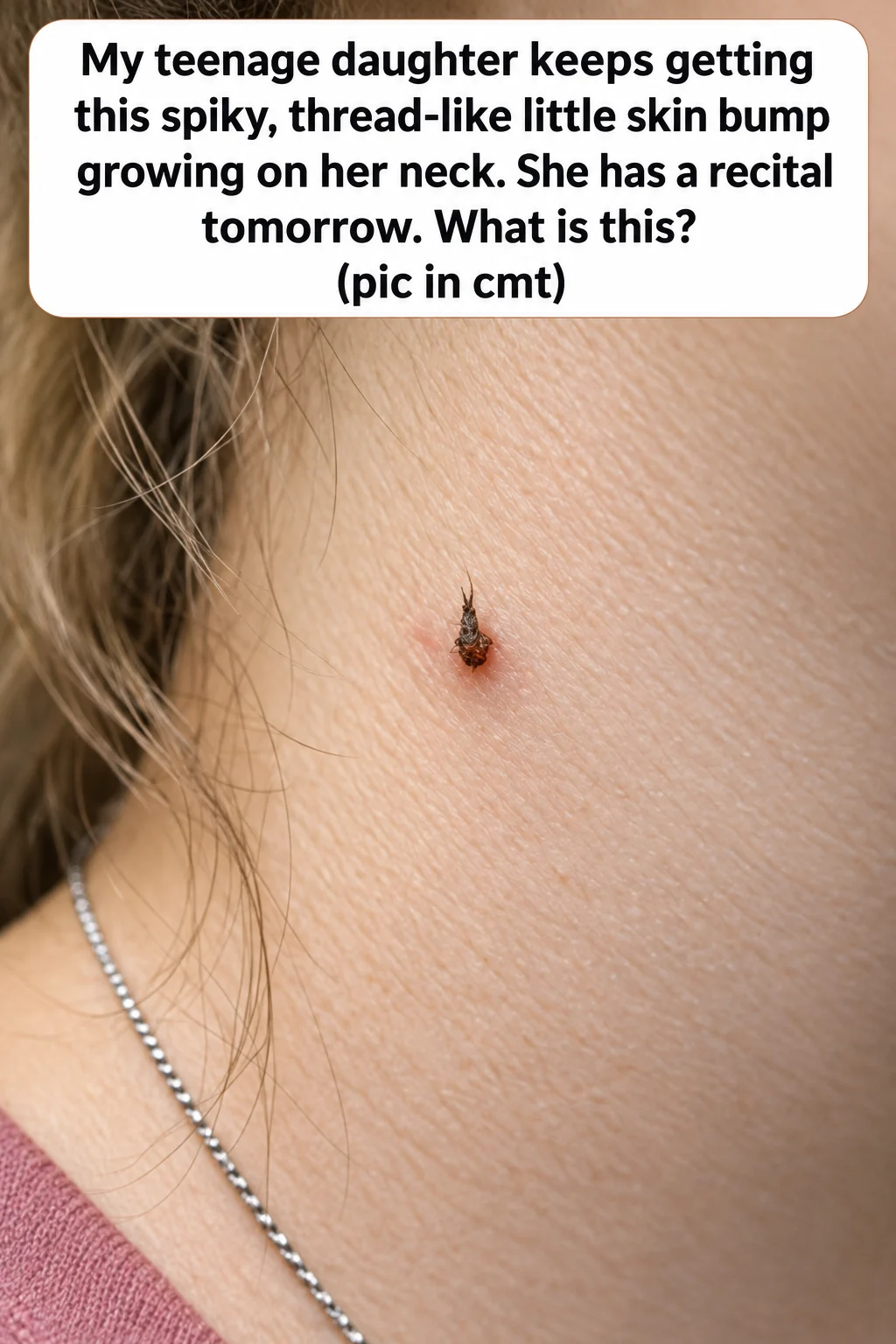
When your teenage daughter spots a strange little skin bump on her neck right before a recital, school dance, family photo, or some other big day, yeah… it can suddenly feel like the only thing anyone is going to notice.
I get it.
A tiny skin growth can look huge when you’re standing two inches from the bathroom mirror under those unforgiving lights. And when the bump looks thin, pointed, or almost like a tiny piece of thread sticking out of the skin, it’s natural to wonder what in the world you’re looking at.
One common possibility is a filiform wart.
Filiform warts are narrow, finger-like skin growths that often appear around the face and neck. They are usually harmless, but because they stick outward instead of lying flat against the skin, they can be pretty noticeable.
Before reaching for scissors, tweezers, wart remover, or one of those internet home remedies, here’s what parents should know.
What Is a Filiform Wart?
A filiform wart is a type of common wart caused by certain strains of human papillomavirus, or HPV.
These warts tend to look different from the round, rough warts people often get on their hands.
A filiform wart may look like:
- A tiny thread
- A narrow spike
- A little finger-shaped projection
- A brush bristle
- A thin piece of skin sticking outward
They are usually small and may be flesh-colored, pinkish, tan, or slightly darker than the surrounding skin.
Some stay tiny.
Others gradually become more visible, especially when they grow on an area like the neck where shirts, necklaces, hair, and costume collars constantly brush against them.
And honestly, that location can make a tiny bump feel way more dramatic than it really is.
Why Filiform Warts Often Appear on the Neck
The neck gets more friction than most of us realize.
Think about everything that rubs against it during a normal week:
Shirt collars, necklaces, scarves, hoodie strings, sports uniforms, dance costumes, backpacks, hair, and even repeated shaving near the hairline.
Small scratches or irritated areas in the skin can make it easier for viruses that cause common warts to enter the outer layers of skin.
Teenagers may also deal with plenty of sweat and friction from sports, dance practice, theater rehearsals, marching band uniforms, or long school days.
That doesn’t mean those activities directly cause a wart.
They may simply make an existing skin growth easier to notice or irritate.
Does a Filiform Wart Mean Poor Hygiene?
No.
And this is an important thing to tell a teenager who may already feel self-conscious.
A common skin wart does not mean someone is dirty.
Skin warts are incredibly ordinary.
The viruses associated with common warts can spread through direct skin contact and sometimes through shared personal items or surfaces. A wart may also appear weeks or months after exposure.
That delay makes it nearly impossible in many cases to say exactly where it came from.
So if your daughter is staring at the mirror asking, “How did I even get this?” the answer may simply be that there is no obvious way to know.
Filiform Wart vs. Skin Tag
Skin tags and filiform warts can look surprisingly similar.
A skin tag usually feels soft and smooth. It often hangs from the skin on a small stalk and can look like a tiny teardrop or loose flap.
A filiform wart tends to look narrower, firmer, rougher, pointed, or slightly frayed.
Skin tags are especially common where skin rubs against skin, including the neck and underarms.
They are more common in adults, although teenagers can sometimes get them too.
If the growth looks distinctly spiky, thread-like, or brush-shaped, a filiform wart may be one possibility worth asking a clinician about.
Still, appearance alone cannot always confirm what a skin growth is.
Could It Be a Pimple or Ingrown Hair?
Possibly, but those usually behave differently.
A pimple often has:
- Redness
- Tenderness
- Swelling
- A white or yellow center
- A broader raised base
An ingrown hair may look inflamed and sometimes has a visible trapped hair underneath or inside the bump.
A filiform wart usually doesn’t contain pus and often isn’t painful.
Your daughter may say something like, “It doesn’t hurt. It’s just… there.”
That description can fit a wart, although several harmless skin growths can look similar.
What Should You Do the Night Before Her Recital?
Here’s the big one.
Leave it alone.
Seriously.
The night before an important performance is not the time to start experimenting with home removal.
Do not:
- Cut it with scissors
- Clip it with nail clippers
- Pull it with tweezers
- Tie dental floss around it
- Scrape it
- Burn it
- Pick at it
- Apply strong wart remover without medical guidance
Why?
Because a tiny bump can turn into a red, swollen, bleeding, irritated spot by morning.
And let’s face it, that’s probably the exact opposite of what your daughter wants before stepping under stage lights.
Instead, gently wash the area with mild soap or cleanser and lukewarm water.
Pat it dry.
Then try to keep necklaces, collars, costume fabric, and hair from repeatedly catching on the spot.
Simple wins here.
Can She Cover It With Makeup?
If the bump is very small, heavy makeup may actually make it stand out more.
Raised skin growths cast tiny shadows, especially under bright stage lights. Thick concealer can collect around the bump and make the texture more obvious.
A better approach may be to gently even out the skin tone around the growth.
If she uses stage makeup:
- Use clean hands or a fresh applicator.
- Avoid aggressive rubbing.
- Apply only a thin amount.
- Remove the makeup gently after the performance.
- Stop if the skin starts burning or stinging.
I know the instinct is to cover the thing like you’re patching drywall, but lighter usually looks better.
Should You Use Drugstore Wart Remover?
Be careful.
Many over-the-counter wart products contain salicylic acid, and many are made for the thicker skin found on hands and feet.
The skin on the neck is more delicate.
Using strong wart treatments there without medical guidance can cause irritation, burns, redness, peeling, or discoloration.
The same concern applies to some home freezing kits.
And the night before a recital? Definitely not ideal timing.
A little skin bump is much easier to deal with than a blister.
Why Picking at It Is a Bad Idea
It’s tempting.
I mean, you see this tiny thing sticking out and your brain immediately thinks, “Surely I can just pull that off.”
Please don’t.
Picking can cause:
- Bleeding
- Irritation
- Infection
- Scabbing
- Possible spread to nearby skin
If the growth is a wart, disturbing it may also spread viral material onto nearby skin.
So, frustrating as it sounds, boring advice wins again.
Hands off.
How a Doctor Can Tell What It Is
A primary care clinician or dermatologist can often recognize a filiform wart by looking at its shape, color, texture, and location.
Many cases do not require complicated testing.
A clinician may look closely at the skin and ask questions such as:
- How long has it been there?
- Has it gotten bigger?
- Does it bleed?
- Does it hurt?
- Has its color changed?
- Are similar bumps appearing elsewhere?
If the growth looks unusual or the diagnosis isn’t clear, a dermatologist may examine it more closely or recommend removing a small sample.
That doesn’t automatically mean something serious is wrong. Sometimes skin growths simply look enough alike that a closer look makes sense.
Common Medical Treatments for Filiform Warts
If a clinician confirms that the growth is a wart, treatment depends on the size and exact location.
Possible medical treatments can include:
- Liquid nitrogen freezing
- Careful removal after numbing
- Electrosurgery
- Prescription topical medications
- Other dermatologist-directed treatments
The neck and face need special care because the skin is visible and more sensitive than areas such as the soles of the feet.
That is one reason professional treatment may make more sense than experimenting at home.
What Happens After Wart Removal?
The skin may not look perfect immediately after treatment.
After freezing, the area may become red, tender, crusty, or blistered for a short time.
After another removal method, there may be a tiny healing spot.
A clinician may recommend basic care such as gentle cleansing and petroleum jelly while the area heals.
The exact instructions depend on the treatment used.
So if the recital is tomorrow and the bump isn’t causing a medical problem, waiting until afterward may be the more comfortable route.
When Should a Parent Call a Doctor?
Most small skin growths are not emergencies.
Still, some changes deserve medical attention.
Contact a healthcare professional if the growth:
- Grows quickly
- Bleeds without being rubbed or scratched
- Becomes painful
- Develops unusual or uneven coloring
- Changes shape noticeably
- Looks infected
- Appears alongside many new growths
- Sits very close to the eye, lip, or nostril
- Keeps returning after treatment
Also mention any health condition or medication that affects the immune system.
Those details may change how a clinician approaches diagnosis or treatment.
Is a Filiform Wart Contagious?
Warts can spread from one area of skin to another and sometimes between people.
That does not mean your daughter needs to avoid friends, school, rehearsal, or normal family contact.
Practical steps make more sense.
Encourage her to:
- Avoid picking the wart.
- Wash her hands after touching it.
- Avoid shaving directly over it.
- Avoid sharing razors.
- Avoid sharing makeup applicators.
- Keep personal washcloths and facial tools separate.
Those habits can help limit irritation and possible spread.
Why This Can Feel Like a Huge Deal to a Teenager
Adults sometimes look at a tiny blemish and think, “Nobody will notice.”
A teenager may hear that and think, “You have absolutely no idea.”
And, fair enough.
School photos, smartphones, stage lights, social media, and close-up mirrors can make even the smallest skin change feel enormous.
So before focusing only on treatment, it helps to acknowledge how she feels.
You don’t have to pretend the bump isn’t there.
You can simply remind her that one small skin growth isn’t what people came to see.
At a recital, the audience will remember the music, her expression, the outfit, and the performance far more than a tiny bump on her neck.
What To Do During the Next 24 Hours
For tonight, keep things simple.
Wash the area gently.
Don’t pick at it.
Avoid harsh treatments.
Keep jewelry and clothing from rubbing against it if possible.
Tomorrow, use minimal makeup around the area if she wants it, then let her focus on the recital.
After the performance, take another look in normal daylight.
You may also want to take a clear photo of the bump now and another photo several days later.
Try to use similar lighting and distance.
That makes it much easier to tell whether the growth is actually changing instead of relying on memory.
Can Filiform Warts Come Back?
Yes, they can.
Because warts are associated with a virus in the skin, removing the visible growth does not always mean another wart will never appear.
Some people get one wart and never notice another.
Others may develop additional warts over time.
If the same area repeatedly develops unusual growths, it is worth mentioning that pattern to a dermatologist.
Should Parents Try Home Remedies?
You’ll find plenty of home remedies online.
Apple cider vinegar.
Dental floss.
Duct tape.
Essential oils.
Scissors.
Needle tricks.
The internet has… ideas.
The problem is that the neck is a sensitive and highly visible area.
Something that merely irritates the thick skin on a finger could cause a noticeable burn or mark on the neck.
For a teenager especially, getting a clear diagnosis first is usually the sensible move.
The Bottom Line
A small spiky, thread-like bump on a teenager’s neck may be a filiform wart, especially if it is narrow, flesh-colored, painless, and sticks outward from the skin.
But a skin tag or another harmless growth can sometimes look similar, so appearance alone cannot confirm the diagnosis.
If your daughter’s recital is tomorrow, the safest practical move is usually pretty boring: don’t cut it, don’t pick it, don’t burn it, and don’t throw a strong wart treatment on it at the last minute.
Keep the area clean, reduce rubbing, and let her enjoy her performance.
Afterward, a primary care clinician or dermatologist can look at the bump and tell you what you’re actually dealing with.
And honestly? That’s a much better plan than turning a tiny mystery bump into a big red spot five minutes before curtain call.
This article is for general educational purposes and does not replace medical evaluation. Any new, rapidly changing, painful, bleeding, unusually colored, or concerning skin growth should be assessed by a qualified healthcare professional.