
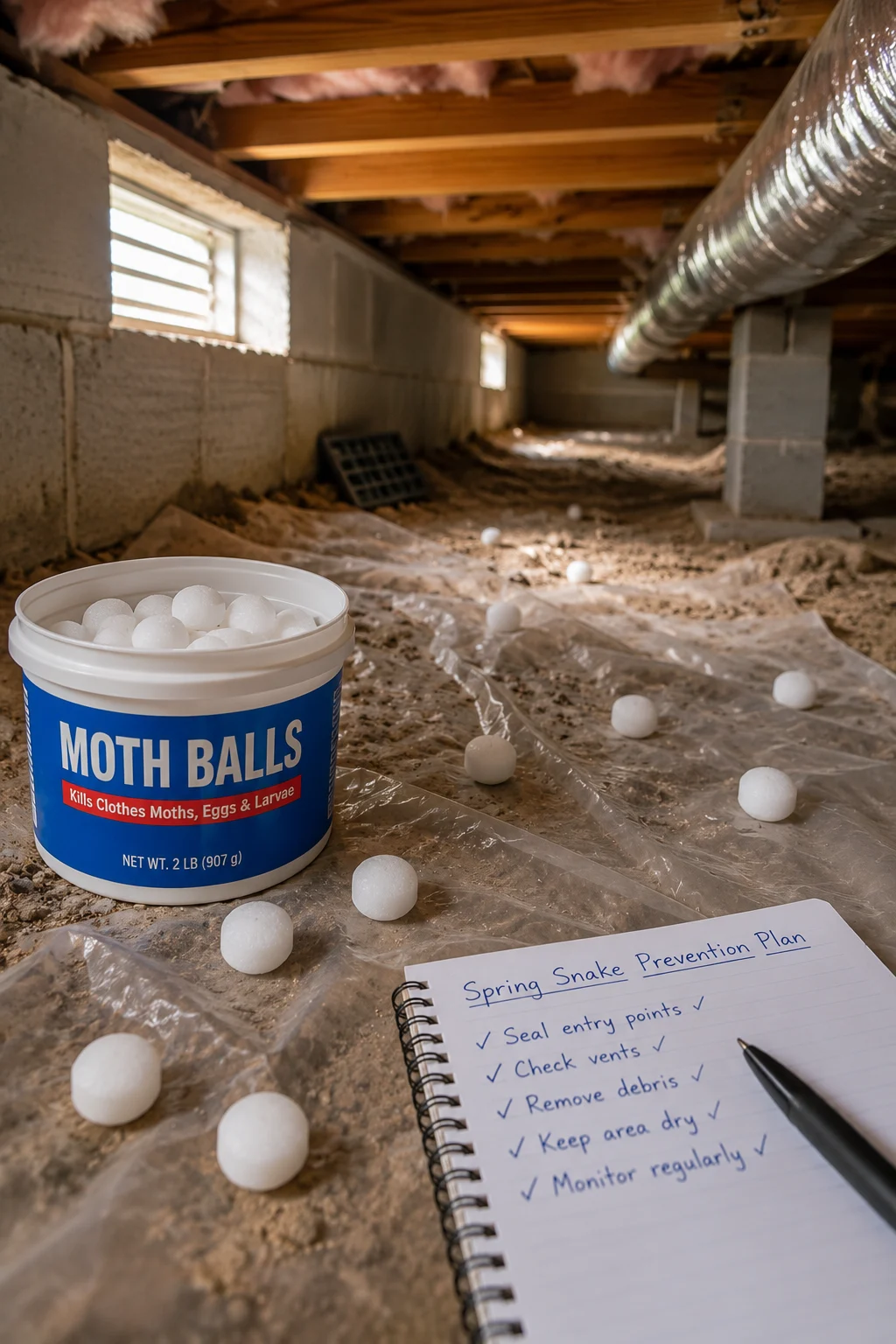
Snakes under the house?
Yeah, that’s one of those discoveries that can make you reconsider every little sound coming from the crawl space.
So I completely understand why the old mothballs for snakes trick keeps making the rounds. Mothballs smell incredibly strong, they’re inexpensive, and generations of homeowners have heard that scattering them around a crawl space, shed, garage, or foundation will make snakes pack their bags.
It sounds almost too easy.
Unfortunately, that’s the problem.
Mothballs are pesticides designed for very specific uses involving clothes moths and other labeled fabric pests. Current EPA-registered mothball labels direct users to place them in tightly closed storage spaces or containers as specified on the label—not scatter them around a crawl space as wildlife repellent. Using a pesticide at a site not permitted by its label can also violate federal pesticide law in the United States. (US EPA)
And there’s another issue: extension guidance doesn’t support ordinary mothballs as a dependable snake-control method. (Caes Secure)
So if you’ve got snakes showing up beneath your home this spring, here’s what I’d do instead.
Why People Put Mothballs in Crawl Spaces
The logic seems straightforward.
Mothballs produce a powerful odor.
Humans can smell that odor from pretty far away, so it’s easy to assume snakes must hate it too.
Then the reasoning goes:
Strong smell + snake = snake leaves.
Except pest management doesn’t work that simply.
Mothballs release pesticide vapors. Depending on the product, the active ingredient may be naphthalene or paradichlorobenzene.
Those vapors are part of how mothballs work against their labeled pests when they’re used correctly in enclosed storage conditions.
That doesn’t turn them into a general-purpose animal repellent.
In fact, the EPA specifically discusses improper mothball use in places such as attics, crawl spaces, and gardens for repelling wildlife. (US EPA)
What Mothballs Are Actually Made to Do
This distinction matters.
Mothballs aren’t little air fresheners that happen to smell terrible.
They’re pesticide products.
A current EPA-approved naphthalene mothball label, for example, directs the product toward controlling clothes moths and their eggs and larvae in clean, airtight storage spaces. It warns users not to use containers that allow vapors to escape into occupied rooms. (US EPA)
Another current mothball label similarly specifies airtight containers and storage closets and instructs users to keep the product away from children and pets. (US EPA)
That’s a completely different situation from throwing handfuls underneath a house.
The label isn’t boring fine print you can improvise around.
With pesticides, the label tells you where and how the product may be used.
Do Mothballs Really Keep Snakes Away?
I wouldn’t rely on them.
University of Georgia Extension guidance states that mothballs aren’t labeled as vertebrate repellents and describes their use for snakes as ineffective. More recent Illinois Extension guidance likewise says repellents such as mothballs and sprays don’t work as a dependable way to discourage snakes. (Caes Secure)
That’s a pretty big problem if you’re filling a crawl space with pesticide vapor specifically to repel snakes.
You’re accepting potential exposure without getting dependable snake control in return.
Not exactly the trade I’d sign up for.
What You Might Notice Right Away
The first thing may not involve snakes at all.
It may be the smell.
A crawl space isn’t necessarily isolated from the air inside your house.
Gaps around plumbing, wiring, ductwork, floors, and other building components can allow crawl-space air to communicate with occupied areas.
If you’ve scattered mothballs around an open crawl space and can smell them inside the house, that odor isn’t evidence that your homemade snake barrier is “working.”
It’s a reason to pay attention.
Current mothball labeling specifically warns against applications that allow vapors to escape into occupied rooms. (US EPA)
Why the Smell Matters
That familiar mothball smell comes from chemicals entering the air.
So don’t treat a powerful odor as merely an inconvenience.
Mothball exposure can occur through inhalation, ingestion, or other routes, and the products need to be kept away from children and pets.
The EPA also warns that naphthalene mothballs can pose particular hazards to young children, including because the products may be mistaken for candy. (US EPA)
If mothball odor from an improper application is entering your living space, I wouldn’t simply cover it with candles, fragrance sprays, or air fresheners.
That fixes the smell exactly as well as turning up the radio fixes a check-engine light.
Why Crawl Spaces Are a Bad Place to Improvise With Pesticides
Crawl spaces are awkward.
They’re enclosed enough that vapors can accumulate, yet they’re often connected to a building in ways homeowners don’t immediately notice.
They may contain HVAC components, plumbing penetrations, insulation, wiring, stored belongings, and access points leading into the home.
They’re also difficult to work in.
If you scatter dozens of mothballs underneath insulation or into inaccessible corners, getting them all back out may become a miserable project.
And if an animal moves them?
Now you’ve got pesticide products somewhere you didn’t intend them to be.
That’s why “I’ll just throw some under the house” isn’t a great pest-control plan.
Mothballs Aren’t a Harmless Home Remedy
This is another misconception worth clearing up.
People sometimes put mothballs in the same mental category as vinegar, baking soda, or cinnamon.
They’re not.
Mothballs are regulated pesticide products.
Their active ingredients have biological effects—that’s why they’re pesticides in the first place.
The fact that you can buy a product at an ordinary store doesn’t mean every household use imaginable is safe or legal.
You wouldn’t pour lawn pesticide into a bedroom because somebody online said it repels spiders.
Mothballs deserve the same respect for their label.
What If You Already Put Mothballs in the Crawl Space?
Don’t add more.
Start by reading the exact product label on the container you used.
Follow its safety, handling, storage, and disposal directions.
If you’re experiencing a strong odor inside occupied areas, or if anyone may have been exposed and is experiencing symptoms, contact the appropriate poison-control or medical resource for guidance.
Don’t send children or pets into the area.
And don’t mix the mothballs with other chemicals while trying to remove the smell.
Different mothball products may contain different active ingredients, so guessing about cleanup isn’t a smart move.
If the application is extensive or the crawl space is difficult to access safely, contacting a licensed pest-management or environmental professional may be the better choice.
Don’t Mix Different Mothball Products
Here’s an easy mistake to make.
One box runs out, so you grab another brand.
Not a good assumption.
Mothball formulations can differ, and current EPA-approved labeling specifically warns against mixing certain moth-preventive chemicals. (US EPA)
If you’re dealing with an existing improper application, identify what was actually used.
Keep the original packaging if you still have it.
That gives professionals much more useful information than:
“It was the white smelly kind.”
Helpful description at Grandma’s house.
Less helpful for pesticide identification.
What Actually Makes a Crawl Space Attractive to Snakes?
This is where snake prevention gets much more practical.
Snakes aren’t generally looking at your crawl space and thinking, “Wow, great architecture.”
They’re looking for things they need.
Shelter.
Suitable temperature.
Protection.
And food.
If mice, insects, frogs, or other prey animals are living around the foundation, snakes may have a reason to investigate.
Clutter can provide hiding places.
Tall vegetation can provide cover.
Openings around the foundation can provide entry.
So instead of asking, “What smell will chase snakes away?” I prefer another question:
Why would a snake want to be here in the first place?
Fix that and you’re addressing the actual problem.
1. Seal Gaps Around the Foundation
Physical exclusion is one of the most practical approaches.
Inspect the foundation and crawl-space perimeter for openings.
Pay attention around:
- Utility penetrations
- Pipes
- Cables
- Crawl-space doors
- Vents
- Foundation cracks
- Gaps beneath siding
- Openings around structural transitions
The correct repair depends on the building and location of the opening.
Don’t blindly fill vents or other components that your home needs for drainage, combustion safety, or ventilation.
When in doubt, have the area inspected by an appropriate building or pest professional.
The goal is to close unwanted animal entry points without creating a different house problem.
2. Deal With Rodents
If your crawl space has mice, that’s a food source.
And where prey goes, predators sometimes follow.
Look for rodent droppings, gnaw marks, nesting material, food storage, or other evidence.
Seal appropriate entry points and manage the rodent problem using methods suited to the situation.
Be especially thoughtful with rodenticides.
Poisoned rodents can create risks for pets and wildlife, and a rodent that dies somewhere inaccessible can create another unpleasant crawl-space problem.
Sometimes the best snake-control strategy starts with mouse control.
Not glamorous.
Very practical.
3. Remove Hiding Places Around the House
Snakes like cover.
So take a look around your foundation.
Do you have stacks of lumber?
Piles of bricks?
Tall weeds?
Dense ground cover pressed against the house?
Old landscaping material?
Random boards you’ve been “definitely going to use someday” since 2018?
Move unnecessary debris away from the structure.
Illinois Extension recommends reducing tall vegetation and removing or relocating piles of rocks, bricks, brush, wood, and other debris that can provide snake habitat. (Illinois Extension)
A tidier perimeter gives snakes fewer comfortable hiding places.
It also makes them easier to notice.
4. Keep Grass and Weeds Under Control
Tall grass provides cover for snakes and the small animals they may eat.
Keeping vegetation shorter around frequently used areas and near the home can make the environment less attractive.
Trim excessive growth around the foundation.
Manage weeds.
Avoid creating dense, undisturbed vegetation immediately beside crawl-space openings.
You don’t need to turn your yard into a golf course.
The idea is simply to reduce easy hiding places near the house. (Illinois Extension)
5. Be Smart About Firewood
A woodpile is basically a luxury apartment complex for small wildlife.
It provides gaps.
Shade.
Protection.
And sometimes rodents.
That doesn’t mean you can’t have firewood.
Just think carefully about placement.
Keeping large piles immediately against the foundation can make your snake-prevention job harder.
The same applies to scrap lumber, rocks, landscaping blocks, and similar materials.
Give the house some breathing room.
And maybe finally get rid of that mysterious stack of boards behind the shed.
You know the one.
6. Repair Crawl-Space Access Doors
A loose crawl-space door can turn all your other prevention work into a very elaborate joke.
Check that the access panel or door closes properly.
Look for warped edges, damaged framing, broken latches, or obvious gaps.
If the door needs replacement, use a solution appropriate for your home’s construction and local climate.
Also inspect screened openings.
Damaged screening can provide entry for various animals.
Again, don’t cover required vents without understanding their purpose.
Snake prevention shouldn’t create moisture problems.
7. Don’t Assume Every Snake Is Dangerous
Finding a snake near your home is unsettling.
But many snakes are nonvenomous and can play useful roles by eating rodents and other animals.
If you can’t confidently identify a snake, don’t handle it.
Illinois Extension specifically advises leaving an unidentified snake alone and notes that head shape by itself isn’t a reliable method for determining whether a snake is venomous. (Illinois Extension)
That’s important.
Internet identification tricks like “triangle head equals dangerous” can be misleading.
Give the animal space.
Keep children and pets away.
Contact an appropriate wildlife professional when necessary.
What Should You Do If a Snake Is Already in the Crawl Space?
Don’t start throwing chemicals at it.
And don’t crawl into a tight space with an unidentified snake because you’re feeling brave after watching three wildlife videos.
Keep people and pets away from the area.
If you can observe the snake safely from a distance, note its appearance without approaching it.
For a snake that may be venomous, is difficult to access, or repeatedly enters the structure, contact a qualified wildlife-removal professional or the appropriate local authority.
Once the snake is gone, focus on entry points and habitat conditions.
Otherwise another snake can simply replace the first one.
What About Commercial Snake Repellents?
This requires a little nuance.
Ordinary mothballs aren’t labeled for scattering around as snake repellent.
However, there are EPA-registered products specifically labeled for certain snake-repellent uses.
For example, one current EPA label covers an outdoor snake-repellent product for certain rattlesnakes and garter snakes around specified exterior areas. The label also contains significant restrictions, including outdoor-only use and instructions not to use the product where snakes are already believed to be present. (US EPA)
So don’t assume “snake repellent” and “mothballs” are the same thing.
If you choose a pesticide product, buy one specifically labeled for the intended use and follow every direction and restriction.
And keep expectations reasonable: extension guidance notes that snake repellents have not shown consistent effectiveness overall. (Caes Secure)
What About Sulfur?
Sulfur is another old snake-remedy favorite.
I wouldn’t casually spread it around the house based on folklore.
The same principle applies to any substance promoted as a repellent.
Ask:
Is the product actually labeled for this use?
Is there good evidence it works?
Is it appropriate for this location?
What are the risks to people, pets, plants, soil, and wildlife?
Strong smell doesn’t equal strong evidence.
Otherwise my gym shoes would be a registered pest-control device.
What About Essential Oils?
Clove oil, cinnamon oil, peppermint oil, and other strongly scented products often appear in homemade snake-repellent recipes.
I wouldn’t assume they’re dependable simply because they smell powerful to us.
Concentrated essential oils can also create their own risks for pets, plants, surfaces, and people.
If a commercial product contains plant-derived ingredients and is specifically labeled for snake control, follow that product’s directions.
That’s very different from improvising a mixture in your kitchen.
Natural ingredients still have chemistry.
Nature invented poison ivy, remember?
Why Exclusion Beats Chasing Snakes With Smells
This is the big takeaway.
Repellents attempt to convince an animal not to enter.
Exclusion physically removes the opportunity.
If there’s a snake-sized opening beneath the house, a smell-based solution depends on that smell continuing to deter the animal.
Close the opening correctly and the route is gone.
That’s a much stronger long-term strategy.
Combine exclusion with reducing rodents and hiding places and you’re addressing several reasons snakes might approach the structure.
It isn’t as dramatic as scattering some miracle product around.
But boring home maintenance wins a surprising number of battles.
Make a Spring Crawl-Space Inspection Routine
Spring is a great time to check the perimeter before animal activity increases.
Walk around the exterior of the house.
Look at the foundation.
Check crawl-space doors and screens.
Inspect vegetation.
Look for rodent activity.
Move debris.
Check drainage and moisture issues.
You don’t need to crawl underneath the house personally if the space is unsafe, cramped, contaminated, or beyond your comfort level.
Hire an appropriate professional.
There’s no trophy for squeezing into a 20-inch crawl space with spiders on your face.
I checked.
Common Mistakes to Avoid
Don’t scatter ordinary mothballs around a crawl space to repel snakes.
Don’t assume a strong smell means a product works.
Don’t ignore pesticide-label directions.
Don’t leave mothballs accessible to children, pets, or wildlife.
Don’t mix different pesticide chemicals.
Don’t crawl toward an unidentified snake.
Don’t rely solely on repellents while leaving foundation gaps open.
Don’t ignore rodents and other prey animals.
Don’t leave piles of debris against the house.
And don’t seal structural openings blindly without determining whether they’re required for ventilation, drainage, or another building function.
The best snake prevention is usually a combination of sensible property maintenance and physical exclusion.
Frequently Asked Questions
Do mothballs keep snakes away?
Ordinary mothballs aren’t a dependable snake-control method. Extension guidance advises against their use for snakes, and mothball pesticide labels don’t permit simply scattering them in crawl spaces as wildlife repellent. (US EPA)
Can I put mothballs in my crawl space?
You should use mothballs only according to the exact pesticide label. Current EPA-approved mothball labels specify tightly closed storage conditions for their labeled fabric-pest uses rather than open crawl-space wildlife control. (US EPA)
Why shouldn’t mothballs be used loosely around a house?
Mothballs release pesticide vapors. Labels restrict how and where they’re used and warn against allowing vapors to escape into occupied rooms. (US EPA)
Are mothballs pesticides?
Yes. Mothballs are pesticide products intended for specific labeled pest-control uses.
What attracts snakes to crawl spaces?
Shelter, suitable temperatures, access points, and prey such as rodents can all make areas around a structure attractive to snakes.
What’s the best way to keep snakes out of a crawl space?
Focus on physical exclusion, repairing appropriate gaps, controlling rodents, reducing clutter, managing tall vegetation, and removing hiding places near the structure.
Should I kill a snake I find near my house?
Don’t approach or handle an unidentified snake. Many snakes are harmless and beneficial. Keep people and pets away and contact an appropriate wildlife professional when removal is necessary.
How can I tell whether a snake is venomous?
Don’t rely on head shape alone. Identification depends on species and location. If you can’t confidently identify the animal from a safe distance, leave it alone and seek qualified local guidance. (Illinois Extension)
Do snake repellents work?
Results are inconsistent. Some pesticide products are specifically registered for limited snake-repellent uses, but extension guidance warns that repellents aren’t consistently effective. Physical exclusion and habitat management remain important. (Caes Secure)
Can I use essential oils instead of mothballs?
Don’t assume homemade essential-oil mixtures provide dependable snake control. If using any commercial repellent, choose one intended for the specific use and follow its label.
What should I do if I’ve already scattered mothballs under my house?
Stop adding them and read the product label for handling and disposal instructions. Keep children and pets away. For extensive applications, persistent indoor odor, or possible exposure, seek guidance from an appropriate pesticide, poison-control, environmental, or pest-management professional.
Will removing mice help discourage snakes?
It can. Rodents can provide food for snakes, so addressing a rodent problem removes one possible reason for snakes to spend time around the structure.
Final Thoughts
I understand why mothballs for snakes sounds like an easy spring trick.
They’re cheap.
They smell powerful.
And the idea has been passed around for years.
But I’d keep the mothballs where their label says they belong.
Scattering them through a crawl space can expose your household to pesticide vapors while giving you a snake-control method that extension experts don’t consider dependable. (US EPA)
Instead, I’d inspect the foundation, repair appropriate entry points, reduce hiding places, manage rodents, trim excessive vegetation near the structure, and call a qualified wildlife professional when a snake needs to be removed.
It’s not quite as exciting as a secret household hack.
But when we’re talking about pesticides underneath the house?
Boring is pretty darn good.