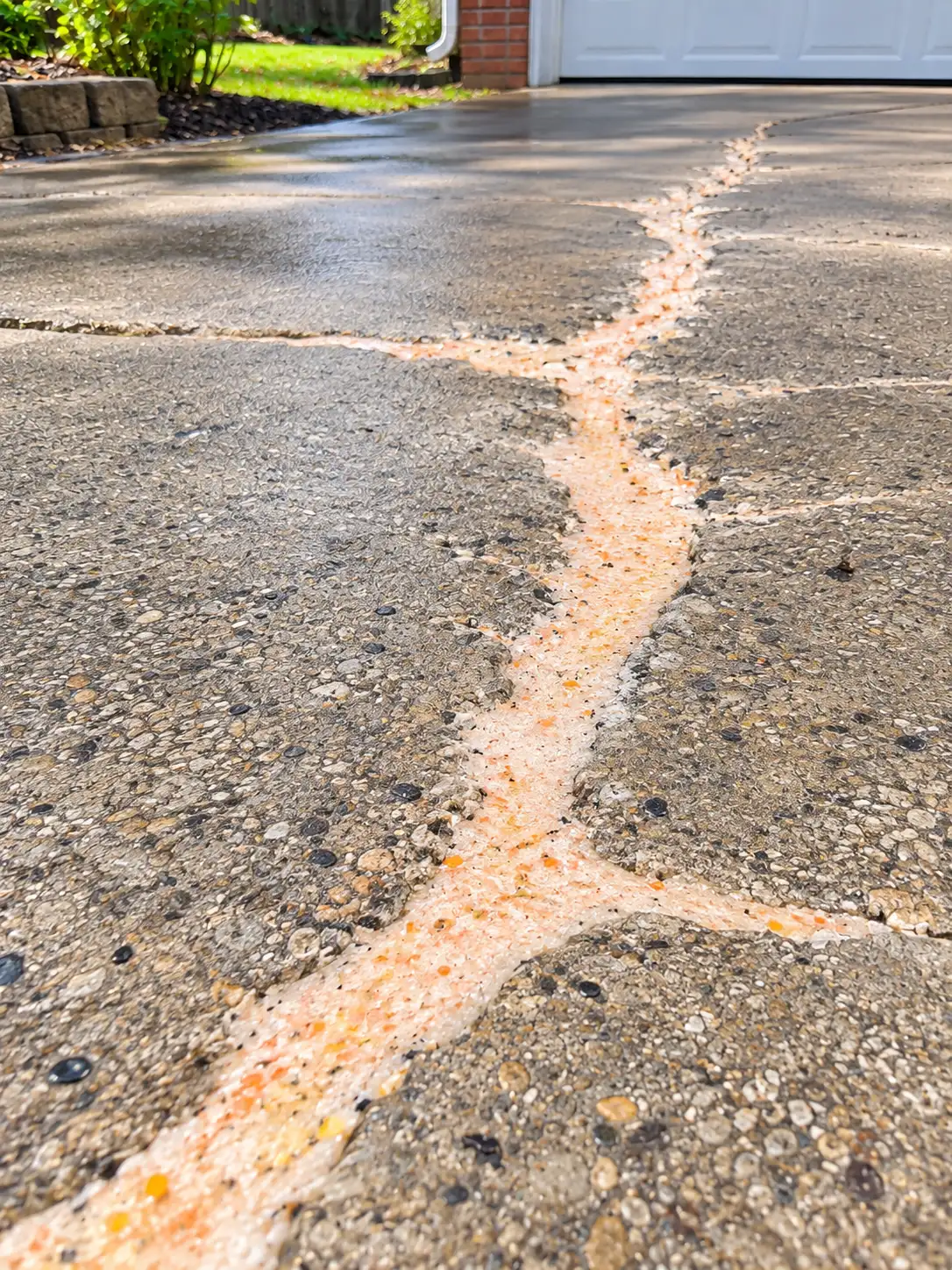
Every July, when the heat settles over the driveway and every little flaw in a slab of concrete seems to open up another hair, I start noticing cracks I ignored all winter. This year, after hearing one of those too-clever “home fix” notions floating around, I decided to try something frankly ridiculous: I filled the narrow gaps in my old concrete driveway with Fixodent denture cream and crushed Flintstones vitamins once each morning for 14 straight days. If you’re here because you’ve seen a similar claim and you’re wondering whether it works, I’ll save you some suspense: what happened was interesting, messy, a little expensive, and not at all a real repair.
I’ve spent enough years in a rural Midwestern kitchen and around an old farmhouse to know the difference between a thrifty trick and a waste of good money. Sometimes the oddball remedies surprise you. Sometimes they leave orange streaks on your concrete and teach you a lesson. I kept notes on temperature, texture, cost, smell, appearance, and what happened after sun, dew, and a light rain. Here’s exactly how I did it, what changed day by day, and what I’d tell any neighbor before they squeeze denture cream into a driveway crack.
1. Why I tried it in the first place
My driveway is an older poured concrete slab, likely close to 30 years old, with several surface cracks near the apron and two longer gaps running across a parking area where the sun beats down hardest from about 11 a.m. to 5 p.m. In July, those cracks looked especially dry and open, roughly 1/8 inch wide in the narrow spots and close to 1/4 inch in the widest points. None of them were deep structural canyons, but they were enough to catch grit, sprout weeds, and make the whole entrance look tired.
I’d heard the claim that denture adhesive could “bind” a crack and that vitamins would somehow harden it or add minerals. Now, I was skeptical from the first breath. Still, I’ve lived long enough to know some old-time experiments are worth trying once, if only so you stop wondering. My thinking was simple: I would test it on a limited section, measure the results with my own eyes, and not pretend nonsense is wisdom if it plainly isn’t.
2. The exact materials I used
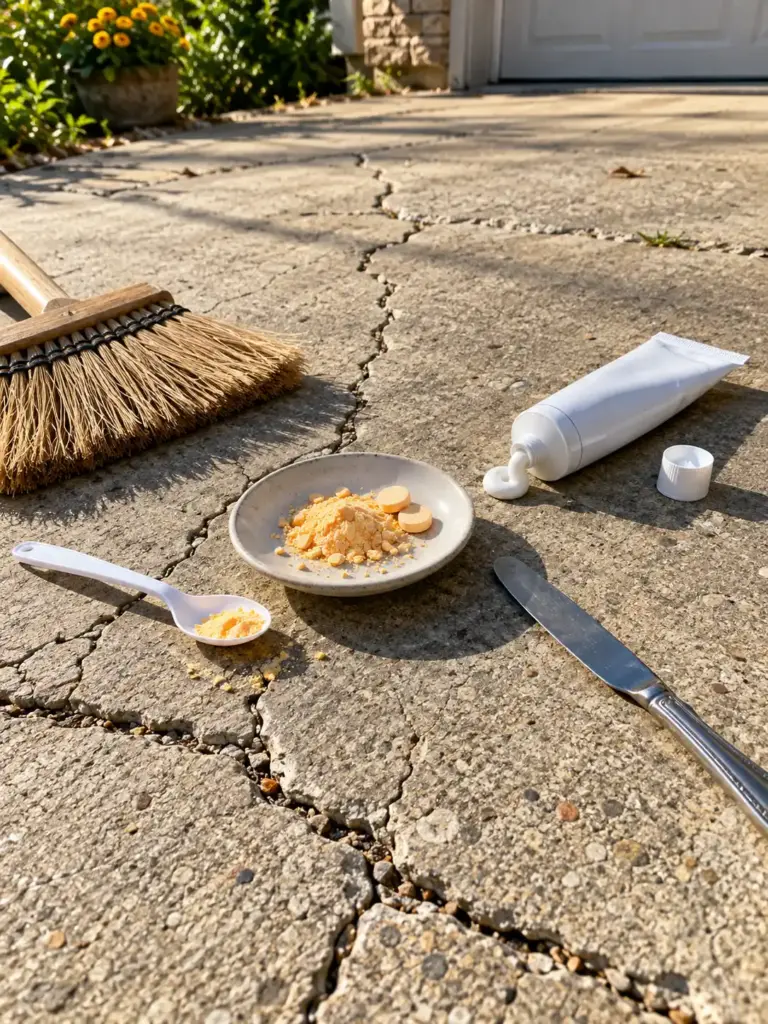
I used two 2.4-ounce tubes of Fixodent Original denture adhesive cream over the course of the experiment. At my local store, they were $5.79 each, so that part alone cost $11.58 before tax. For the vitamins, I used one 60-count bottle of Flintstones chewable vitamins, which cost $9.49. I crushed 2 to 4 tablets each morning with the bottom of a mason jar on a saucer until they became a coarse powder with a few stubborn granules.
I also used a whisk broom, an old butter knife, a plastic spoon, a shop brush, a dustpan, and about 2 cups of plain tap water total over the two weeks for light cleaning. The test area covered about 6 linear feet of crack. If anyone imagines this is a cheap substitute for proper crack filler, the numbers already tell another story. For less than the cost of this experiment, I could have bought a basic tube of concrete crack sealant made for outdoor use.
3. How I prepared the driveway section
Before starting on day 1, I swept the test cracks thoroughly and loosened packed dirt with the tip of the butter knife. I pulled out two tiny weeds, brushed away loose sand, and let the area dry completely. The morning temperature that first day was 74 degrees by 8 a.m., and the concrete was already warming up. By midafternoon, it reached 91 degrees.
I did not pressure wash the area, and that matters. A true repair needs a cleaner bond surface than what I used here. Still, I wanted to mimic what a typical person trying a “quick hack” might actually do. The crack edges were dry, dusty in spots, and slightly crumbly. In other words, a fair test for an everyday bad idea.
4. My 14-day routine, step by step
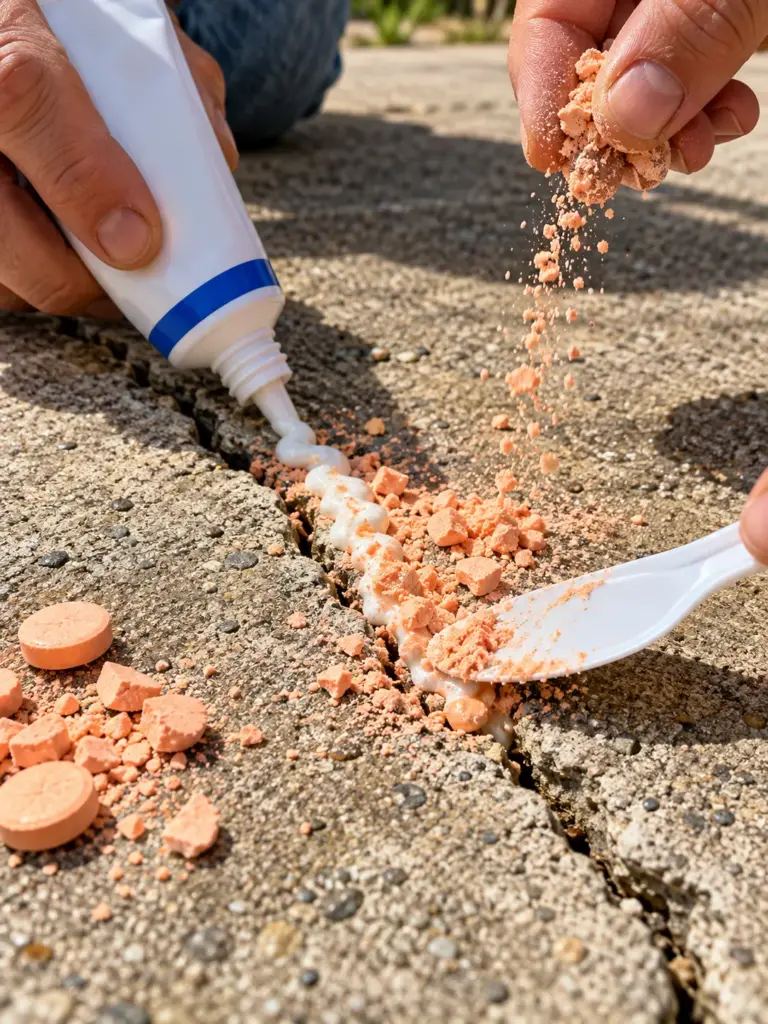
Each morning between 7:30 and 8:15, I swept the crack lightly, squeezed a narrow bead of Fixodent directly into the gap, and then sprinkled the crushed vitamin powder over the top. After that, I pressed the mixture down with the back of the plastic spoon or the butter knife so it sat a little below flush with the concrete surface. On the wider sections, I added a second dab of denture cream to help hold the powder in place.
On average, I used about 1 teaspoon of denture cream and 2 crushed vitamins per day for the full 6-foot section. On days 9 through 14, I used a bit more because some of the earlier material had shrunk or washed out, especially in the wider 1/4-inch portions. The whole process took 8 to 12 minutes each morning, not including the time spent crushing vitamins and washing my hands afterward.
5. What it looked like on day 1
Freshly applied, the mixture looked exactly like what it was: off-white paste dusted with chalky orange-yellow powder. Once pressed in, it resembled a weak frosting rubbed into a sidewalk seam by a distracted child. The denture cream itself had a smooth, slightly glossy finish at first, while the vitamins dulled the surface and gave it a grainy texture.
Within 2 hours of full sun, the material skinned over. It did not cure hard like masonry filler. Instead, it became tacky on the surface and rubbery underneath. When I touched a test dab at the edge with a twig around noon, it dragged and smeared rather than resisting pressure. That was my first clear sign that this was not setting up in any meaningful structural way.
6. What changed by days 3 through 5
By the third morning, the narrowest crack sections still looked partly filled, but the surface had sunken in by roughly 1/16 inch. The wider sections had tiny pull-away lines along the crack edges, meaning the material was shrinking and losing contact with the concrete. Some powder had blown loose and collected in pale orange dust along the side of the slab.
Days 4 and 5 were hotter, 88 to 93 degrees in the afternoon, and the driveway baked hard. That heat made the denture cream drier on top but still not truly hardened. In one section where a car tire rolled within 3 inches of the repair, the edge picked up grit and became dingy gray. It was beginning to look less like a filled crack and more like someone had spilled medicine and toothpaste and tried to tamp it in with a spoon.
7. What happened after a light rain and morning dew
On day 6, we had a light overnight rain, less than 1/4 inch, followed by heavy morning dew. That was the turning point. The material in the shallower portions turned soft again at the surface. The vitamin powder, which had given a false impression of body and bulk, turned pasty in places and vanished in others. A few little streaks of diluted orange washed 6 to 10 inches downhill across the concrete.
I’ve seen enough outdoor materials in my lifetime to know that water finds the truth quickly. Proper concrete patch products may need dry application conditions, but once cured, they belong outdoors. This mixture behaved like something that wanted to be in a bathroom cabinet, not out on a driveway under weather. After that damp morning, I had to refill nearly one-third of the test area.
8. The smell, texture, and general unpleasantness
Now this is the sort of detail people leave out when they’re trying to make a foolish trick sound clever. Denture cream has a clean medicinal smell indoors, but out in the heat, mixed with crushed vitamins and dust, it takes on a faintly sweet, stale odor. Not terrible, exactly, but odd enough that every time I stepped past it, I noticed. By day 7, the warmed-up patches had a gummy look that attracted fine debris.
The texture was worse than the smell. When dry, it was chalky on top and sticky just beneath. When damp, it got mushy. When pressed, it dragged. It never reached that reassuring firmness you want underfoot or under a broom. I would not want pets walking through it, and I certainly wouldn’t want children poking at it, because it looked too much like something between candy powder and caulk.
9. Whether it actually sealed the cracks
In the most generous possible sense, it temporarily masked a few of the narrowest surface gaps. If all you mean by “worked” is that for 24 to 48 hours a shallow crack looked less open from 10 feet away, then yes, it did something. But it did not seal against moisture in a durable way, did not bond strongly to the concrete edges, and did not remain stable under sun and dew.
I checked one section with the tip of a thin craft stick on day 10. The stick slipped under the edge of the filling and lifted a strip nearly 2 inches long. That told me water and grit could get underneath easily. In a real repair, that sort of edge failure is a dead end. Once the bond fails, the filler is only pretending to help.
10. The cosmetic result after 14 days
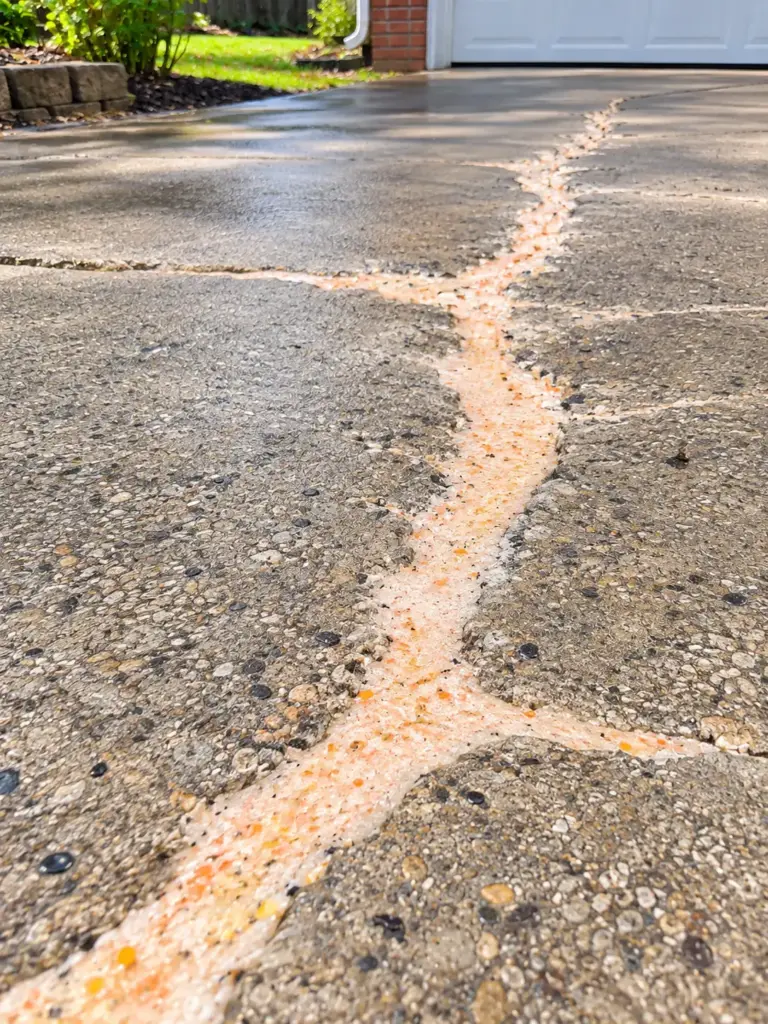
By the end of the full 14-day run, the driveway looked worse than when I started. I say that plainly. The original gray cracks had become a patchwork of pale residue, orange specks, dark dirt stuck to gummy sections, and uneven recessed spots where material had shrunk away. Instead of simple cracks, I now had cracks plus discoloration.
In two places, the vitamins left faint yellow-orange staining that took extra scrubbing to reduce. The concrete wasn’t ruined, but it certainly wasn’t improved. If a person hoped this would blend invisibly into a slab, that hope would dry up before the first week was over. Traditional concrete filler may not be glamorous, but at least it is designed to cure in a color family that makes sense.
11. The cost compared with doing it properly
All in, I spent a little over $21 before tax on the denture cream and vitamins. If I add my time at even a modest value, say 10 minutes a day for 14 days, that’s 140 minutes, or 2 hours and 20 minutes of fiddling. A decent bottle or tube of concrete crack sealant in many hardware stores runs roughly $8 to $15, with some better polyurethane or self-leveling products going higher depending on the size of the job.
For a 6-foot test crack like mine, one proper product and one careful application would likely have outperformed the entire two-week experiment at lower or similar cost. That’s the part my mother would have called “being penny-wise and foolish twice over.” There’s thrift, and then there’s paying retail price to learn what the label already knew.
12. What I learned about heat and July concrete
July is a hard month for makeshift repairs. My driveway surface was often hot to the touch by late morning, and the expansion and contraction between a coolish dawn and a hot afternoon likely worked against the mixture every single day. A material that softens, shrinks, or loses grip under heat simply has no business in a concrete joint exposed to direct sun.
I noticed the north-facing crack segment, which got partial shade after 2 p.m., held the mixture a little better than the south-facing portion. Even there, though, the improvement was only relative. “Less bad” is not the same as good. Outdoor repairs need weather resistance, adhesion, and flexibility where appropriate. This combination had none of those qualities in any reliable measure.
13. Was there any surprising benefit at all?
If I’m being charitable, the denture cream did momentarily hold loose dust and powder together, and the vitamins acted like a crude filler bulk. For a very brief time, the crack looked filled from a standing position. That is the only honest “benefit” I can report. It was visual, temporary, and superficial.
There was also one indirect advantage: the experiment forced me to inspect the driveway closely every day. I noticed where water was collecting, which crack was widening, and where weeds were most likely to return. In that sense, the silliness served a practical purpose. Sometimes a failed shortcut teaches you where the real problem begins.
14. How difficult cleanup was
Cleanup took more effort than application should ever require for something this ineffective. I scraped the remaining gummy material out with a plastic putty knife and stiff brush, then swept repeatedly. The dried residue clung in small patches, especially where the crack edges were rough. I used warm water and a little dish soap on a scrub brush for the stained spots, and even then, a trace of color remained until weathering faded it further.
If I had left it there much longer, I suspect more dirt would have embedded itself into the adhesive layer. That would have made the driveway look even more blotchy. Removing a failed patch is one thing. Removing a failed patch that also acts like flypaper for road dust is another annoyance entirely.
15. What I would do instead
If your concrete cracks are narrow, clean them well first. Use a shop vacuum if you have one, or at least a stiff brush and careful sweeping. Then use a crack filler or sealant made specifically for concrete. For hairline and small non-structural cracks, a masonry crack filler may be enough. For wider exterior joints, a self-leveling polyurethane sealant often performs better, especially where movement and weather are concerns. Follow the temperature recommendations on the label, because those are there for a reason.
If the cracks are widening, offset, or deeper than they appear, I’d have a contractor or at least a knowledgeable local concrete supplier advise you. In my part of the Midwest, freeze-thaw cycles can turn a little gap into a real headache in a season or two. A proper repair now is cheaper than replacing a section later. And unlike my vitamin-and-Fixodent detour, it gives you a result you don’t have to explain to visitors.
16. My final verdict after 14 days
No, Fixodent denture cream and crushed Flintstones vitamins did not repair my cracked July concrete driveway. They did not create a durable fill, did not stand up to heat and moisture, did not save money, and did not improve the appearance in any lasting way. What happened, in plain terms, is that I created a soft, shrinking, slightly sticky, oddly colored mess that had to be cleaned back out.
I don’t mind trying the occasional oddball idea, because every home and every family has its stories of making do. Goodness knows I was raised around plenty of practical improvising. But the best lessons from those days were never about pretending the wrong material was the right one. They were about using what works, taking care of what you own, and learning enough to tell folklore from fix. This one belongs squarely in the folklore pile.