If you have an older electric ice cream maker tucked on a basement shelf, stashed above the fridge, or buried behind holiday platters in a pantry cabinet, this is one of those “go check right now” situations. I’m usually the person telling friends not to panic and to verify the details first, but recalled countertop appliances are different, especially the ones with motor housings, overheating risks, cracked electrical parts, or paddle assemblies that can break during use. A lot of these frozen dessert machines were bought with the best intentions for summer birthdays and family cookouts, then quietly stored away for years. That’s exactly why they’re still sitting in so many American homes.
I’m writing this as someone who loves a homemade pint and also knows how easy it is to forget what’s in the back of the basement. In my house, appliance “storage” has a way of becoming appliance archaeology, and I’ve absolutely rediscovered gadgets I hadn’t touched in five or six years. Below, I’m walking through 11 types of recalled electric ice cream makers and frozen dessert churners the U.S. Consumer Product Safety Commission has flagged over time, plus how to identify a risky unit, what to do if you still own one, and how to replace it without wasting money or precious kitchen space.
1. Why old frozen dessert machines are still hanging around
Ice cream makers are classic occasional-use appliances. Unlike a toaster or coffee maker, they may only come out 3 to 10 times a year. That means a recalled unit can stay unnoticed for a very long time, especially if it was purchased 8, 10, or even 15 years ago and then moved from one house to another.
In a lot of Midwestern homes like mine, these machines end up in the basement because they’re bulky. A typical compressor-style machine can weigh 20 to 35 pounds, and even smaller canister-style electric churners take up the same footprint as a large slow cooker. Once they’re off the kitchen counter, they’re easy to forget. If the recall notice came out months or years after purchase, many owners never connected the dots.
2. The main hazards the CPSC usually flags on these devices
When a frozen dessert device is recalled, the issue is not usually about the ice cream itself. It’s generally about the machine’s electrical and mechanical components. The most common hazards include overheating motors, smoking or melting wiring, electrical shock risk, fire risk from internal components, and broken paddles or drive parts that can create sharp fragments.
Another issue is liquid intrusion. Ice cream makers deal with condensation, freezing bowls, salted ice, and wet countertops. If a unit has weak sealing around the motor base, moisture can eventually reach electrical parts. Even a small crack in a housing or switch assembly can matter. If a machine smells hot after 15 to 20 minutes of use, trips a breaker, sparks, or makes a grinding noise, stop immediately and unplug it.
3. The first one to worry about: older electric bucket-style ice cream makers with motor units mounted on top
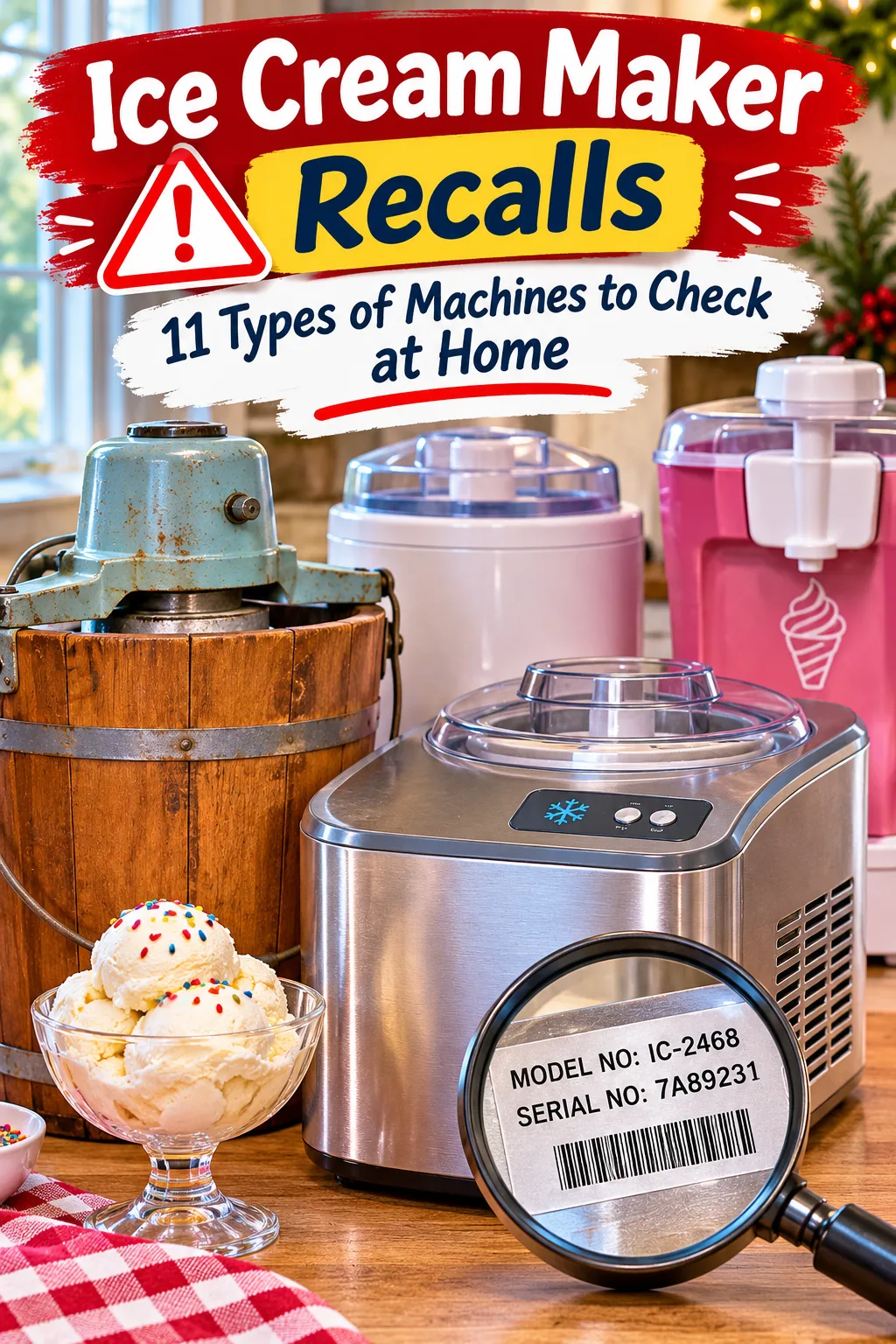
If I had to name the style most likely to still be sitting in American homes, it would be the old-fashioned electric bucket-style ice cream maker with a wood or wood-look tub, a metal canister in the middle, and a detachable motor on top. These were popular for family reunions, Fourth of July parties, and church picnics. They often made 4 to 6 quarts at a time and were sold for decades under multiple brand names.
Some recalled versions were flagged because the motor housing or wiring could overheat, while others had issues with extension cords, drive components, or assembly defects. These are the machines many people still keep “just in case” because they feel sturdy and nostalgic. Unfortunately, age does not make them safer. If yours has a removable top motor, exposed cord wear, rust near the switch, a brittle plastic connector, or no readable model label, it should not go back into service until you verify it against recall information.
4. Rival, White Mountain, and similar legacy-style churners deserve a careful label check
A huge number of older ice cream makers sold in the U.S. came from long-established brands or closely similar private-label versions. That’s why brand memory alone is not enough. You need the model number, approximate purchase year, and any serial or production code on the underside, motor cap, or product plate.
On older units, the label may be faded or partly peeled off. I’ve had luck using my phone flashlight at an angle and wiping the plate gently with a barely damp microfiber cloth. Do not scrub hard, because older paper-backed labels can disintegrate. Write down every number exactly as shown, including dashes and letters. Then compare it against official recall listings, not random marketplace posts or forum comments.
5. Compressor-style ice cream makers can be a bigger fire concern because they generate their own cold
Compressor models are convenient because you don’t need to pre-freeze a bowl for 12 to 24 hours, but they’re also more complex internally. They contain a refrigeration system, motor, controls, and wiring in one housing. That means more potential failure points if a recall was issued.
If you own a compressor machine that suddenly stopped freezing, made a loud buzzing sound, ran unusually hot on the sides, or produced a burnt-plastic smell, do not assume it’s just “old.” A 1- to 1.5-quart home compressor unit can draw several hundred watts while running. Any appliance with that kind of electrical load deserves caution. A recalled compressor-style machine should be unplugged, tagged, and kept out of reach until you complete the manufacturer’s remedy steps.
6. Soft-serve and gelato machines sold through big-box stores are easy to overlook
One reason recalled frozen dessert devices stay in homes is that people don’t think of them as “serious appliances.” Small soft-serve makers, frozen yogurt machines, and countertop gelato churners often look playful or seasonal. Some were sold under gift-oriented packaging, especially between May and August, and many ended up as wedding, graduation, or housewarming presents.
These units may have lower capacities, often 1 pint to 1.5 quarts, but the hazards can be just as real if the recall involved internal wiring, a switch defect, or a motor assembly issue. If yours was purchased from a warehouse club, department store, home goods chain, or online flash-sale site, look for archived order emails. Even a rough purchase window, like “summer 2017” or “holiday 2019,” can narrow down whether your machine falls inside a recall batch.
7. Replacement parts do not automatically make a recalled machine safe
This is a point I feel strongly about because so many of us were raised to fix things rather than toss them. I’m all for repairing a stand mixer or replacing a blender gasket. But with recalled electric ice cream makers, a homemade fix is not the same as an approved remedy.
If the CPSC notice says the manufacturer offered a refund, repair kit, replacement motor top, new cord, or full unit exchange, that specific remedy matters. Swapping in a generic cord, taping a cracked housing, or using a paddle from a different model does not address the original safety issue unless the manufacturer explicitly says it does. In some cases, owners were told to cut the power cord and submit photo proof before receiving a refund or replacement. Follow the published steps exactly.
8. How to identify your machine in 10 minutes
Set the machine on a clear surface with good light and do a quick checklist. First, find the brand and model number. Second, note the capacity, such as 1.5 quarts, 4 quarts, or 6 quarts. Third, locate any UL, ETL, CSA, or other certification markings. Fourth, inspect the cord from plug to housing for nicks, flattening, or discoloration. Fifth, check the switch, top motor assembly, and paddle connection points.
Then search the official CPSC recall database and the manufacturer’s website using the exact model number. If the label is unreadable, search by product style and compare photos carefully. Keep in mind that color changes matter. A machine sold in white in 2014 may be recalled while a nearly identical stainless version from 2018 may not be. Close is not close enough when safety is involved.
9. 11 categories of recalled frozen dessert devices to check for immediately
Because these products were sold under many brand names and product lines over the years, the fastest practical screening method is to check whether your machine fits one of these commonly recalled categories:
1) electric bucket-style 4-quart churners with top-mounted motors; 2) 6-quart party-size churners with extension cord or motor cap issues; 3) compressor-style 1- to 1.5-quart ice cream makers with overheating complaints; 4) gelato makers with cracked paddle-drive assemblies; 5) soft-serve countertop units with faulty switches; 6) frozen yogurt machines with liquid intrusion into the motor housing; 7) dual-bowl dessert makers with adapter or plug overheating; 8) private-label electric ice cream makers sold seasonally by chain retailers; 9) imported countertop churners with recalled power supplies; 10) older units with replacement motor tops later found defective; and 11) electric models bundled in holiday gift sets that lacked updated safety components.
This doesn’t mean every machine in those categories was recalled. It means every machine in those categories deserves a careful check against official notices. If your device fits one of these descriptions and you cannot positively rule it out, treat it cautiously.
10. What to do right now if you think yours is affected
First, unplug it if it is currently in use or stored within reach of an outlet. Second, do not “test it one last time.” Third, move it to a dry area where kids cannot access it. Fourth, photograph the front, the label, the plug, and any visible damage. Fifth, look up the recall and contact the manufacturer through the phone number, web form, or email listed in the official notice.
If the remedy requires disabling the unit, cut the cord only after you’ve read the instructions fully. Some manufacturers want a specific section of the cord visible in the photo, usually the plug end or a cut made within a few inches of the housing. If a refund or replacement is available, save screenshots of every step and note the date you submitted your claim. These processes can take 2 to 8 weeks depending on the company.
11. Signs a non-recalled machine is still unsafe to keep
Even if your exact model is not listed in a recall, there are cases where retirement is still the smartest move. I personally would stop using any electric frozen dessert machine that has a cord with exposed copper, a plug that feels loose in the outlet, visible melting, scorch marks, a switch that sticks, or a motor housing that gets too hot to touch comfortably after 20 minutes.
Other red flags include wobbling paddles, unusual metal-on-metal scraping, coolant-like odors in compressor models, repeated breaker trips, and cracking around screw points in the plastic housing. If replacement parts are unavailable and the unit is more than 10 years old, replacing it is often safer and less frustrating than trying to nurse it through one more summer.
12. Safe disposal matters more than most people think
Do not donate a recalled ice cream maker to a thrift store, list it for free online, or pass it along to a neighbor. That just moves the hazard to someone else’s kitchen. Follow the recall instructions first. If there is no active remedy and the manufacturer is out of business, disable the unit by cutting the cord, recycling eligible components where allowed, and disposing of the remainder according to your local waste guidelines.
For compressor models, check whether your municipality has special rules for small appliances containing refrigerants or sealed cooling systems. Many county recycling centers have designated drop-off days for e-waste or appliances. In my area, those events are usually once a month or once a quarter, and they’re worth the extra errand.
13. A practical replacement strategy if you still want homemade ice cream
If you use an ice cream maker fewer than 6 times a year, a modern freezer-bowl machine is often enough. These usually cost about $50 to $90, make 1.5 quarts, and store more easily. If you make frozen desserts twice a month during summer or like to batch for parties, a compressor model in the $200 to $350 range may be worth it because you can run multiple batches back to back.
Before buying, measure your storage shelf and your freezer clearance. A typical freezer bowl can be 7 to 8 inches tall and 8 to 9 inches wide, and it needs to sit level in the freezer for 12 to 24 hours. I always tell friends to decide where the machine will live before they click “buy,” because a safe, frequently used appliance beats a bulky impulse purchase every time.
14. My rule of thumb for basement appliances: if you forgot it existed, verify it before using it
This is the lesson I keep coming back to. Forgotten appliances are the exact ones most likely to miss safety updates, warranty notices, and recalls. If you find an old frozen dessert machine next to canning jars, extension cords, and coolers, don’t plug it in on nostalgia alone.
Take 10 to 15 minutes, look up the model, and make the call based on facts. Homemade ice cream is supposed to be fun. If the machine making it has a recall history, damaged wiring, or mystery parts, the safest choice is to let it go immediately and move on to something you can use with confidence.