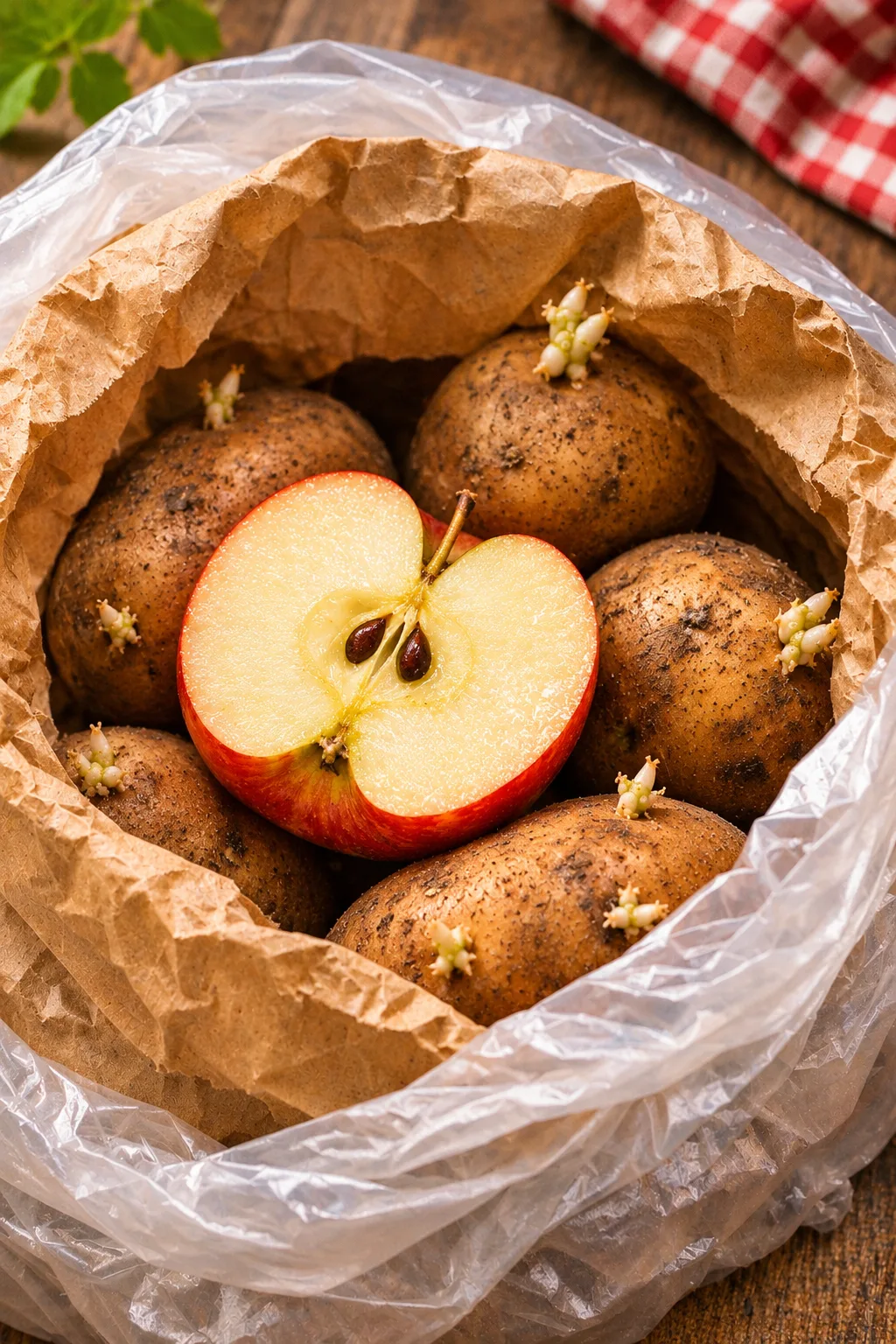
I’ve stored potatoes in one form or another for most of my life, from the old cellar shelves at my parents’ place to wire baskets in my own pantry, and I’m still tickled when a plain kitchen trick actually earns its keep. So when I tucked half an apple into a bag of raw potatoes and left it alone for 3 weeks, I wasn’t expecting magic exactly, but I was curious.
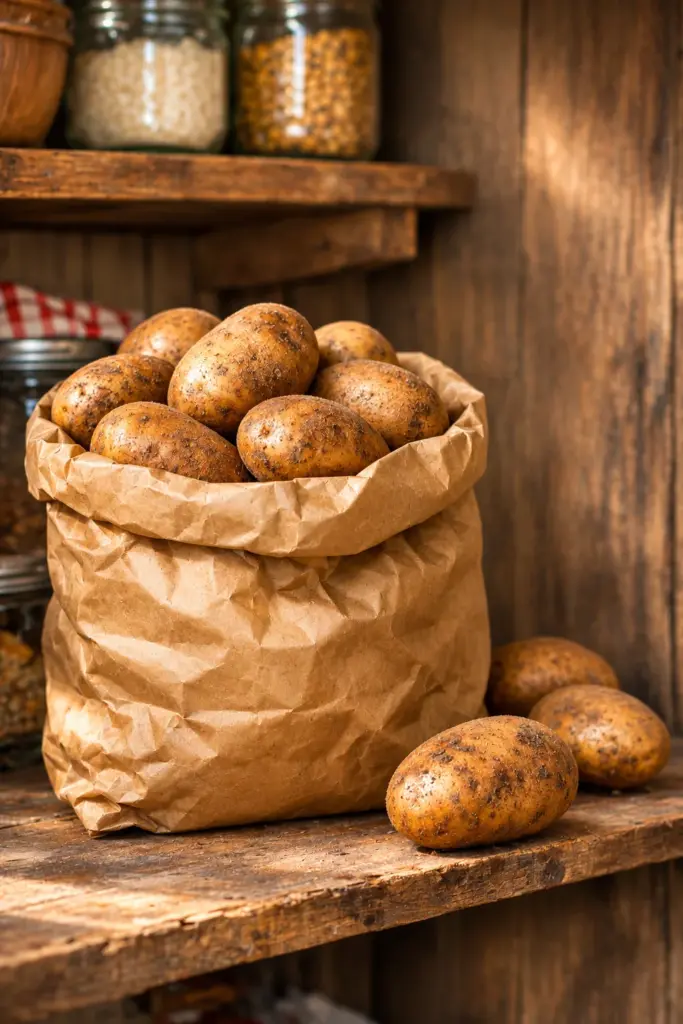
Potatoes have a way of humbling you: one week they’re firm and clean, and the next they’re sprouting like they’ve got plans of their own.
What happened after those 3 weeks was simple, practical, and worth knowing if you buy potatoes in 5- or 10-pound bags and hate waste. I’ll walk you through what I did, what I noticed day by day, why the apple seemed to make a difference, what it can and can’t do, and how I’d use this trick in a real Midwestern kitchen where we try our best not to throw out food that still has life in it.
1. Why I tried the apple-and-potato test in the first place
Where I live, I tend to buy potatoes in bigger bags because it makes sense for both budget and cooking. A 10-pound bag of russets is often cheaper per pound than buying just 2 or 3 loose potatoes, especially in fall and winter. The trouble is that potatoes don’t always keep as long as we hope, especially in a heated house where pantry temperatures can hover around 68 to 72 degrees Fahrenheit.
I’d heard for years that apples release ethylene gas, and that ethylene can affect nearby produce. Depending on the fruit or vegetable, that can be a blessing or a nuisance.
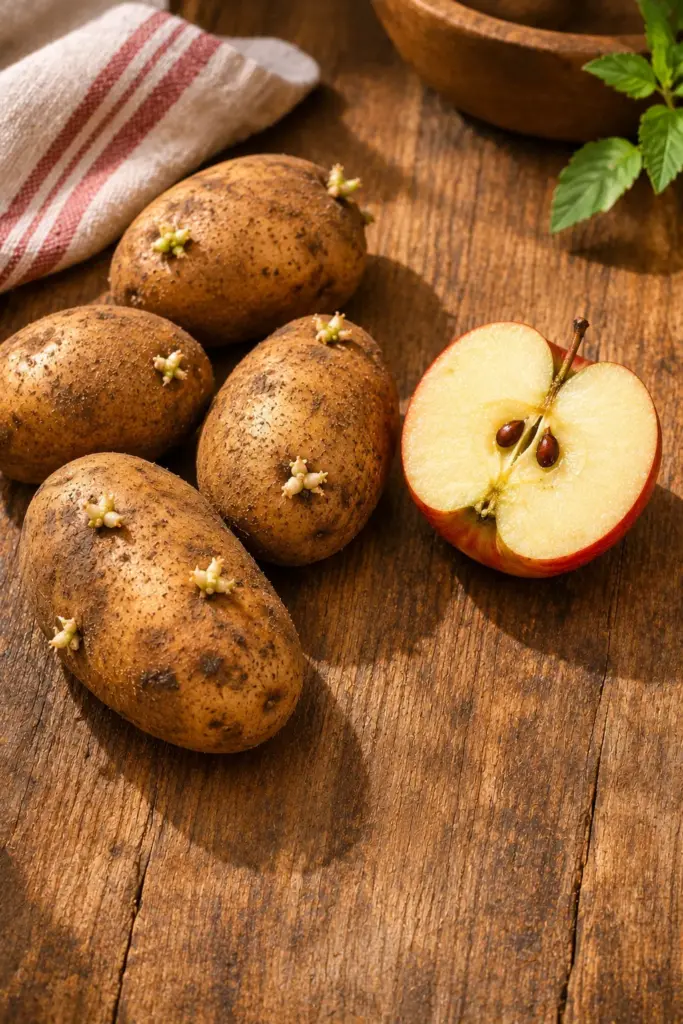
I wanted to see, in ordinary home conditions, whether half an apple in a potato bag would help keep the potatoes from drying out too fast, or whether it would speed up spoilage. I used what I had on hand and paid close attention.
2. Exactly how I set up the test
I started with about 6 pounds of raw russet potatoes in a brown paper sack set inside a loosely tied plastic grocery bag, which is fairly typical of how many folks end up storing them after a shopping trip. The potatoes were firm, medium to large, with smooth skins and no visible green patches. I added half of a medium apple, cut side exposed, about 3 inches across. It was a standard sweet apple from the grocery store, nothing fancy.
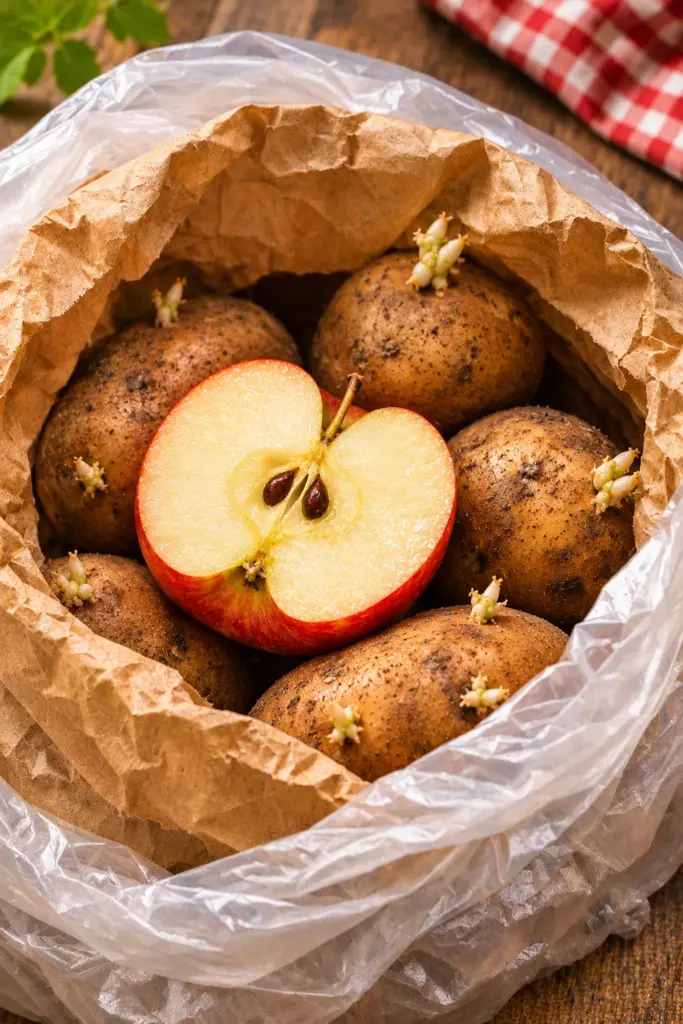
I kept the bag in a dark pantry corner away from the stove, but I won’t pretend it was ideal root-cellar storage. That pantry stayed around 64 to 69 degrees Fahrenheit most days. I checked the bag at the start, then lightly again around the 1-week mark, and more carefully at 3 weeks. I didn’t refrigerate anything, and I didn’t add paper towels or any other moisture control.
3. What the potatoes looked like at the beginning
At day 1, the potatoes were in good shape: tight skin, no soft spots, no sprouts longer than a pinhead, and no musty smell. If you’ve handled plenty of potatoes, you know the feel I mean. They were heavy for their size and not at all wrinkled. The apple half was fresh and juicy, with bright flesh and a clean scent.
This starting condition matters. If your potatoes already have soft patches, bruises, or active sprouts 1/4 inch long or more, an apple won’t rescue them. Storage tricks work best on produce that’s sound to begin with. It’s a little like canning jars: good results start with good ingredients, not with hope alone.
4. What I noticed after 1 week
At the 7-day mark, the apple half had browned on the cut surface, just as you’d expect, and it had started to soften. The potatoes still looked mostly unchanged. I didn’t see major sprouting, and they were still firm in the hand. The bag smelled faintly earthy with a light apple note, but nothing sour or unpleasant.
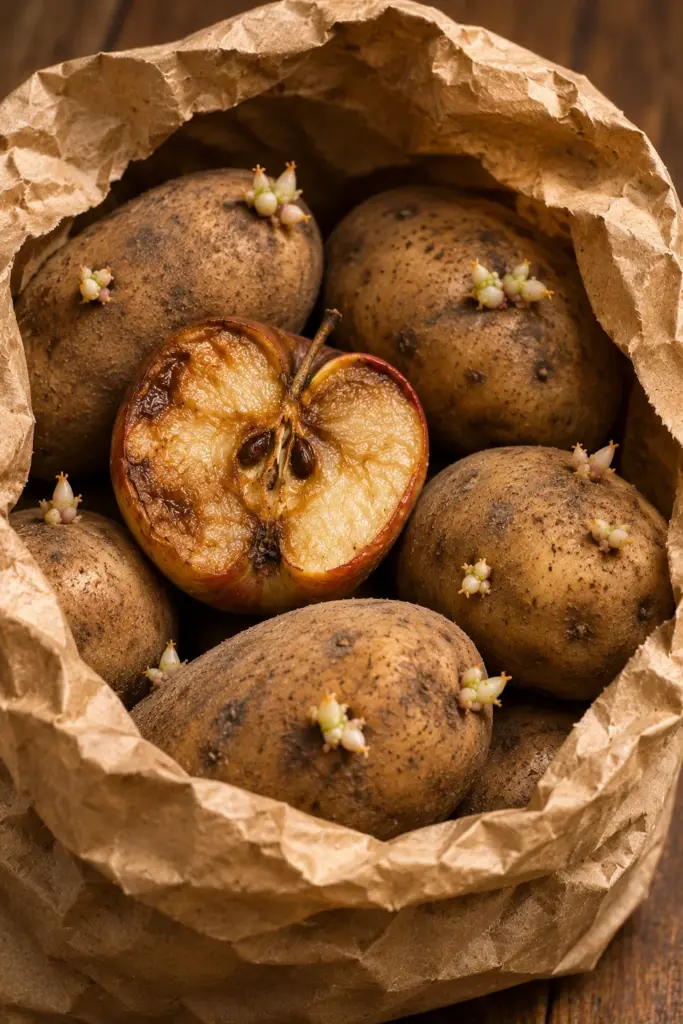
What did stand out was that the potatoes seemed a touch less dry than I expected for that room temperature. Usually, in a warm pantry, I start seeing a little skin dullness or the first signs of wrinkling by the end of a week or so, especially if indoor air is dry. This batch still looked nicely hydrated.
5. What happened after 3 weeks
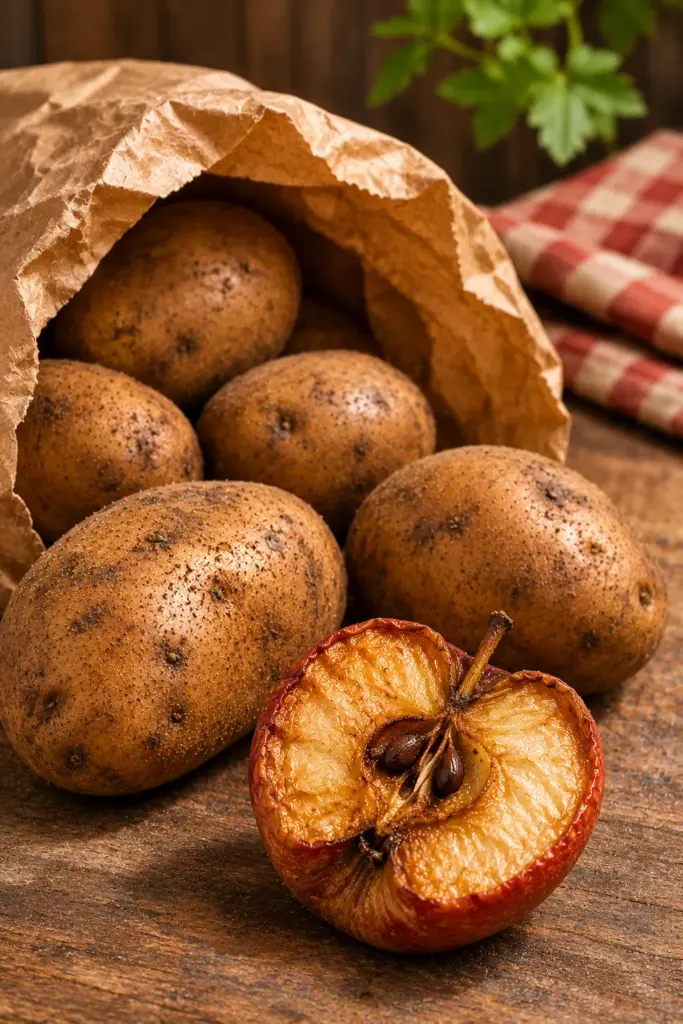
By the end of 3 weeks, the apple half had collapsed quite a bit. It was soft, shrunken, and brown, and it was no longer something you’d want to eat. But the potatoes were the real story. They were still surprisingly firm, and they had fewer and smaller sprouts than I often see under similar pantry conditions without the apple.
Most of them had only tiny eyes beginning to wake up, with sprouts well under 1/8 inch. I found very little shriveling. There was no widespread rot, and only 1 potato in the whole batch had a slightly softened bruise spot about the size of a nickel. Compared with plenty of bags I’ve opened after 3 weeks, this was better than average. Not perfect, but clearly useful.
6. My honest conclusion: the apple seemed to help moisture more than anything else
If you were hoping for a miracle that stops time, this isn’t that. Potatoes are living things, and they continue to age after harvest. But in my kitchen, the apple appeared to help the potatoes stay plumper and less wrinkled over those 3 weeks. My best plainspoken read is that the apple contributed a little moisture to the enclosed environment, which kept the potatoes from drying out so quickly.
I would not say the apple made the potatoes last forever, and I would not promise it will stop sprouting in every home. In fact, depending on the variety of potato, the apple type, and your storage temperature, results may vary. But in this test, I ended up with potatoes that were still very usable for frying, baking, mashing, and soup.
7. The science behind it in simple kitchen terms
Apples release ethylene gas as they ripen. Ethylene is a natural plant hormone, and even tiny amounts can influence nearby produce. Potatoes are a little tricky in this regard because ethylene can affect sprouting and sugar development, but storage conditions matter a great deal. Temperature, airflow, humidity, and how tightly things are packed can change the outcome.
There’s also the moisture factor. A cut apple gives off both aroma and water as it breaks down. Inside a bag, that can create a slightly more humid little pocket than dry pantry air alone. Potatoes stored too dry can wrinkle and lose firmness. Potatoes stored too damp can rot. That’s why this trick may work best as a short-term helper, not a long-haul storage method for months on end.
8. What can go wrong if you leave the apple too long
Here’s the caution I’d give my own grandchildren: don’t toss in half an apple and forget about it for 6 or 8 weeks. By then, the apple can become a sticky, mold-prone mess, especially if your pantry runs warm, say 70 degrees Fahrenheit or higher. Excess moisture plus declining airflow is exactly how you invite spoilage.
If you want to try this method, I’d check the bag once a week. Remove the apple if it shows visible mold, leaking juice, or a fermented smell. A browned, softened apple is one thing. Fuzzy mold or wet rot is another. Potatoes absorb odors more than people realize, and once decay gets going in a closed bag, it can spread quicker than you’d like.
9. The best kind of bag and storage spot to use
In my experience, potatoes do best in a breathable container: paper sacks, burlap, cardboard boxes with holes, or open-weave baskets lined with newspaper. A fully sealed plastic bag traps too much moisture. That can turn a helpful idea into a swampy one in a hurry.
The ideal storage temperature for potatoes is around 45 to 50 degrees Fahrenheit, in the dark, with decent airflow. Most modern kitchens are warmer than that, so we make do. If your home has a basement, enclosed porch that stays above freezing, or a cool mudroom, those are often better than the cabinet beside the oven. Darkness matters too, because light encourages greening, and green potatoes can develop solanine, which you don’t want to eat.
10. Which potatoes are most likely to benefit from this trick
I think this trick is most useful for starchy potatoes like russets when you plan to use them within 2 to 4 weeks. They’re common, affordable, and they can start looking tired if your pantry air is dry. Yukon Golds may also do well, though I’ve found waxier potatoes sometimes hold themselves a little better to begin with.
If you’ve bought 3 pounds for immediate use, you probably don’t need any special trick at all. But if you’ve got 5, 8, or 10 pounds sitting there and you know you’ll be cooking baked potatoes one week, potato soup the next, and hash browns after that, this is where a little storage help can be worthwhile.
11. Which potatoes should be discarded no matter what trick you use
I’m thrifty by nature, but I’m not reckless. If a potato is deeply green, smells bitter or off, leaks liquid, or has soft, sunken spots larger than a quarter, I throw it out. If sprouts are small, you can trim them off and use the potato if the flesh is still firm. But if the whole potato has gone rubbery and the sprouts are long and tangled, it’s past its best.
A cut apple won’t make unsafe potatoes safe again. It’s only a storage aid. Always sort the bag before cooking. One bad potato really can affect the rest, especially in a closed space.
12. How I’d use this trick in a real working kitchen
If I bring home a 10-pound bag in November, I’d first remove any bruised potato and set it aside to use within 2 or 3 days. Then I’d put the rest in a paper bag or shallow box, add half an apple if the house is dry, and store it in the coolest dark place I have. I’d plan to use the bag within 3 weeks, checking it every 7 days.
That’s the practical rhythm of it. Not glamorous, just sensible. Good baked potatoes might use 4 large russets, a pot of chowder might take another 1 1/2 pounds, and a Sunday roast supper with mashed potatoes can finish off 2 more pounds before anything has time to get questionable.
13. A few better companions for potatoes than onions
One thing I’d mention, since kitchen storage habits get passed down every which way, is this: don’t store potatoes with onions. I know many of us grew up seeing them side by side in bins, but onions release moisture and gases that can speed spoilage in potatoes, and vice versa. They’re better stored separately.
If you want to improve potato life, focus on darkness, cool temperature, airflow, and weekly sorting. The apple trick can be one extra tool, but it shouldn’t replace the basics. Think of it as a nudge in the right direction, not the whole answer.
14. My final verdict after 3 weeks
So what happened 3 weeks later? In my pantry, the potatoes stayed firmer, showed less shriveling, and had only minimal sprouting compared with what I often see under the same conditions. The apple itself deteriorated, of course, but it seemed to create just enough of a kinder environment for the potatoes to hold steady a while longer.
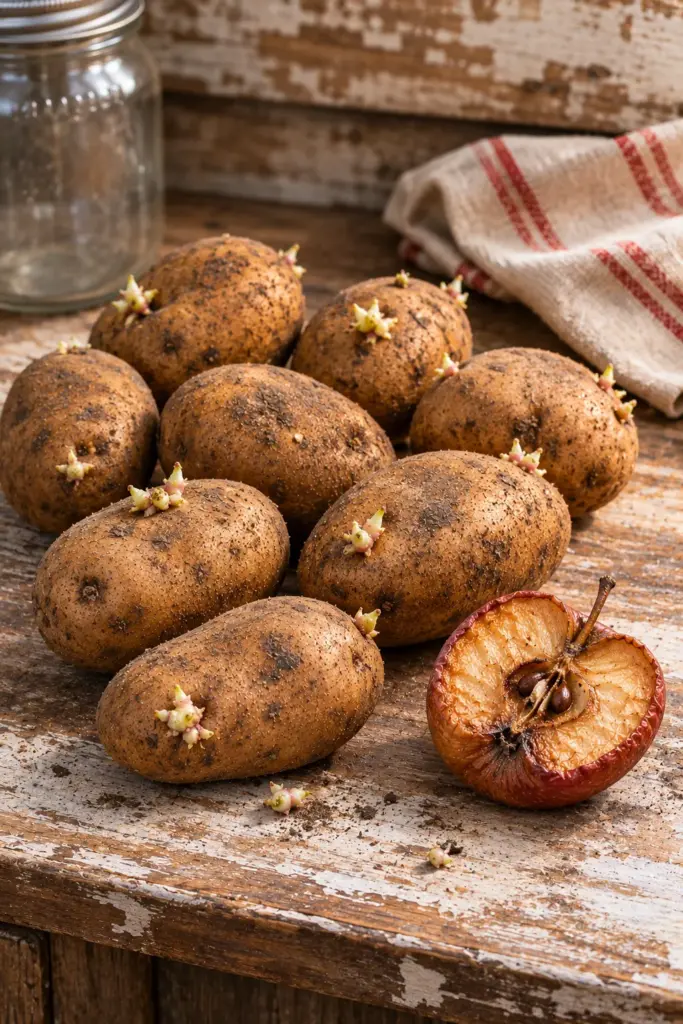
Would I do it again? Yes, for short-term storage, especially in winter when indoor air gets dry from the furnace running day and night. It’s a small, old-fashioned kind of trick, the sort of thing a person learns by trying, observing, and not being too proud to admit that sometimes half an apple can teach you something useful about a bag of potatoes.