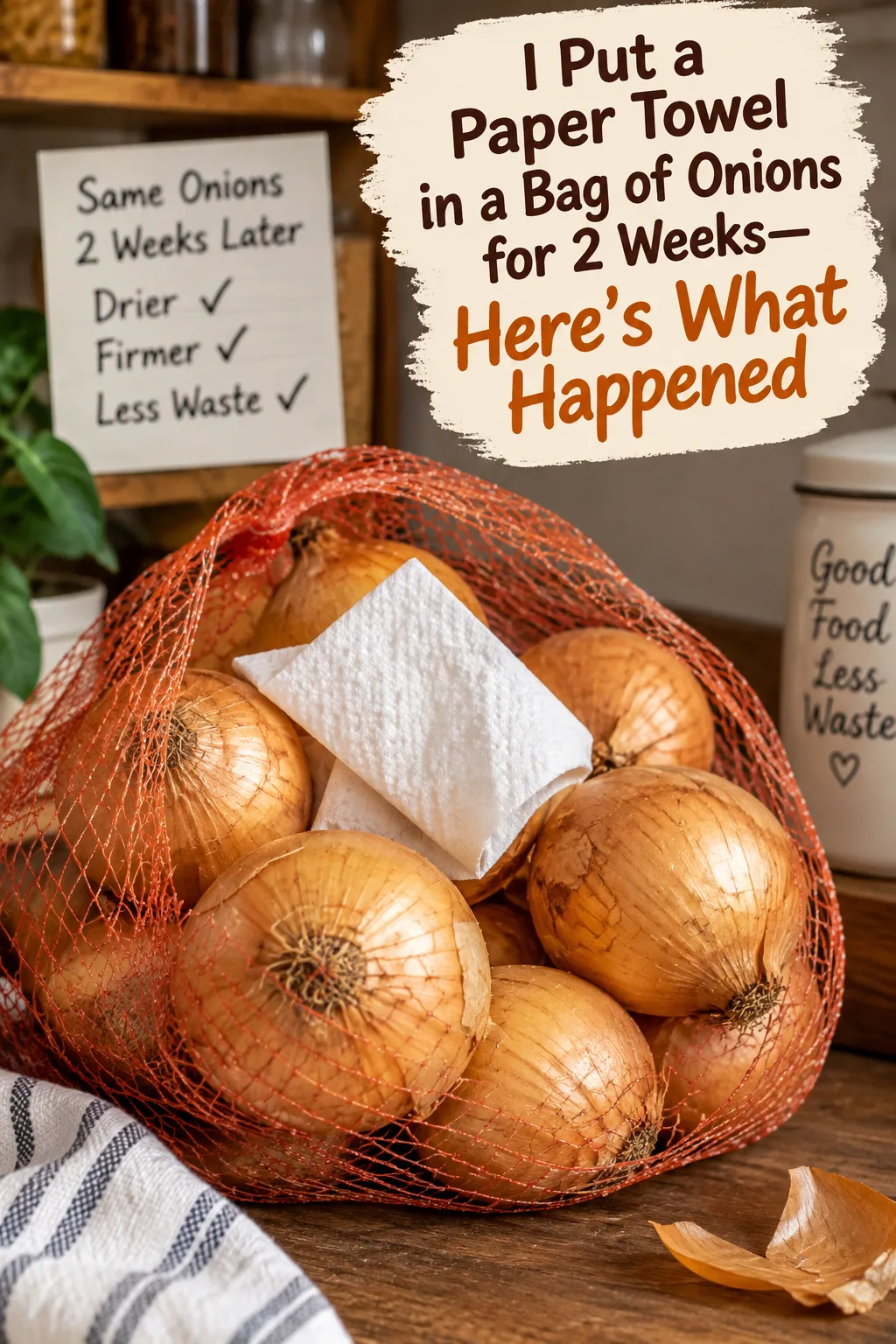
I am always looking for small kitchen habits that save money, reduce waste, and make weeknight cooking easier, especially with ingredients I use constantly. Onions are one of those staples in my kitchen. I buy yellow onions in 3-pound or 5-pound bags almost every week, and more than once I have reached into the pantry only to find one soft onion leaking onto the others. So I decided to try a very simple experiment: I placed a plain paper towel in the bag with a fresh batch of onions and left them alone for 2 weeks.
The result was more interesting than I expected. The onions stayed noticeably drier, firmer, and cleaner than they usually do, but the paper towel was not some miracle cure on its own. What happened had everything to do with moisture, airflow, and how onions naturally age in storage. Here is exactly what I noticed, why I think it worked, where this trick helps, where it does not, and how I would use it again if I wanted my onions to last longer without fuss.
1. What I started with
I began with a 3-pound mesh bag of yellow onions from a neighborhood grocery store, 8 medium onions total. Each onion was about the size of a tennis ball, with dry papery skins, no visible mold, and no soft spots at the time I bought them. I used one standard white paper towel, folded once, and tucked it loosely into the bag rather than wrapping the onions individually.
I stored the bag in my pantry on a lower shelf where the temperature usually sits between 62 and 68 degrees Fahrenheit. The shelf is dark most of the day and is not directly beside the oven, dishwasher, or any heating vent. That matters more than people think. Onions do best in a cool, dark, dry place with decent airflow.
2. What I saw after 2 weeks
After 14 days, the biggest difference was dryness. The outer skins still felt crisp instead of slightly tacky. The bottoms of the onions, where moisture often seems to collect, were dry to the touch. I did not see any wet spots in the bag, and there was none of that slightly sour, stale onion smell that can build up when one onion starts to deteriorate.
The paper towel itself had changed. It was no longer perfectly crisp. It felt a little soft, especially along the folds, which told me it had absorbed some ambient moisture. It was not soaked, and it did not smell bad, but it clearly was doing something. Of the 8 onions, 7 remained in excellent shape. One had begun to soften very slightly near the neck, but it was still usable and had no mold.
3. Why the paper towel seems to help
In my experience, the towel works as a moisture buffer. Onions naturally release a little moisture as they sit, especially if they were recently harvested, transported in fluctuating temperatures, or handled roughly enough to create tiny bruises. That extra humidity can get trapped in a bag, particularly if the onions are crowded together.
A paper towel cannot stop spoilage, but it can absorb condensation and surface dampness before it lingers. That is important because moisture is what turns a dry storage environment into a friendly place for mold and soft rot. Think of the towel as cheap insurance. It helps keep the microclimate around the onions a bit drier, and dry is what you want.
4. The biggest benefit was slowing the chain reaction
When onions spoil, they rarely do it politely and in isolation. One onion softens, then leaks, then presses against the others, and suddenly the whole bag goes downhill faster than it should. I have had bags where 2 bad onions took 4 healthy ones with them in less than a week.
That did not happen this time. I suspect the paper towel helped by catching some of the moisture that otherwise would have sat on the onions or at the bottom of the bag. Less dampness means less transfer from one onion to the next. It is not dramatic, but in a practical kitchen sense, preventing one bad onion from affecting the whole bag is a meaningful win.
5. The bag itself made a difference too
I would not give all the credit to the paper towel. My onions were in a mesh bag, and mesh allows much better airflow than sealed plastic. If you put a paper towel into a tightly closed plastic bag and leave onions there for 2 weeks, you are still likely to trap too much humidity.
If your onions come home in plastic, I strongly recommend moving them. A wire basket, mesh produce bag, paper sack with the top loosely folded, or even a cardboard tray works better than sealed plastic. The paper towel trick is most effective when it supports good storage, not when it tries to fix bad storage.
6. Which onions respond best to this trick
Yellow onions and white onions are the best candidates because they are usually cured for storage and tend to have lower moisture than sweet onions. Red onions can also do reasonably well. In my kitchen, standard yellow storage onions are the most forgiving and often last 3 to 5 weeks if I store them properly.
Sweet onions, including Vidalia-style onions, are another story. They have higher water content and generally a shorter shelf life. A paper towel may still help with excess moisture, but it will not turn a sweet onion into a long-storage onion. If I buy sweet onions, I plan to use them within 7 to 10 days, sometimes sooner in summer.
7. What this trick does not fix
If an onion is already bruised, cut, moldy, or starting to rot internally, a paper towel will not rescue it. It may slow visible mess in the bag, but the onion is still on its way out. The same goes for onions stored too warm. If your kitchen is consistently 75 degrees Fahrenheit or higher, shelf life will shorten no matter what.
It also does not replace regular checking. I still like to inspect onions every 5 to 7 days. I give the bag a quick look and gently press for soft spots. If one onion feels spongy or smells unusually strong, I pull it out and use it immediately if it is still sound inside. If not, out it goes. Vigilance saves more onions than any trick.
8. The best way to set it up
If I were advising a friend to try this, I would keep it simple. Start with dry, unpeeled onions. Remove any that already have cuts, mushy spots, or visible black mold around the neck. Place the onions in a breathable container, then add 1 or 2 plain paper towels depending on quantity. For a 3-pound bag, 1 towel is enough. For a 5-pound bag with 10 to 12 onions, I would use 2.
Tuck the towel along the side or bottom rather than wrapping every onion. You want airflow around the whole batch. Store the bag in darkness at roughly 45 to 70 degrees Fahrenheit, with lower humidity if possible. And keep onions away from direct sunlight, under-sink cabinets, and spots beside the stove.
9. Why onions and potatoes should not be stored together
This is one of those old kitchen habits that seems convenient but usually causes trouble. Potatoes release moisture and gases as they age, and onions do the same. Stored side by side, they can speed each other’s spoilage. In my pantry, I keep potatoes in one ventilated bin and onions on a completely different shelf about 3 feet away.
If you are using the paper towel trick but still storing onions next to potatoes, you may not see much benefit. Separation matters. The same is true for storing onions near apples or other produce that gives off ethylene gas. Onions are hardy, but they are not immune to the company they keep.
10. Signs your onions are still good
A good storage onion should feel heavy for its size, firm all over, and dry on the outside. The skin may loosen a bit, and that is fine. A little sprouting at the top does not automatically mean the onion is bad either. If the onion is still firm and not moldy, I usually peel away the sprouted center and use the rest in soups, sautés, or roasted dishes.
Warning signs are softness, wet patches, a fermented or sour smell, dark mold near the stem, or liquid seepage. If you cut into an onion and the layers are translucent, slimy, or brown in an unpleasant way, discard it. A paper towel can help maintain quality, but common sense still has the final word.
11. My favorite onion storage upgrades beyond the paper towel
The paper towel is useful, but I have found a few other low-effort improvements that matter just as much. First, do not overbuy unless you cook onions constantly. A 3-pound bag is realistic for many households; a 10-pound sack only makes sense if you truly use that many in 2 to 4 weeks.
Second, rotate the bag once or twice a week. I simply shift the onions around so the same ones are not always sitting at the bottom. Third, do not wash onions before storing them. Any added moisture shortens shelf life. And if one onion loses its outer skin and looks exposed, I use that one first rather than leaving it in storage.
12. How this compares with other produce-saving tricks
I use paper towels with several kinds of produce, but not in exactly the same way. For salad greens, a paper towel in a container absorbs excess moisture and can extend freshness by several days. For herbs, I often wrap them loosely in a barely damp towel. For onions, though, the goal is the opposite: keep things dry, not moist.
That distinction is worth remembering. Produce storage is all about matching the method to the ingredient. Onions want darkness, ventilation, and low humidity. Mushrooms want breathability. Lettuce wants moisture control without drying out. Once you understand that each ingredient has its own storage logic, small tricks like this become much more effective.
13. The cost savings are real, even if the trick is modest
One onion may cost only 60 cents to $1 depending on season and store, so it is easy to shrug off a spoiled one. But if you throw away 2 onions from every bag, week after week, that adds up. Over 6 months, even a modest reduction in waste can save $20 to $40 for a regular home cook, and that is from one ingredient alone.
What I appreciate most is not just the money. It is the convenience. When I am making chili, a pot roast, fajitas, or a quick pasta sauce on a Tuesday night, I want to reach for an onion and know it is usable. Anything that makes that more likely earns a place in my routine.
14. My final verdict after 2 weeks
So what happened 2 weeks later? My onions were in better shape than usual: firmer, drier, and less prone to that damp, beginning-to-spoil feeling that often shows up in a crowded bag. The paper towel had absorbed enough moisture to prove the idea has merit, and I will absolutely do it again, especially with store-bought bags that I know I will not finish in under a week.
That said, I would call this a helpful storage habit, not a miracle hack. The real formula is fresh onions + breathable storage + cool darkness + occasional checking. Add a paper towel to that setup, and you have a simple, inexpensive way to tilt the odds in your favor. In a busy kitchen, that is often exactly the kind of trick worth keeping.