
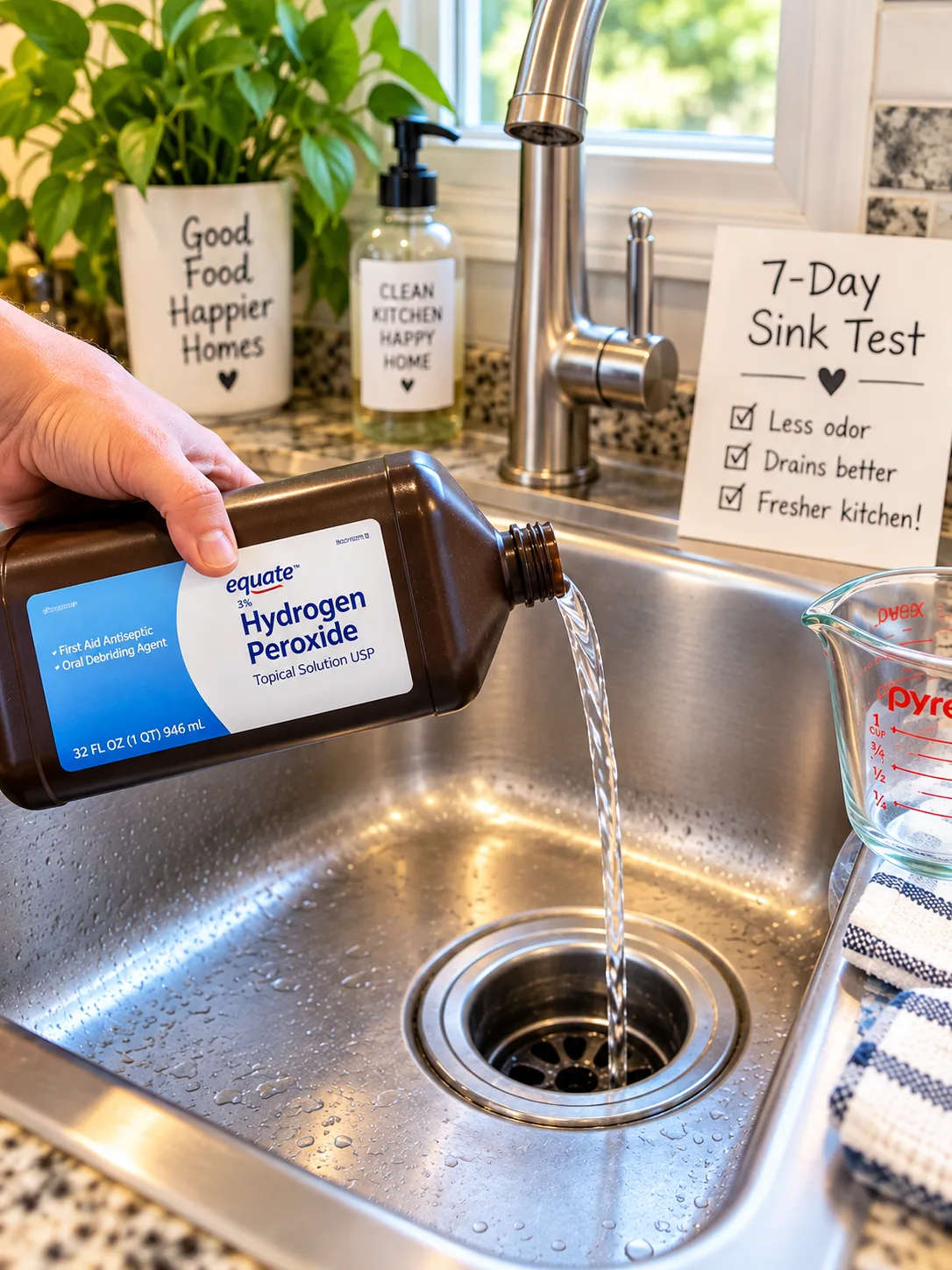
Every September, when the weather starts to tip from sticky summer into soup-and-casserole season here in the Midwest, I get into one of my annual “let’s get the house back in order” moods. This year, one little project kept nagging at me every time I washed supper dishes: my kitchen sink drain had started smelling a bit musty and sour, and it was draining just slowly enough to be annoying. Not a full clog, but enough that I noticed standing water around the strainer after spaghetti night. So I decided to try something simple and inexpensive: I poured 1 cup of basic 3% store-bought hydrogen peroxide down the kitchen sink drain every night for 7 days.
After a week, I had some very clear results, a few surprises, and a couple lessons I’d absolutely pass along before anyone else tries it. I’m going to walk you through exactly what I did, what changed day by day, what did not change, how much it cost me, and where hydrogen peroxide fits in compared with hot water, baking soda, dish soap, plunging, and the old-fashioned habit of not letting grease go down the drain in the first place.
1. Why I tried hydrogen peroxide in the first place
My kitchen sink wasn’t in disaster shape. It was what I’d call “family kitchen normal but heading the wrong direction.” We cook at home most nights, and that means a lot of little drain offenders: skillet drippings that someone swears got wiped out, bits of rice, creamy soup residue, coffee grounds that should have gone in the trash, and that invisible film that seems to build up no matter how careful you are.
I wanted something cheap, easy, and already available at the grocery store or pharmacy. A 32-ounce bottle of 3% hydrogen peroxide at my local store was just a couple dollars, which made this feel like a low-risk experiment. I also liked that it wasn’t a heavy chemical drain opener. I was not trying to dissolve a major blockage with harsh products; I was trying to freshen and possibly loosen the light gunk that causes odor and sluggish draining.
2. Exactly what I used and how I did it
I used plain 3% hydrogen peroxide from a brown bottle, the ordinary first-aid kind. No special additives, no industrial-strength formula. Each night for 7 nights, I measured out 1 cup and poured it slowly right into the kitchen sink drain after the sink had been mostly unused for the evening.
I did this around 9:00 p.m. most nights, after dinner cleanup, so the peroxide could sit in the drain and trap area for several hours. I did not run the water afterward. I simply let it work overnight. In the morning, I usually ran warm to hot tap water for about 30 to 45 seconds when I started breakfast dishes.
One important detail: I did not combine it with vinegar in the drain at the same time, and I did not use any commercial drain cleaner during that week. I wanted to see what hydrogen peroxide alone would do without muddying the results.
3. What my drain was like before day 1
Before I started, I paid attention for 2 days so I’d have a fair comparison. Water drained, but not quickly. If I emptied a large mixing bowl or a pasta pot, I’d see water hover in the sink basin for roughly 8 to 12 seconds before fully clearing. That may not sound terrible, but in a busy kitchen, it’s noticeable.
The smell was the bigger issue. It wasn’t sewer gas, and it wasn’t overpowering. It was more of a stale, sour odor that showed up strongest when I first turned on warm water or when the kitchen had been closed up overnight. If you’ve ever had a drain that smells like old dishwater and forgotten onion peels, you know the one.
4. What happened on nights 1 and 2
The first thing I noticed was a light fizzing sound. It wasn’t dramatic, and there was no bubbling volcano situation, but I could hear a faint activity down in the drain for a short while after pouring. That told me it was reacting with whatever residue was in there.
By the morning after night 1, the smell seemed a little less sharp. Not gone, but softer. After night 2, I noticed the sink seemed to clear a bit faster after rinsing cereal bowls and my coffee mug. I would call it a small improvement, not a miracle. If I had been expecting one cup of peroxide to magically fix years of kitchen drain buildup, I’d have been disappointed. But as a gradual cleaner-fresher, it showed promise early.
5. What changed by the middle of the week
By days 3 and 4, the odor reduction was the most obvious result. When I walked into the kitchen first thing in the morning, I no longer caught that stale drain smell unless I put my face fairly close to the sink. For me, that alone made the experiment feel worthwhile.
The draining also improved, though modestly. That same large-bowl pour-out that had been taking around 8 to 12 seconds to fully clear was now more in the 5 to 7 second range. Again, this was not a clogged-drain rescue. It was more like the drain had lost some of its sticky internal coating and was moving water more freely.
6. What happened by day 7
At the end of the week, the sink drain smelled noticeably cleaner. I’d estimate the odor was reduced by about 75% to 85%. It didn’t have that “perfumed clean” smell some chemical products leave behind. It just smelled neutral, which is what I want in a kitchen.
Drain speed improved, too, but not perfectly. By day 7, standing water still appeared briefly when I drained something large, but it cleared faster and with less gurgling. I’d say performance improved about 25% to 30%. In plain terms: enough to notice, not enough to call it a total fix if you have a true clog forming deeper in the line.
7. What hydrogen peroxide helped with best
In my experience, hydrogen peroxide was best at freshening the drain and helping with light organic buildup. Kitchen drains collect a film from food residue, grease traces, dairy, starches, and soap scum. Peroxide seems most useful when the problem lives in that category: funk, slime, and minor sluggishness.
If your sink has a disposal, there may also be bits of food clinging in places regular rinsing doesn’t reach well. If you do not have a disposal, like me, buildup often settles in the trap and upper pipe walls. In both cases, a gentle oxidizer like peroxide can help clean things up a bit over time.
8. What it did not do
It did not blast away a serious clog. I want to be very clear about that. If your kitchen sink is backing up into both basins, draining over several minutes instead of seconds, or gurgling because of a deeper blockage in the line, 1 cup of 3% hydrogen peroxide each night is probably not going to solve your problem.
It also did not remove the need for basic sink care. During the week, I still scraped plates well, avoided pouring grease down the drain, and used my sink strainer. If a family keeps sending bacon grease, pasta starch, peels, and oily leftovers down the drain, no simple nightly pour is going to stay ahead of that forever.
9. The cost breakdown
This was one of the cheapest sink experiments I’ve tried. I used 1 cup per night for 7 nights, which comes to 7 cups total. Since 1 gallon equals 16 cups, I used a little under half a gallon.
That worked out to roughly two 32-ounce bottles or one 64-ounce bottle plus a little extra, depending on how your store sells it. In my area, that cost me around $3 to $6 total. Compared with many commercial drain products that can cost $7 to $15 a bottle, it was a budget-friendly test.
10. The biggest lesson I learned after a full week
The biggest lesson was that hydrogen peroxide is a maintenance helper, not a heavy-duty repair. I’d absolutely use it again for a mildly smelly kitchen drain that’s just starting to slow down. It gave me enough improvement to feel like I was getting ahead of the problem before it became a Saturday-afternoon plumbing headache.
But if I had ignored a worsening drain for another month or two, I suspect I would have needed stronger mechanical help, like cleaning the trap, plunging properly, or snaking the line. Sometimes the simplest household fix works best when you use it early.
11. How I’d do it differently next time
If I repeat this, I’d pair the 7-day peroxide routine with one extra weekly step: flushing the drain with very hot water and a little grease-cutting dish soap earlier in the evening. For example, I’d wash the sink, squirt in 1 teaspoon of dish soap, run the hottest tap water for 1 to 2 minutes, wait 30 minutes, and then pour in the peroxide before bed.
I’d also probably remove and scrub the sink strainer and stopper assembly on day 1 instead of halfway through the week. It’s amazing how much smell can come from that little area alone. A toothbrush, dish soap, and 5 minutes of scrubbing can make a bigger difference than people realize.
12. A simple routine that works even better for family kitchens
For busy family kitchens, I think prevention matters more than rescue. What works best in my house is a simple routine: scrape plates into the trash or compost, wipe greasy pans with a paper towel before washing, use a fine-mesh sink strainer, and once a week give the drain some attention before bed.
If you have picky eaters like I do, you may also find your sink ends up with lots of half-finished noodles, rice, or little bits of cheese from “deconstructed” dinners. Those soft foods are sneaky drain troublemakers. I keep a small silicone scraper by the sink so everyone can push leftovers into the trash first. It’s not glamorous, but it saves trouble.
13. Safety notes that matter
Even though this is a mild household product, I still treat it with care. Hydrogen peroxide can lighten fabrics and irritate skin, so I wipe up spills right away and avoid splashing. I also store it in its original bottle, out of reach of children and pets.
Most importantly, I would not mix peroxide in the drain with unknown leftover cleaners. If you’ve recently used a commercial drain opener, bleach product, or another strong chemical, wait and follow the product label guidance before adding anything else. Mixing cleaners is never worth the risk.
14. My honest final verdict after 7 nights
After 7 nights of pouring 1 cup of cheap store-bought hydrogen peroxide down my kitchen sink drain, my honest verdict is this: it helped. The drain smelled much better, water moved a bit faster, and the whole sink felt fresher and less grimy to use. For a total cost of just a few dollars, that’s a solid result in my book.
Would I call it a miracle fix? No. Would I recommend it for a lightly smelly, slightly slow kitchen drain as part of a practical home routine? Yes, absolutely. In a real family kitchen, not every solution has to be fancy. Sometimes a plain brown bottle from the store, a measuring cup, and a week of consistency are enough to make things noticeably better.