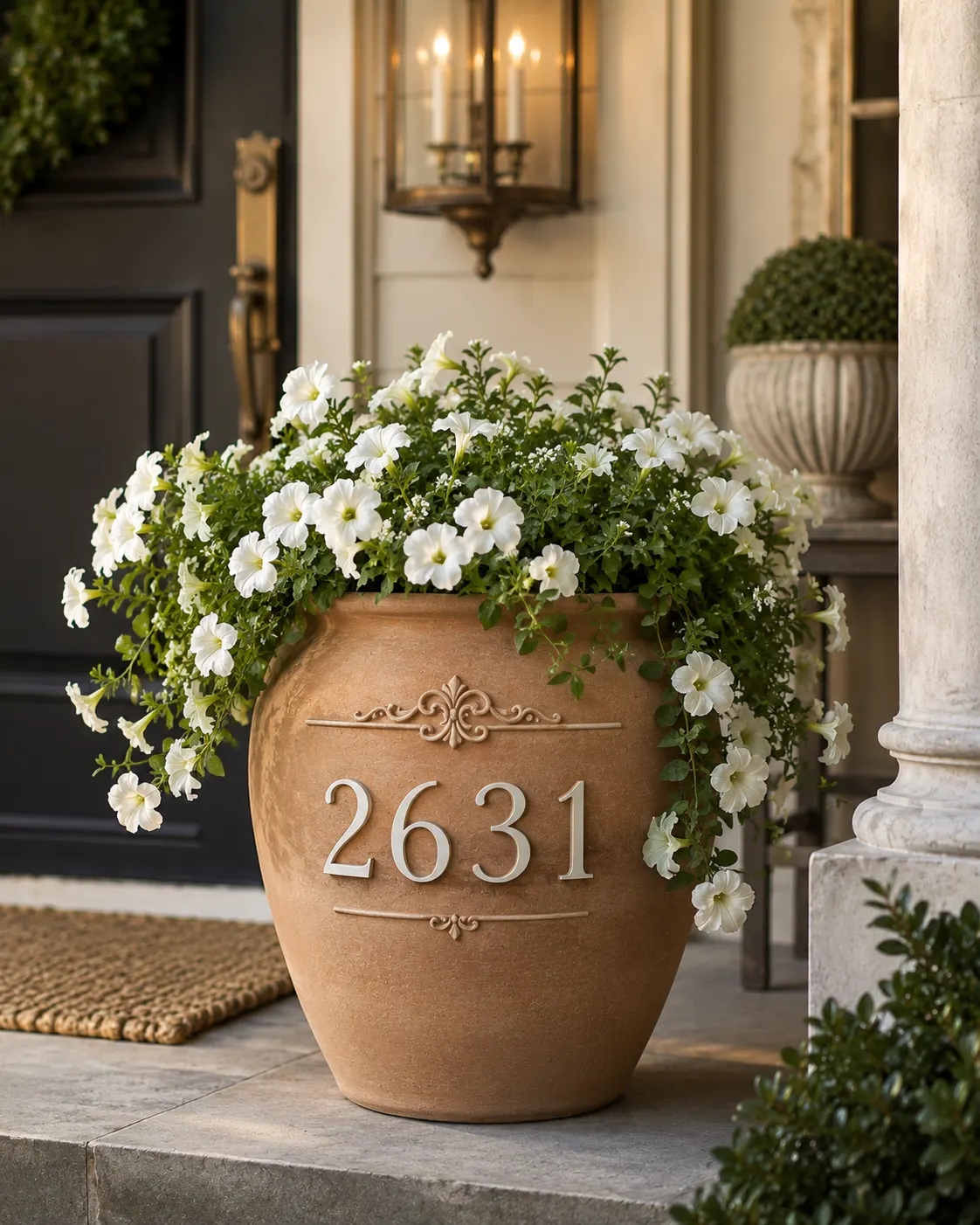
You know those front porches that somehow look pulled together without looking like somebody spent an entire weekend fussing over every little detail?
There’s usually one simple feature doing a lot of the work.
For me, a DIY house number flower pot is exactly that kind of project.
You take a large terracotta pot, give it a little personality, paint your house numbers where they’re easy to see, fill the planter with gorgeous flowers, and place it near the front door.
That’s pretty much it.
Yet the finished planter can completely change the entrance.
I especially love this idea because the house numbers aren’t just decorative. They’re useful. Guests, delivery drivers, neighbors, and family members can spot the address while the planter adds color to the porch.
Plus, you can make the style fit your home. Keep the natural terracotta for a warm traditional look, paint the pot black for something modern, go creamy white for farmhouse charm, or bring in a bold color if your porch needs a little summer fun.
Here’s how I’d make one from start to finish.
Why a House Number Flower Pot Works So Well
A regular flower pot already makes an entrance feel friendlier.
Adding house numbers gives it another purpose.
Instead of putting another decoration beside your front door, you’re creating something that works as both a planter and an address display.
That matters on smaller porches where every inch counts.
It can also help draw attention toward an address that’s difficult to notice from the driveway.
And, honestly, there’s something ridiculously satisfying about taking a plain terracotta pot and turning it into something that looks custom-made for your house.
No complicated construction.
No giant pile of lumber.
No “why did I start this?” moment halfway through Saturday afternoon.
Choose a Large Terracotta Pot
Start with the planter.
For this project, bigger usually looks better.
A large pot gives you enough surface area for numbers that can actually be read without somebody walking three feet from the porch and squinting.
It also gives you room for a fuller plant arrangement.
Look for a pot with a relatively smooth area where the numbers will go.
Some terracotta pots have heavy texture, decorative bands, or pronounced ridges. Those can be beautiful, but they may make painting clean numbers more difficult.
Also check the pot carefully before buying it.
Look for cracks, chips, or damage around the drainage hole.
Terracotta has plenty of rustic personality already. You don’t need a giant crack joining the party.
Pick a Pot Size That Matches Your Porch
Scale makes a huge difference.
A tiny planter beside a tall front door can disappear.
Meanwhile, an enormous planter on a narrow apartment porch can feel like it’s blocking traffic.
Stand back and look at your entrance.
If you have a wide porch, large steps, double doors, or tall columns, a substantial planter usually feels more balanced.
For a small entry, choose a medium-size pot with large, clear numbers.
You can also use two pots if your entrance has enough room.
One could display the house number while the second carries matching flowers.
That creates symmetry without repeating the address like your porch is trying really, really hard to make a point.
Decide Whether to Keep the Natural Terracotta
You don’t have to paint the entire pot.
Natural terracotta has a warm orange-brown color that works beautifully with green foliage, white flowers, black lettering, and traditional homes.
Keeping the original finish also makes this project quicker.
Clean the pot.
Add the numbers.
Plant it.
Done.
The natural look works especially well with Mediterranean, cottage, Southwestern, rustic, and casual porch styles.
Black numbers against terracotta can look simple and classic.
White or cream lettering can create a softer contrast.
If the natural clay already matches your house, I’d seriously consider leaving it alone.
Sometimes the easiest option is also the prettiest.
Or Paint the Pot for a Bigger Change
Want more drama?
Paint the planter.
Black can create a sharp modern look.
Charcoal feels slightly softer.
Cream and warm white work beautifully with farmhouse-style porches.
Navy can look great with white siding.
Muted sage green fits garden-heavy entrances.
Deep blue can bring color without feeling too loud.
Before choosing anything, look at your front door, siding, shutters, trim, porch furniture, and existing planters.
The pot doesn’t need to match everything exactly.
Actually, a little contrast often looks better.
But it should feel like it belongs there.
Clean the Terracotta Before Painting
Don’t paint a dusty pot.
I know that sounds painfully obvious, but this is one of those shortcuts that’s tempting when you’re excited to start.
Remove dirt and loose debris from the surface.
If you’re reusing an older pot, clean it thoroughly and allow it to dry completely before painting.
Terracotta is porous.
That means moisture can remain in the material longer than you might expect.
Starting with a clean, dry surface gives your coating a much better foundation.
And if the pot has flaky old paint?
Remove loose material before adding another layer.
Fresh paint over peeling paint is basically putting lipstick on a problem.
Lightly Prepare the Surface
Depending on the pot and coating you’re using, some surface preparation may help.
If the planter has rough spots, lightly smooth areas that could interfere with your lettering.
Wipe away all dust afterward.
Don’t go wild with aggressive sanding.
You’re not trying to turn terracotta into polished marble.
You simply want a clean working area for paint and numbers.
Always follow the instructions for the specific primer, paint, or coating you choose because products vary.
A paint labeled for suitable exterior surfaces is a smarter choice for a porch planter than leftover interior wall paint you found behind the washing machine.
Think About Moisture Before You Paint
Here’s something worth remembering: terracotta is porous.
Water can move through unglazed clay.
That natural behavior is one reason terracotta works so well as a planter, but it can also affect decorative finishes.
Choose coatings intended for the material and intended location.
If you’re painting or sealing the planter, follow the manufacturer’s directions closely.
Also keep the drainage hole functional.
Please don’t turn your flower pot into a decorative bathtub.
Roots generally don’t appreciate that.
Choose House Numbers That Are Easy to Read
This project is decorative, but the address still needs to do its job.
Readability matters.
Choose large numbers with clear shapes.
Simple block-style numbers are usually easier to read from a distance than extremely thin or ornate lettering.
Contrast matters too.
Black numbers on a pale pot?
Easy to see.
White numbers on black?
Great contrast.
Pale gray numbers on a slightly different pale gray?
Pretty in a close-up photo, maybe.
Useful from the driveway?
Eh… not so much.
Before painting, test your idea with paper numbers taped to the pot.
Then walk away.
Farther.
A little farther.
Can you still read them?
That’s the test that matters.
Use Number Stencils for Clean Results
If freehand painting isn’t your thing, welcome to the club.
Stencils make this project much easier.
Choose number stencils that fit the scale of the planter.
Position them on the front of the pot and check the spacing before applying paint.
Measure the total width of your address first.
Then find the center of the visible front area of the planter.
This helps keep the number sequence balanced.
For example, a four-digit address needs enough space between each character so the numbers don’t blend together.
Take your time here.
Five extra minutes measuring beats staring at a permanently crooked “7” every time you come home.
Try Vinyl Numbers as Temporary Guides
Another option is using removable vinyl numbers as guides or masks, depending on your chosen painting technique.
You can position the numbers carefully, paint around or over the designated area as your design requires, and remove them according to the method you’re using.
The advantage is crisp positioning.
The downside?
Curved pots can be tricky.
A stencil or vinyl piece that lies perfectly flat on a wall may wrinkle slightly around a rounded planter.
Work slowly.
Smooth from the center outward.
And don’t assume the first placement is final until you’ve stepped back and checked it.
How to Center Numbers on a Round Pot
Round planters can fool your eye.
The surface curves away on both sides, so numbers that technically fit may look crowded from the front.
Focus on the area that’s visible when someone approaches the house.
Measure that front section rather than wrapping your address too far around the sides.
Mark a subtle vertical center line with a removable guide.
Then build the number arrangement outward from that point.
If you have an odd number of digits, centering the middle digit first can help.
For an even number, center the space between the two middle digits.
Yep, we’re doing porch math now.
Don’t worry. There’s no quiz.
Tape the Stencil Securely
Once the placement looks right, keep that stencil from moving.
Use painter’s tape or another suitable temporary method to hold it in place.
Pay special attention to the edges around each number.
A loose stencil can allow paint to creep underneath.
That’s how a crisp “3” becomes something that looks like it had a rough night.
Because the planter surface is curved, you may need to work with one number at a time rather than taping a huge stencil across the entire pot.
Honestly, I prefer that approach.
It’s slower, but you get more control.
Use Less Paint Than You Think
This is one of my favorite stencil tricks.
Don’t load the brush or sponge with a giant blob of paint.
Too much paint increases the chance of bleeding beneath the stencil.
Use a small amount.
Build the color gradually.
A stencil brush, small foam applicator, or another tool suited to your chosen paint can work well.
Apply the paint carefully rather than brushing aggressively toward the stencil edges.
Several light applications can give you cleaner results than one heavy coat.
Crafting rule number 47: more paint does not automatically mean more better.
Yes, I know the grammar hurts.
But the rule stands.
Let Each Number Dry Properly
Don’t get impatient.
I know.
You want to peel the stencil off immediately and admire your work.
Follow the paint instructions and your chosen stencil method so you don’t smear the edges.
If you’re painting multiple layers, allow the required drying time between coats.
Once the stencil comes away, resist touching the number just to check whether it’s dry.
We all know what happens next.
Fingerprint.
Tiny gasp.
Immediate regret.
Give the paint time.
Your porch can wait.
Fix Small Painting Mistakes Without Panicking
A little paint slipped under the stencil?
It’s okay.
Let the area reach the appropriate stage for correction based on the paint you’re using.
Then carefully touch up the edge with a small artist’s brush and the background color if needed.
Tiny imperfections usually disappear once the planter is filled with flowers and viewed from several feet away.
Remember, nobody is inspecting your porch with a magnifying glass.
And if they are?
Maybe don’t invite that person over for lemonade.
Try Vertical House Numbers
Horizontal numbers aren’t your only choice.
A tall planter can look fantastic with the address running vertically.
For example:
1
2
4
8
This style works particularly well on narrow pots and contemporary porches.
Vertical numbers also create a strong graphic feature.
Keep the spacing consistent.
Use a ruler or measuring tape to mark each position.
A simple sans-serif number style looks especially good with this layout.
Pair it with a black or charcoal planter and green foliage, and you’ve got a clean modern look without much fuss.
Create a Modern Black-and-White Version
For modern curb appeal, keep things simple.
Paint the planter matte or satin black using a suitable outdoor coating.
Add large white house numbers.
Then fill the pot with structured greenery.
Or reverse it.
Use a warm white planter with black numbers.
This version looks great beside contemporary doors, black hardware, concrete steps, and simple porch lighting.
Skip the extra bows and decorative signs.
Let the numbers and plants carry the design.
Sometimes a project looks more expensive because you knew when to stop decorating.
That’s a lesson my craft closet refuses to learn.
Make a Rustic Terracotta Version
If your style is warmer and more relaxed, keep the clay visible.
Add black, cream, or muted green numbers.
Then plant something loose and colorful.
Think trailing greenery around the edge with taller flowers toward the center.
A slightly weathered terracotta surface can actually add character.
Don’t try to make every mark disappear.
Natural clay develops personality.
Pair the planter with a woven doormat, wooden bench, lantern, or simple wreath.
Suddenly the porch feels welcoming without looking overly planned.
Try a Farmhouse House Number Planter
Farmhouse style works beautifully with this idea.
Start with a white, cream, charcoal, or natural terracotta pot.
Use bold black numbers.
Then choose simple flowers and greenery.
White blooms can keep the look calm.
Trailing greenery softens the pot.
A taller central plant gives the arrangement height.
You could place the planter beside a black lantern or a natural fiber doormat.
Just don’t add every farmhouse symbol you’ve ever seen.
You don’t need buffalo check, a rooster, three galvanized buckets, six wooden signs, and a tiny decorative tractor.
Give the poor planter some breathing room.
Make a Colorful Cottage Version
Cottage-style porches can handle more color.
Keep the terracotta natural or paint it a soft pastel.
Then add house numbers in cream, charcoal, or another contrasting shade.
Fill the planter with flowers in several complementary colors.
Pink, lavender, white, yellow, and soft blue can create a cheerful garden look.
Allow some plants to spill slightly over the rim.
That loose growth makes the planter feel established rather than freshly assembled.
And once everything starts blooming?
So cute.
Like your porch decided to host its own little garden party.
Choose Flowers for Your Actual Light Conditions
This is where people get distracted by pretty plant tags.
Don’t choose flowers based only on color.
Look at your porch.
How much direct sunlight does the planter actually receive?
Full sun?
Morning sun?
Bright shade?
Deep shade?
Then choose plants suited to those conditions and your local climate.
A gorgeous sun-loving flower isn’t going to become shade-loving because it matches your front door.
Plants are annoyingly stubborn that way.
Check plant labels or local nursery guidance before buying.
It saves money and disappointment later.
Use the Thriller, Filler, Spiller Idea
For a full-looking container, I love the classic thriller-filler-spiller approach.
The “thriller” is the taller focal plant.
The “fillers” create fullness around the middle.
The “spillers” trail over the rim.
This gives the planter height, body, and movement.
You don’t need dozens of plants.
A few well-chosen varieties can make a large container look lush.
Just check mature sizes and spacing requirements.
That adorable tiny plant at the nursery may become the Godzilla of your flower pot by midsummer.
Give everybody room.
Flower Ideas for Sunny Porches
For sunny locations, your options may include many colorful annuals and heat-loving container plants, depending on your region.
Petunias can provide abundant color.
Geraniums bring a classic porch look.
Marigolds add warm yellow and orange tones.
Verbena can add smaller flower clusters.
Sweet potato vine can create dramatic trailing foliage.
Calibrachoa can spill beautifully over container edges.
Ornamental grasses can add height.
However, plant needs vary.
Check sunlight, water, mature size, and local growing conditions before combining varieties.
A beautiful arrangement is much easier when all the plants want roughly the same lifestyle.
Basically, don’t put the botanical equivalent of a desert camper and a swamp enthusiast in the same apartment.
Flower Ideas for Shadier Porches
A shady entrance doesn’t mean boring plants.
Depending on your climate and light levels, shade-friendly container choices may include impatiens, begonias, coleus, ferns, and other foliage plants.
Coleus is especially fun because the leaves provide color even without lots of flowers.
You can mix burgundy, lime, pink, cream, and green foliage for a planter that looks interesting all season.
Again, check the plant requirements.
“Shade” can mean different things.
Two hours of morning sun is not the same as sitting under a dark covered porch all day.
Your plants will notice the difference even if you don’t.
Don’t Forget Drainage
This deserves its own section because it’s easy to overlook when you’re focused on the pretty part.
Your planter needs appropriate drainage for the plants you’re growing.
Make sure the drainage opening remains functional.
Don’t accidentally block it while painting or sealing the pot.
Use a planting setup appropriate for the container and chosen plants.
After watering, excess water needs somewhere to go.
A pot full of soggy roots isn’t giving curb appeal.
It’s giving botanical crime scene.
Use Potting Mix Made for Containers
Garden soil and container potting mix aren’t automatically interchangeable.
For most typical porch containers, use a growing medium intended for container gardening and suitable for your plants.
Container mixes are designed with drainage and root conditions in mind.
Fill the planter according to the needs of your chosen plants.
Don’t pack the mix down like you’re making a sandcastle.
Roots need suitable growing conditions, not concrete.
Also leave enough room near the top so watering doesn’t send soil cascading over your freshly painted house numbers.
That would be… unfortunate.
Plant Without Hiding the Address
Here’s a surprisingly important detail.
Don’t choose trailing plants that completely cover the numbers.
Remember, this is a house number flower pot.
The address needs to stay visible.
Position heavy trailing growth toward the sides or back if necessary.
Trim plants lightly when they begin covering the numbers.
You can also place the address slightly higher on the pot where foliage is less likely to hide it.
The flowers should frame the numbers.
Not eat them.
Position the Planter Where People Can See It
Once finished, don’t automatically shove the planter into the prettiest corner.
Stand where a visitor would approach.
Look from the sidewalk.
Look from the driveway.
Look from the front walkway.
Can you see the numbers?
If your planter sits behind a porch column, giant shrub, parked vehicle, or outdoor chair, the address display loses much of its usefulness.
Place it where the numbers face the main approach.
Then check it at night too.
Visibility can change dramatically after sunset.
Keep Existing House Numbers
A decorative planter can supplement your home’s permanent address display, but don’t automatically remove existing numbers.
Local building, fire, postal, emergency-service, HOA, or municipal rules may have requirements for address visibility, size, placement, or contrast.
A planter can also move.
Plants can grow over it.
Snow could cover it.
Someone could relocate it while cleaning the porch.
For those reasons, I’d treat this project primarily as decorative curb appeal unless you’ve confirmed that it meets any address-display rules that apply to your home.
Cute planter?
Absolutely.
Only emergency address marker?
I’d be careful with that.
Think About Nighttime Visibility
If you want the planter to help visitors find your house after dark, lighting matters.
Place it near existing porch lighting where possible.
Don’t hide it in deep shadow.
You could also position a suitable outdoor landscape light nearby.
Keep cords and fixtures out of walkways.
And don’t depend on decorative lighting that makes the flowers glow while leaving the actual numbers invisible.
The number is the important bit.
The petunias will survive without their own spotlight.
Probably.
Protect the Finish From Weather
Outdoor planters deal with sun, rain, humidity, dirt, watering, and temperature changes.
Choose paints, primers, and protective coatings suited to the pot material and intended exposure.
Follow all curing directions before planting.
If the product requires several days before exposure to moisture, give it those days.
Don’t paint the pot at breakfast, plant it at lunch, soak it at dinner, and then wonder why the finish looks unhappy.
Products need curing time.
Patience isn’t exciting, but neither is repainting the whole thing next weekend.
A Covered Porch Can Help the Finish Last
If you have a choice, place the planter where it receives the light your plants need while getting some protection from harsh weather.
A covered porch can reduce direct rain exposure.
However, sunlight requirements still matter.
Don’t move sun-loving flowers into deep shade solely to protect your paint job.
Find a balance between plant health and decorative longevity.
If weather exposure is intense where you live, expect outdoor finishes to need occasional maintenance.
That’s normal.
Outdoor decor lives a harder life than the stuff sitting peacefully on your mantel.
Rotate Carefully—But Keep the Numbers Facing Forward
Container plants sometimes grow toward the light.
Rotating a pot can encourage more even growth.
But there’s an obvious problem here.
Your house numbers need to face outward.
If you rotate the planter temporarily for plant growth, remember to return the numbers to their visible position.
Otherwise your beautifully painted address may spend the afternoon introducing itself to the brick wall.
Not super helpful.
Water Without Constantly Soaking the Painted Area
Water the plants according to their needs.
Whenever practical, direct water toward the soil rather than repeatedly splashing the decorative surface.
This can help keep the planter cleaner.
A watering can with a controlled spout makes this easier.
If soil splashes onto the numbers, clean it gently using a method appropriate for your finish.
Avoid harsh scrubbing unless the coating manufacturer says it’s safe.
You worked hard on those crisp numbers.
They deserve a little respect.
Change the Flowers With the Seasons
One reason I really like this project is that the planter itself can stay while the plants change.
Spring could bring cool-season flowers suited to your climate.
Summer can bring colorful annuals.
Fall can shift toward mums, ornamental foliage, or other seasonal plants.
In suitable climates and conditions, winter greenery can take over later.
The house number remains the same.
The personality changes.
That’s a much easier seasonal porch update than making a completely new sign every three months.
Your storage closet will thank you.
Add Pumpkins Around It in Fall
When fall arrives, don’t hide the planter.
Work around it.
Place a couple of pumpkins near the base.
Add seasonal plants.
Bring in a simple fall wreath.
Natural terracotta looks especially good with orange, cream, green, and burgundy autumn colors.
A black planter can look amazing with white pumpkins.
Suddenly your summer address planter becomes part of fall decor without needing a makeover.
That’s the kind of seasonal decorating I can get behind.
Minimal work.
Maximum “Oh wow, your porch looks cute.”
Give It a Holiday Look
For winter, you can create a completely different arrangement if your climate and container allow it.
Evergreen-style greenery, branches, or other suitable seasonal materials can give the planter a festive look.
Keep the house numbers visible.
Add a simple bow if that fits your style.
If you’re using decorative lights, choose products intended for outdoor use and follow their safety instructions.
And maybe resist the temptation to attach seventeen ornaments.
Remember our earlier conversation about knowing when to stop?
Yeah.
December is where that rule gets tested.
Make Two Matching Planters
Have a wide entrance?
Two large planters can create beautiful symmetry.
Put the house number on one.
Keep the second plain or add a simple decorative element.
Plant both with matching or coordinating arrangements.
This can make a front door feel more substantial.
If you have double doors, matching planters can look especially balanced.
Just make sure the address planter remains easy to identify.
You don’t want guests playing “Which pot has the number?” while holding a pizza.
Nobody wants cold pizza because of porch design.
Stack Terracotta Pots for More Height
Want a more dramatic version?
You can create a stacked-pot display using a stable design intended for outdoor planters.
Paint one house-number digit on each visible pot or place the complete address on the largest container.
This can create a taller feature beside the door.
However, stability becomes much more important.
Heavy pots, soil, plants, wind, pets, children, and uneven porch surfaces all need consideration.
If the arrangement wobbles when you touch it, that’s your answer.
Don’t use it.
A front porch planter should welcome guests.
It should not challenge them to dodge falling pottery.
Try a Numbered Planter Box Instead
If terracotta isn’t your style, the same concept can work on other suitable outdoor containers.
A wooden planter box can carry painted numbers.
A metal-style planter may suit a modern farmhouse porch.
A simple rectangular container can work well on a narrow entrance.
Just adapt your paint and preparation methods to the actual material.
Don’t assume a product that works on porous clay will behave exactly the same way on plastic, wood, or metal.
The design idea transfers easily.
The surface preparation may not.
Add a Small Decorative Border
If the numbers feel a little plain, add a subtle decorative detail.
A thin painted line can frame the address.
Small dots can create a folk-art look.
A simple leafy motif can suit a cottage porch.
A geometric border can feel modern.
Keep it restrained.
The numbers should remain the first thing you notice.
I love decorative details as much as the next craft-obsessed person, but we don’t need the address competing with twelve hand-painted sunflowers.
Unless you’re painting a sunflower farm.
Then, okay, maybe.
Common Mistakes to Avoid
The biggest mistake is choosing numbers that are too small.
They might look adorable while you’re sitting beside the planter, but disappear from the driveway.
Another mistake is poor contrast.
Make the address easy to read.
Don’t paint a dirty or damp pot.
Don’t rush drying and curing times.
Don’t block drainage.
Don’t choose plants without checking sunlight requirements.
Don’t place trailing plants directly over the address.
Don’t position the planter somewhere hidden.
Don’t assume decorative numbers replace any legally required permanent address display.
And don’t overload a small porch with a planter so large that everybody has to turn sideways to reach the door.
Curb appeal should make arriving home nicer.
Not harder.
Why This DIY Has Such Great Curb Appeal
I think this project works because it connects three things people already notice at an entrance:
Flowers.
Color.
House numbers.
Instead of treating those elements separately, you combine them into one strong focal point.
The planter gives the porch height.
The flowers add texture and seasonal color.
The numbers make the piece personal to the house.
And because terracotta is such a familiar garden material, the project doesn’t feel forced.
It just looks like it belongs by the front door.
That’s my favorite kind of DIY.
Useful.
Pretty.
And not so complicated that I need three coffees and a motivational speech before starting.
Frequently Asked Questions
How do you make a DIY house number flower pot?
Start with a clean, dry planter. Prepare and paint the surface if desired, position large number stencils on the visible front area, apply suitable paint carefully, allow everything to dry and cure, then fill the pot with plants suited to your porch conditions.
What size pot is best for painted house numbers?
Choose a planter large enough to display your complete address clearly from the main approach to your home. Longer addresses generally need a wider visible surface or a vertical layout.
What paint should I use on terracotta pots?
Choose a coating designed for the surface and intended exposure. Product directions vary, so check whether the paint requires a primer, sealer, specific preparation, or curing period.
Should I seal a painted terracotta pot?
That depends on the paint system and the look you want. Terracotta is porous, so use products designed for the material and follow their directions. Keep drainage and plant requirements in mind.
How can I stop stencil paint from bleeding?
Secure the stencil well, use a small amount of paint, and build color with controlled applications rather than loading the brush heavily.
What color should the house numbers be?
Choose strong contrast. Black works well against light backgrounds, while white or cream can stand out against black, navy, charcoal, or other dark colors.
Can I paint house numbers vertically?
Yes. Vertical addresses can look especially good on tall or narrow planters. Keep the digits evenly spaced and make sure the complete number remains easy to read.
What flowers look good in a house number planter?
Choose plants based first on sunlight, climate, water needs, and container suitability. Then create a color palette that complements the house and planter.
Where should I put my house number planter?
Place it near the main entrance where the address faces visitors approaching from the driveway, sidewalk, or front walk. Keep it out of traffic paths and make sure the planter sits securely.
Can this planter replace the house numbers attached to my home?
I wouldn’t automatically rely on it as the only address marker. Local requirements may specify where and how an address must be displayed, and a planter can move or become hidden by vegetation.
How do I make the planter look expensive?
Keep the color palette limited, use large clean numbers, choose a substantial pot, and create a balanced plant arrangement. Simple designs often look more polished than heavily decorated ones.
Can I change the planter for different seasons?
Absolutely. Keep the painted address and change the plant arrangement or surrounding decorations as the seasons change.
Final Thoughts
A DIY house number flower pot is one of those front porch projects that gives you a surprising amount of impact for a pretty simple idea.
Start with a good-size terracotta planter.
Keep the natural clay or paint it to suit your house.
Add large, readable numbers.
Give the paint enough time to dry and cure.
Then fill the pot with flowers and foliage that actually like the conditions on your porch.
That’s the whole idea.
You can make it modern with black and white.
Keep it warm with natural terracotta.
Give it farmhouse character with cream and black.
Or fill it with colorful cottage-style flowers and let things get a little wild.
Just keep the address visible.
Because if your gorgeous trailing flowers completely swallow the numbers by July, congratulations—you’ve made a beautiful regular flower pot.
Still cute.
Just slightly missing the assignment.