I have been around enough kitchens to know that the odd little tricks people swear by usually come from one of two places: hard-earned experience or pure wishful thinking. Not long ago, I kept hearing about folks stirring a pinch of baking soda into their morning coffee to “smooth it out,” and since I’m a curious woman with a stovetop kettle and a practical streak, I decided to try it for myself. Five minutes later, I understood exactly why some people do it, and also why it is not a trick I’d recommend without a little caution.
If you have ever brewed a cup that tasted too sharp, too bitter, or a little rough on the stomach, this article will walk you through what baking soda actually does in coffee, what changed in mine almost immediately, how much is too much, and when this old-fashioned kitchen fix can help more than it hurts. I’ll tell you what I noticed in flavor, texture, and aftereffects, and I’ll share the sort of sensible advice I wish more folks gave before passing along a “miracle” tip.
1. Why I tried it in the first place
On our place, coffee is not some fancy ceremony. It is the first warm thing in your hands before the sun is fully up, especially in winter when the barn path is hard as iron. But even good coffee can turn harsh if the grounds are over-extracted, the roast is dark, or the pot sits on heat too long. That morning, I had made a 12-cup drip pot with a dark roast, about 2 tablespoons of grounds per 6 ounces of water, and the first sip had that bite at the back of the tongue that told me it was headed toward bitter.
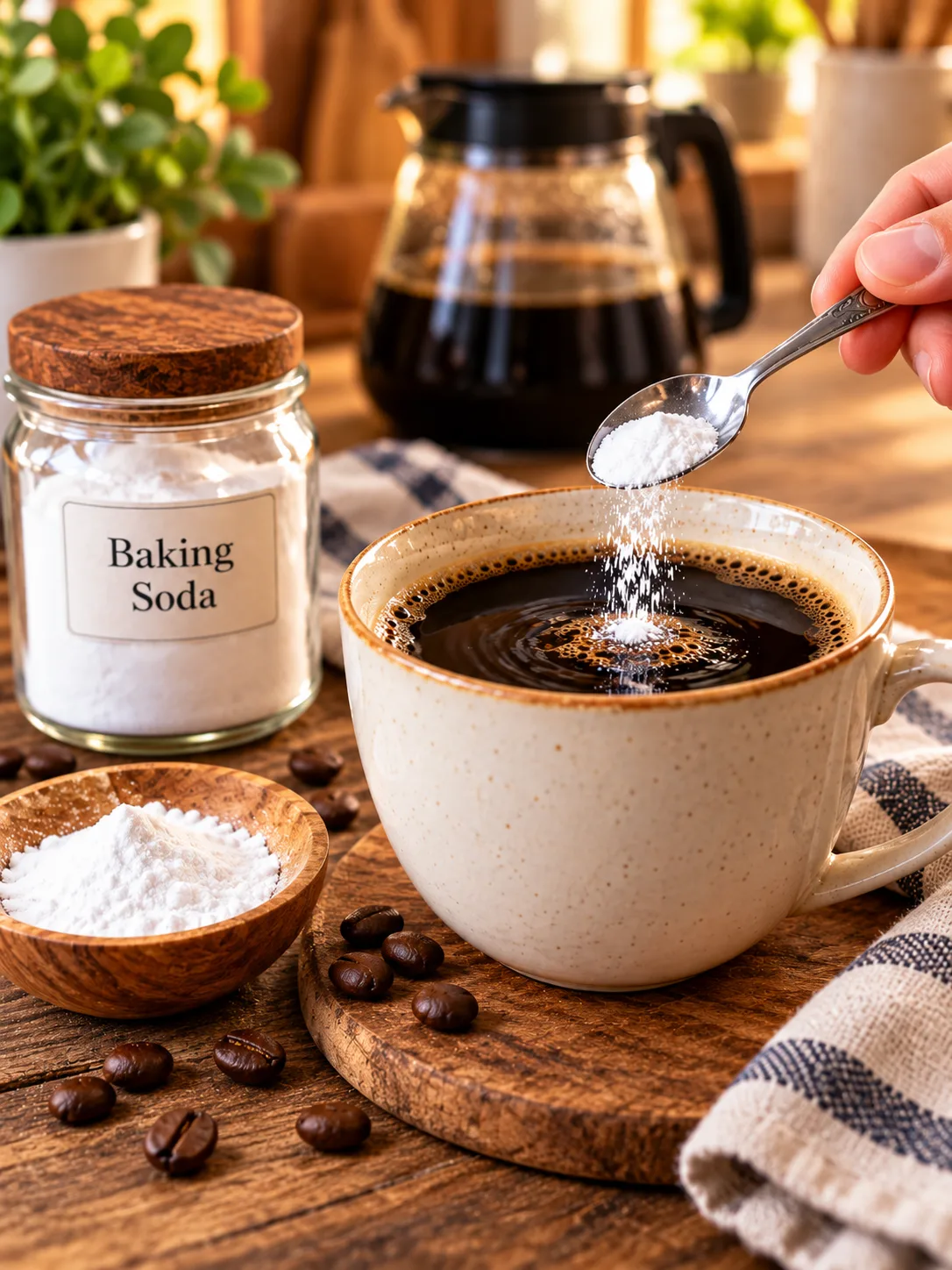
I had heard that baking soda, being alkaline, can tame acidity. So I poured myself an 8-ounce mug, stirred in a very small pinch, roughly 1/16 teaspoon, and waited a few minutes to see whether I had improved my coffee or ruined breakfast.
2. What happened in the first 5 minutes
The change was not dramatic in the way internet tales like to make things sound, but it was noticeable. Within about 5 minutes, after the coffee settled and cooled just a touch, the sharp acidic edge had softened. The cup tasted rounder, flatter in one sense, but also gentler. If the original coffee had a bite, that bite was reduced.
What did not happen is just as important. I did not suddenly have “super coffee,” a burst of energy, or some magical detox effect. The real result was simple chemistry: the baking soda muted some of the acidity, and that changed the flavor profile of the coffee in a fairly immediate way.
3. The science behind the trick
Baking soda is sodium bicarbonate, an alkaline compound. Coffee naturally contains acids, including chlorogenic acids and quinic acid, which contribute brightness, tang, and sometimes stomach irritation. When you add a small amount of baking soda, it helps neutralize part of that acidity.
That means the pH of the coffee shifts upward slightly, making it less acidic. You do not need much. In fact, too much will overpower the cup quickly. In an 8-ounce mug, even 1/8 teaspoon can be excessive for many people. A tiny pinch, often less than 1/16 teaspoon, is enough to make a difference.
4. How the flavor changed in my cup
The best way I can describe it is this: the coffee lost some of its sparkle and some of its sting at the same time. The sour-bitter edge calmed down, especially at the sides of the tongue. The roast notes came forward a little more, while the brighter notes faded back.
That can be helpful if your coffee is cheap, overbrewed, or particularly acidic. But if you started with a lovely medium roast that has natural fruit notes, baking soda can dull the very qualities you paid for. In my cup, it improved a harsh brew, but I would not use it in a carefully made pour-over with good beans from a local roaster.
5. What it did to the smell and mouthfeel
I noticed the aroma changed less than the taste. The coffee still smelled like coffee, warm and toasty, but the fragrance seemed a bit flatter. The lively high notes were not as pronounced after the baking soda went in.
The mouthfeel also seemed smoother, though not thicker. It felt less prickly and less sharp going down. That may be one reason some folks believe it is “easier” coffee. It does not become creamy or rich from baking soda, but it can seem more mellow on the palate.
6. How it affected my stomach
This is where some people are most interested, and I understand why. Plenty of folks love coffee but do not love the way it sometimes sits in the stomach. In my case, one cup made with a small pinch of baking soda felt a little gentler than the usual sharp dark roast. I did not get that faint hollow burn that strong coffee can sometimes bring on if breakfast is running late.
That said, one cup is not a medical study, and I would be careful about promising too much. Some people may feel relief from reduced acidity, while others may notice little difference. If heartburn, reflux, or stomach pain happens often, it is smarter to look at roast choice, brewing method, meal timing, and medical advice than to rely on a kitchen shortcut alone.
7. The biggest mistake people make with this trick
The biggest mistake is using too much. Baking soda is powerful in small doses. Add 1/4 teaspoon to a single mug, and there is a good chance your coffee will taste dull, salty, chalky, or oddly soapy. Once that happens, there is no stirring your way back to a proper cup.
If anyone wants to experiment, I always say start smaller than you think. For an 8-ounce mug, begin with just a pinch between finger and thumb, around 1/32 to 1/16 teaspoon. Stir well, wait 2 to 5 minutes, and taste before adding more. You can always add a little; you cannot take it back out.
8. When baking soda helps most
In my experience, this trick helps most with coffee that is overly acidic, bitter from over-extraction, or made from inexpensive dark-roasted beans. It can also help if you have brewed a pot that sat on the warming plate 20 or 30 minutes too long and developed that stewed edge.
It may also be useful in camping coffee, church basement coffee, fundraiser coffee, and those big percolator batches where consistency is not always the star of the show. I have tasted enough reunion and harvest-supper coffee to know that sometimes “good enough and gentler” is a real improvement.
9. When I would not use it
I would skip it with high-quality beans that already have balanced acidity, especially light and medium roasts with floral, citrus, or berry notes. Those natural flavors are part of what makes specialty coffee interesting, and baking soda can flatten them in a hurry.
I would also avoid making it a daily habit if you are watching sodium closely. Baking soda contains sodium, and while a small pinch is not enormous, repeated use adds up. Roughly speaking, 1/8 teaspoon of baking soda contains about 150 milligrams of sodium. If a person drinks 3 or 4 cups altered that way every day, that is worth noticing.
10. A better way to use it: in the grounds, not the mug
If the goal is to tame a whole pot, I actually think a better approach is to add a tiny amount to the dry grounds before brewing rather than dosing each mug. For a 10- to 12-cup pot, start with 1/4 teaspoon mixed into the grounds. That is enough for most home brewers.
This gives a more even result and avoids one cup tasting strange while the next tastes fine. It is the old sort of practical measure many cooks like: small amount, consistent method, fewer surprises. Even then, I would only use it when the coffee truly needs help.
11. Other ways to reduce bitterness without baking soda
There are gentler fixes that often work better. Use fresher beans, measure carefully, and avoid overheating the water. Ideal brewing water is usually around 195 to 205 degrees Fahrenheit. If the water is much hotter or the grounds steep too long, bitterness creeps in fast.
You can also change the roast or the brew method. Cold brew, for example, is naturally lower in perceived acidity and can be smoother on the stomach. A medium roast brewed in a drip machine with the right coffee-to-water ratio, around 1 to 2 tablespoons per 6 ounces, often solves the problem before it starts. A splash of milk or a bit of cream can also soften sharpness without changing the chemistry quite so aggressively.
12. What this little experiment taught me
It reminded me that kitchen wisdom is often partly right and partly oversold. Yes, baking soda in coffee can change the cup within 5 minutes. In my case, it made a harsh mug smoother and less acidic. But no, it did not transform bad coffee into wonderful coffee, and it certainly did not perform any miracle beyond what basic chemistry would suggest.
That is true of many old-time tricks. My mother used a pinch of this and a dab of that, not because she believed in magic, but because she understood ingredients well enough to coax them in a better direction. There is wisdom in that, as long as we keep our expectations sensible.
13. My honest verdict
If your coffee is too acidic or rough, a tiny pinch of baking soda can help. That is the plain truth. Five minutes after I stirred it into my morning mug, the coffee was softer, easier to sip, and less sharp on my stomach. For a rescue job, it worked.
But I would call it a correction, not an upgrade. The best coffee still comes from decent beans, proper measurements, clean equipment, and careful brewing. Baking soda is a back-pocket fix for a bad or overly harsh cup, not a daily secret ingredient for every pot.
14. A simple step-by-step if you want to try it safely
Here is the method I would recommend. Brew your coffee as usual. Pour 8 ounces into a mug. Add just a pinch of baking soda, about 1/32 to 1/16 teaspoon. Stir for 10 to 15 seconds. Let it sit for 2 to 5 minutes. Taste.
If it still seems too sharp, add only a few more grains, not another full pinch. Stop as soon as the acidity softens. If the coffee starts tasting flat, salty, or chalky, you have gone too far. And if you have high blood pressure, sodium restrictions, kidney concerns, or digestive trouble that persists, talk with your doctor rather than treating coffee like medicine.
15. The bottom line
So what happened 5 minutes later? My coffee became noticeably less acidic, somewhat smoother, and a little less lively in flavor. In a less-than-perfect mug, that was an improvement. In a truly good mug, it probably would have been a loss.
That is the whole of it, and to my mind, the truth is useful enough without dressing it up. Sometimes a pinch of baking soda can save a bitter cup on a cold morning. Sometimes the better answer is to brew a better pot tomorrow. After all these years in the kitchen, I find most good sense still comes down to that.