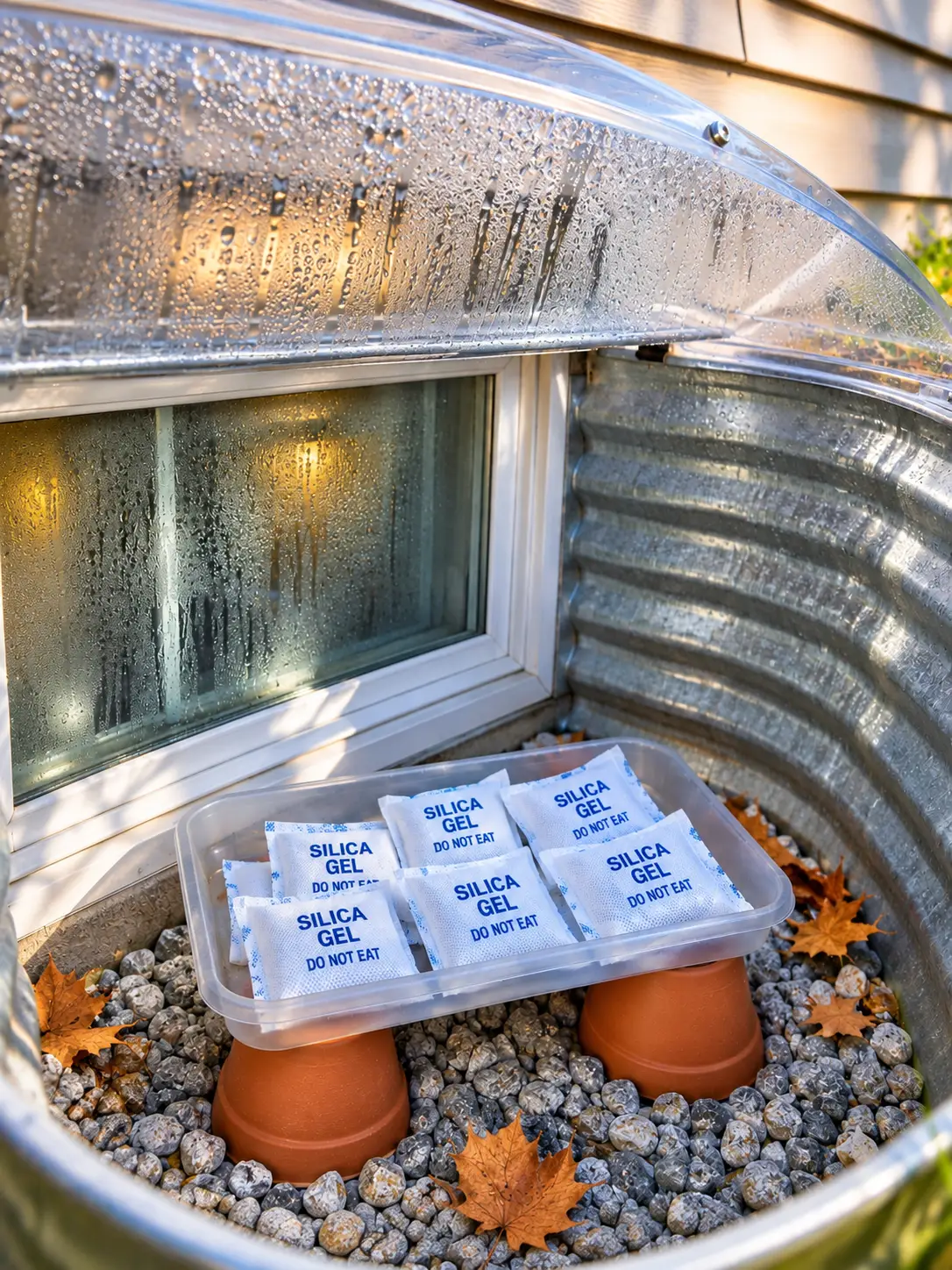
Every November, my basement window wells become a little science experiment. In the Midwest, we can get a 28-degree night followed by a 46-degree afternoon, and that swing is exactly the kind of weather that exposes every weak point around below-grade windows. This year, I noticed persistent condensation collecting on the inside of the window well covers and dampness lingering along the metal well walls. So I tried a very simple test: I placed silica gel packets inside my basement window wells for 14 days and tracked what happened as frost cycles came and went.
I’m an experienced cook, not a building scientist, but kitchens teach you to observe moisture closely. Steam, humidity, trapped condensation, airflow—those lessons carry over surprisingly well into home maintenance. In this article, I’ll walk you through exactly how I set up the test, what the weather did during those two weeks, what improved, what did not, and when silica gel packets are actually useful versus when they’re just a temporary bandage.
1. Why I decided to try silica gel in the first place
The issue started with repeated morning fogging under my clear plastic window well covers. By 7 a.m., after a cold night, I could see beads of water ranging from pinhead size to roughly 1/4 inch wide clinging to the underside of the cover. By midafternoon, some of that moisture would evaporate, but not always completely. The wells never looked flooded, yet they never looked truly dry either.
Silica gel packets seemed worth testing because they are designed to absorb limited amounts of moisture from enclosed spaces. I had saved several large packets from pantry-item shipments and small appliance packaging, and I also purchased additional packets labeled 50 grams each. My thought was simple: if the window wells were acting like semi-enclosed damp chambers, perhaps the packets could reduce short-term humidity enough to cut condensation.
2. My basement window well setup
I tested two basement window wells on the north side of my house. Each well measured about 36 inches wide, 16 inches out from the foundation, and 18 inches deep from the surrounding grade to the gravel base. Both had fitted clear polycarbonate covers, which helps keep out leaves and direct rain but also reduces airflow.
The wells had approximately 2 to 3 inches of gravel at the bottom. The window frames themselves are older vinyl replacement units, and while the glass and frames are still serviceable, the wells are not perfectly sealed environments. There are gaps where air can move in and out around the cover edges, which turned out to matter a great deal.
3. The weather conditions during the 14-day test
The timing could not have been better for a condensation test. Over the 14 days, overnight lows ranged from 26 to 34 degrees Fahrenheit, while daytime highs ran between 39 and 52 degrees. We had six mornings with visible frost on the lawn and three afternoons with direct sun bright enough to noticeably warm the plastic covers.
That freeze-thaw rhythm is important. Cold surfaces encourage moisture in the air to condense. Then daytime warming shifts the moisture again, sometimes drying surfaces and sometimes just moving water from one place to another. I also had one light rain event, about 0.18 inch, and one windy day that improved natural ventilation around the house.
4. What I used and how much I placed in each well
I used a total of 16 silica gel packets. Twelve were 50-gram packets, and four were smaller 10-gram packets. In the first window well, I placed six 50-gram packets for a total of 300 grams. In the second, I placed another six 50-gram packets plus the four 10-gram packets, for a total of 340 grams.
I set the packets in shallow plastic trays elevated slightly above the gravel using upside-down nursery pots. I did that for a practical reason: I did not want the packets sitting directly on damp gravel where they could wick moisture too fast or become muddy. The trays sat roughly 2 inches off the base and about 6 inches below the bottom edge of the window.
5. How I tracked the results day by day
I’m not fancy about these things, but I do believe in taking notes. Each morning between 6:30 and 7:30 a.m., I checked for visible condensation under the cover, moisture on the metal sides of the well, and any dampness on the lower window frame. I also took quick phone photos from the same angle for comparison.
I used two inexpensive digital hygrometer-thermometer units, one in each well, both rated for basic indoor/outdoor use. They are not lab instruments, but they gave useful trend information. I wrote down relative humidity and temperature in the wells once in the early morning and again around 3 p.m. each day.
6. What I noticed in the first 48 hours
The first two days were the most encouraging. On day 1, the wells started with early-morning relative humidity readings of 91% and 89%. By the afternoon, both had dropped into the low 70s. On day 2, after another frosty night, I still saw condensation, but there were fewer large droplets and more of a fine mist pattern under the cover.
Visually, the change was modest but real. Instead of heavy beading clustered along the coldest outer edges, there was a thinner film in spots and more dry area in the center of the cover. The lower metal wall of one well also dried faster than usual by lunchtime. At that point, I thought the packets might be doing more than I expected.
7. What happened from days 3 through 7
By the middle of the first week, the improvement leveled off. Morning humidity in the wells still often climbed back into the mid-80% range after cold nights. Daytime readings typically settled between 68% and 76%, depending on sun exposure. The packets were clearly absorbing some moisture, but they were not transforming the wells into dry environments.
This is where the reality of volume and air exchange set in. Window wells are not sealed containers like a spice jar or a shoebox. Even with covers, they breathe. New moist air enters, temperatures swing, and surfaces stay cold enough to keep generating condensation opportunities. Silica gel can help nibble at excess humidity, but in this setting it was working against a constantly replenished source.
8. What happened after the light rain and another frost cycle
On day 8, we had a light rain followed by a nighttime temperature drop to about 30 degrees. The next morning, condensation was back in a more obvious way. The underside of both covers had widespread droplets, especially around the perimeter, and one tray of packets felt noticeably heavier when I lifted it.
That was the clearest sign that the packets were nearing saturation. They had taken on moisture, but once the wells were challenged by fresh damp air and wet exterior conditions, their effect diminished. In cooking terms, it reminded me of putting a paper towel under a pile of washed herbs: it helps, but only up to a point, and eventually it’s spent.
9. The measurable difference the packets did make
Even though they did not solve the condensation problem, I would not call the test a failure. Comparing my photos from before the experiment and during the first week, I’d estimate there was about a 20% to 30% reduction in visible heavy droplet formation on average mornings. The hygrometers also showed somewhat faster drying in afternoon conditions, especially on sunnier days.
The best-case benefit appeared when weather was cold but dry. On those days, the wells reached afternoon humidity readings near 66% to 69%, versus the mid-70s I had seen before in similar conditions. That is useful, but it is not dramatic. If you are hoping silica packets will make a damp window well behave like a dry closet, they will not.
10. The limitations I ran into
The biggest limitation was simply capacity. A few hundred grams of silica gel is not much when it’s dealing with outdoor-adjacent air, a gravel base, cold metal surfaces, and temperature-driven condensation. In a small enclosed package, that amount can be impressive. In a basement window well, it is quickly outmatched.
The second limitation was placement. To work well, desiccants need to interact with the air volume you are trying to dry. In the wells, air movement was inconsistent. Some pockets likely stayed damp regardless of where the trays sat. The third issue is that once packets are saturated, they stop helping unless they are dried out or replaced. That creates a maintenance cycle many homeowners won’t want to keep up with every week in late fall.
11. Whether the packets affected the window itself
I was especially watching the bottom corners of the vinyl frames, where moisture can linger and invite mildew or trim damage over time. During the 14 days, I did notice slightly less persistent dampness at the interior-facing lower edge of one window, but the difference was subtle. There was no miracle change in the frame or glass performance.
That makes sense. If the condensation source is driven partly by the temperature of the glazing, the seal quality of the cover, and cold-soaked materials in the well, drying the air a little helps only a little. The packets reduced some ambient moisture, but they did not change the underlying thermal conditions causing condensation to form.
12. What worked better than the packets alone
The most effective improvement came when I slightly increased ventilation. On two dry afternoons, I propped each cover open by about 1/2 inch for three hours while the outside air was crisp and the sun was out. Those wells dried more noticeably than they did with silica gel alone. By evening, one well’s humidity had dropped to 61%, the lowest reading I recorded.
I also cleaned out a thin layer of decomposing leaves tucked along one edge under the cover. It was not a dramatic amount, maybe a loose handful, but organic debris holds moisture and slows drying. After removing it, that corner stayed less damp. Good drainage, clean gravel, and occasional venting outperformed desiccant packets in my test.
13. When silica gel packets are actually worth using
I do think silica gel packets have a place in home moisture control, just not as a primary solution for window wells. They make sense as a short-term helper in a relatively contained spot: a small utility cabinet, a tool box, a drawer near an exterior wall, or a storage bin with a good lid. They can also be a supplemental aid if you already have a dry, well-draining window well and just want to reduce occasional dampness during cold snaps.
If you use them in a window well, I would treat them as a temporary experiment or a supporting measure. Use larger packets, keep them elevated, and check them every few days. For a well of the size I tested, I would not bother with less than 250 to 300 grams total, and even then I would set expectations low.
14. Better long-term fixes for basement window well condensation
If your wells are repeatedly wet, the bigger wins are usually structural and airflow-related. Check that the well drain is functioning if your setup has one. Confirm the gravel base is not compacted with soil. Make sure the surrounding grade slopes away from the house at least 1 inch per foot for the first 4 to 6 feet if possible. Inspect the cover fit so it sheds water without trapping every bit of humid air.
You may also need to look at the window itself. Older glass, leaky weatherstripping, and poorly insulated frames can keep surfaces colder and more prone to condensation. In some homes, interior basement humidity is part of the problem too. If your basement regularly sits above 55% relative humidity, a dehumidifier set around 45% to 50% can reduce condensation pressure overall.
15. My final verdict after 14 days
After two weeks, my conclusion was straightforward: the silica gel packets helped a little, quickly, and temporarily. They reduced some visible condensation during the first several days, especially in drier weather, but they did not solve the problem and they lost effectiveness as the frost-rain-frost cycle continued. I would describe the result as mildly useful but not robust enough to rely on.
If you already have silica packets on hand, there is no harm in trying them as a small, low-cost experiment. But if your basement window wells are routinely collecting condensation, the real answers are better drainage, cleaner wells, improved airflow, and attention to the window and cover conditions. As with so many things in cooking and home care, managing moisture is rarely about one magic fix. It’s usually about understanding the environment and making a few smart adjustments that work together.