
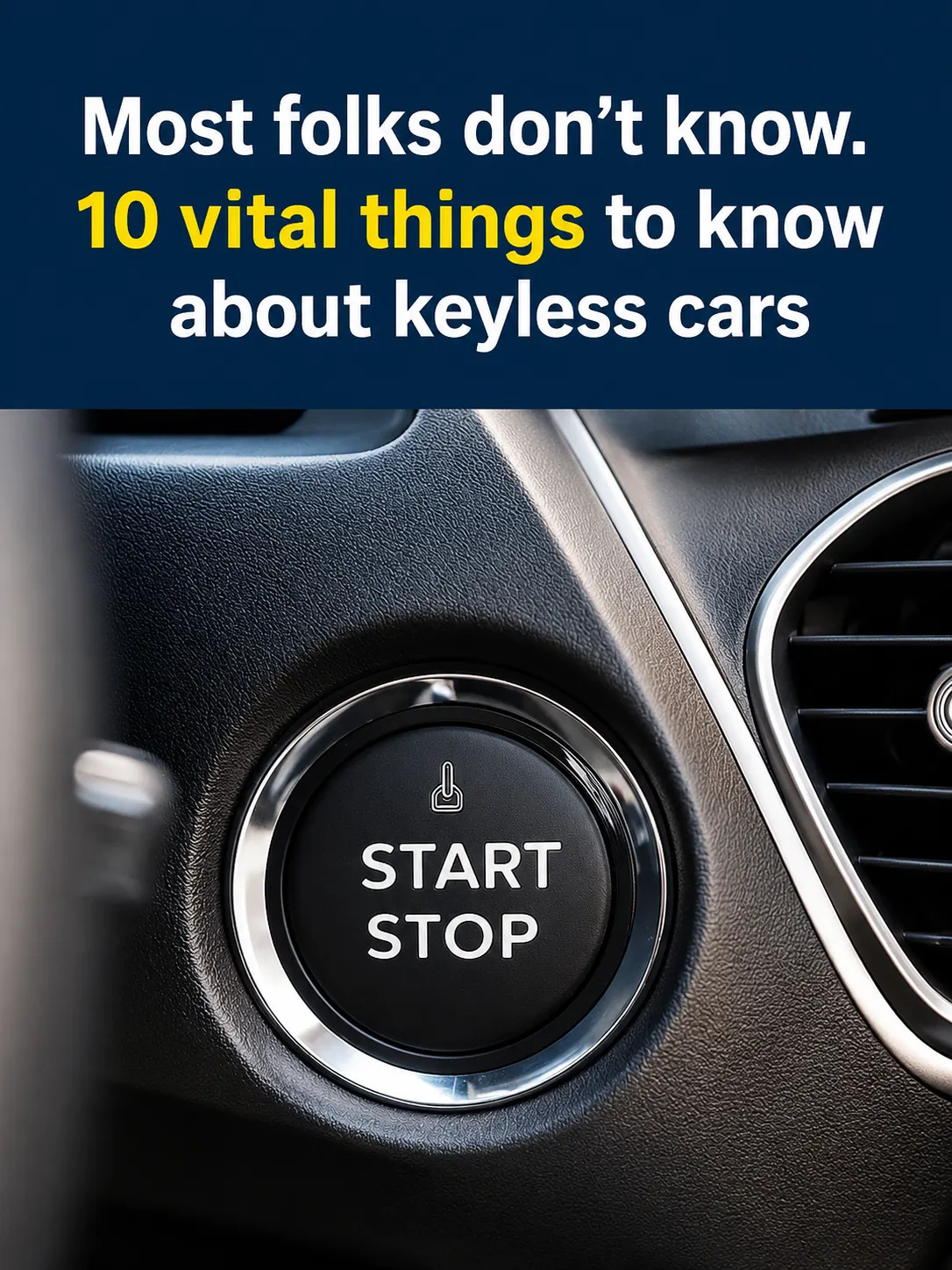
I’ll admit it: the first time I drove a keyless car, I loved the convenience immediately.
The key fob stayed in my pocket. I grabbed the door handle, climbed in, pushed a button, and drove away. No digging through a purse or checking every pocket while standing in a parking lot.
Pretty sweet, right?
But keyless cars also introduce a few things drivers never had to think about with an old-fashioned metal key. What happens when the key fob battery dies? Can someone copy its signal? Will the engine stop if you drive away without the fob? And what is that little hidden key inside some remotes actually for?
Modern keyless entry and push-button start systems are convenient, but understanding how yours works can save you from a frustrating morning—or potentially help protect your vehicle from theft.
Here are 10 vital things to know about keyless cars, including several details that plenty of longtime owners overlook.
What Is a Keyless Car?
A keyless car uses electronic communication between the vehicle and an authorized key fob, smartphone, card, or another compatible device.
With passive keyless entry, the vehicle can recognize an authorized fob when it gets close enough. Depending on the model, touching or pulling the door handle can then unlock the doors without requiring you to press the unlock button.
Push-button start works on a similar principle.
When the vehicle detects the authorized key inside the cabin, you can typically press the brake pedal and push the start button.
Simple on the surface.
Underneath, though, your car and key are performing an electronic authentication process.
And that brings us to the first thing every owner should understand.
1. Your Key Fob Is Constantly Important, Even When You Aren’t Pressing Buttons
A modern key fob isn’t simply a plastic replacement for a metal key.
It contains electronics that allow the vehicle to recognize an authorized key.
Depending on the system, the vehicle and key communicate wirelessly when they’re within the required range.
That’s why you may be able to leave the fob in your pocket while unlocking and starting the vehicle.
It’s wonderfully convenient when you’re carrying groceries.
You know the move—six grocery bags in one hand because making two trips is apparently against the law.
But that wireless convenience also means you need to think differently about where you keep the key at home.
More on that in a minute.
2. Keyless Cars Can Still Be Targeted by Thieves
One of the biggest misconceptions about keyless vehicles is that sophisticated electronics automatically make them impossible to steal.
Unfortunately, no vehicle security system should be treated as unbeatable.
One method associated with some keyless vehicles is called a relay attack.
In simplified terms, criminals may use electronic equipment to relay or extend communication between a vehicle and a nearby legitimate key fob.
The vehicle may then behave as though the authorized key is closer than it really is.
The details and vulnerability vary greatly by vehicle, key system, model year, and manufacturer.
Newer systems may include technology designed to make this type of attack harder.
Still, keyless-car owners shouldn’t assume that keeping the fob somewhere inside the house automatically makes the vehicle untouchable.
3. Where You Store Your Key Fob at Home Matters
I used to think tossing car keys onto a table beside the front door was the most logical place to keep them.
You walk in.
Keys go down.
You know exactly where they’ll be tomorrow.
For a keyless vehicle, however, keeping a fob immediately beside an exterior door or window may not always be the best choice.
A better habit is to store keys farther inside the home and follow the security guidance provided by your vehicle manufacturer.
Some owners also use properly designed signal-blocking containers or Faraday pouches.
If you buy one, periodically test it rather than assuming it works forever.
Put the key inside according to the product directions, take the pouch near the vehicle, and see whether the vehicle still recognizes the key.
The specific procedure depends on your car.
And don’t accidentally test this while your spare fob is sitting in your other pocket.
Yep, that’s exactly the kind of thing I’d do.
4. Your Key Fob Battery Will Eventually Die
This one catches people off guard.
The car battery isn’t the only battery involved anymore.
Your key fob normally contains a small replaceable battery, often a coin-cell type.
As it weakens, you may notice reduced operating range or receive a low-key-battery warning from the vehicle.
Don’t ignore that warning for six months.
Replacing a small fob battery at home is often considerably easier than figuring out what to do with an apparently dead remote in a dark parking lot.
The correct battery type and replacement procedure vary by fob, so check the owner’s manual.
I also like the idea of keeping a suitable spare battery at home.
Just check its expiration date occasionally.
A dead replacement battery isn’t much of a backup plan.
5. A Dead Fob Battery May Not Leave You Completely Stranded
Here’s one of the most useful keyless-car facts.
Many vehicles provide a backup method for getting into and starting the car when the fob battery is weak or dead.
The exact procedure varies.
Some key fobs contain a hidden mechanical key.
Look carefully at yours.
There may be a small release switch that allows a traditional metal key blade to slide out.
Meanwhile, the driver’s door may have a visible key cylinder or one hidden underneath a removable cover.
Starting procedures also vary.
Some vehicles can recognize the fob when it’s placed against a designated area or held near the start button, even when its battery is too weak for normal operation.
Other vehicles use a different backup procedure.
This is one of those things you should learn before you need it.
Open the owner’s manual and find the emergency key and dead-fob starting instructions.
It may be the most useful five minutes you spend with that manual all year.
6. The Car May Keep Running If the Key Leaves the Vehicle
Here’s a scenario that surprises people.
Suppose two people get into a push-button-start vehicle.
The passenger has the key fob.
The driver starts the engine.
Then the passenger gets out—with the fob still in their pocket.
What happens?
Many vehicles will warn the driver that the key is no longer detected, but an already-running engine may continue running rather than immediately shutting itself off.
That behavior can prevent a sudden engine shutdown in traffic.
However, once the engine is turned off, restarting it without the authorized key may be impossible.
The exact behavior differs between vehicles.
So make one habit automatic:
Before leaving, confirm that the driver actually has the key.
This matters especially with couples or families who share a car.
Nothing spices up a road trip quite like realizing the key is 45 miles behind you.
7. Push-Button Start Makes It Important to Confirm the Engine Is Actually Off
Traditional keys gave drivers a physical routine.
Turn key.
Remove key.
Engine off.
Push-button systems change that routine.
In some situations, drivers may leave a vehicle without realizing the engine is still running, particularly with quiet modern engines or hybrids.
Never rely only on engine noise.
Check the dashboard.
Confirm that the vehicle is in Park.
Turn it off according to the manufacturer’s instructions.
Take the key with you.
Lock the vehicle.
This becomes especially important when parking in or near an attached garage.
A running gasoline engine produces carbon monoxide, an odorless, colorless gas that can cause severe poisoning or death.
Never leave a combustion engine running inside an enclosed garage, even if the garage door is open.
That isn’t merely a car-care tip.
It’s a serious household safety habit.
8. Keyless Doesn’t Mean Maintenance-Free
Because there isn’t a traditional ignition key to turn, it’s easy to think there isn’t much to maintain.
Not quite.
Your keyless system depends on several components.
There’s the fob battery.
There’s the vehicle’s 12-volt battery.
There are electronic receivers and other components.
Depending on the vehicle, software may also play a role.
A weak vehicle battery can sometimes produce electronic symptoms that appear unrelated at first.
Likewise, a damaged or water-exposed key fob may stop behaving normally.
Keep the fob reasonably protected.
Don’t intentionally soak it.
Don’t leave it somewhere exposed to extreme heat.
And if the case breaks, don’t wait until the internal electronics are hanging out before doing something about it.
Your key fob has one job.
Give the little guy a fighting chance.
9. Physical Anti-Theft Devices Can Still Have Value
We have smartphones that can act as keys and cars packed with computers.
So an old-fashioned steering-wheel lock can look almost comically basic.
But visible physical security can still serve as another obstacle.
Think in layers.
Lock the vehicle.
Close the windows.
Don’t leave valuable items visible.
Store your keys thoughtfully.
Use manufacturer-provided security settings where appropriate.
Consider additional approved physical security for vehicles at elevated theft risk.
Park in a well-lit or secured area when possible.
No single measure makes a vehicle impossible to steal.
The idea is to make unauthorized access more difficult.
Sometimes low-tech and high-tech can work perfectly well on the same driveway.
10. You Need to Learn Your Specific Car’s Keyless Features
This might be the most important point in the entire article.
Not all keyless cars behave the same way.
One vehicle may automatically lock when you walk away.
Another may not.
One may beep when the fob is left inside.
Another may behave differently depending on settings.
One may have a hidden mechanical key cylinder.
Another may place it somewhere completely unexpected.
Your car may also let you change keyless settings through the infotainment system.
That’s why generic advice can only go so far.
Spend a few minutes with your owner’s manual and learn:
- How to enter the vehicle with a dead key-fob battery
- How to start it when the fob battery is dead
- How to replace the fob battery
- What the key warning lights mean
- Whether walk-away locking is available
- What happens when the key leaves a running vehicle
- How to disable or change keyless functions, if supported
- Where the emergency mechanical key is located
- What to do if the fob is lost
- How spare keys are handled
Future-you may be extremely grateful.
What Happens If You Lose Your Keyless Car Fob?
Losing a modern key can be more complicated than losing an old metal key.
A replacement may need to be programmed or paired with the vehicle.
Depending on the manufacturer, that may require a dealer, locksmith, authorized service provider, or specific equipment.
If your key was stolen rather than simply misplaced, contact the appropriate service provider and ask what steps can be taken to prevent the missing key from continuing to access or start the vehicle.
Don’t automatically assume that buying a random replacement fob online will solve the problem.
Compatibility and programming requirements vary.
Before spending money, confirm exactly what your vehicle requires.
Should You Keep a Spare Key Fob?
Yes, having a working spare can be extremely useful.
But don’t store it inside the vehicle.
That rather defeats the point.
Keep the spare somewhere secure.
Check its battery periodically.
Make sure household members who may need the car know where the spare is stored.
And if you’re taking a long road trip, think carefully about backup-key arrangements.
For some trips, having a second authorized key kept securely by another adult can provide useful redundancy.
Just don’t put both keys on the same key ring.
That’s not two backups.
That’s one very expensive thing to lose.
Should You Keep Your Key Fob Near the Front Door?
For convenience, it’s tempting.
For security, farther inside the home may be preferable, depending on your vehicle’s system and manufacturer guidance.
The main goal is to avoid making wireless access easier than necessary.
You should also keep keys away from places where someone could simply reach through an open window, letter slot, or easily accessible entrance and grab them.
And yes, this sounds incredibly obvious.
But the obvious stuff is usually obvious right up until the morning your keys aren’t there.
Are Faraday Pouches Worth Using?
A Faraday-style key pouch is designed to block radio signals when used correctly.
It may be a useful layer for some keyless-car owners concerned about relay theft.
However, quality varies.
A poorly designed, damaged, worn, or improperly closed pouch may not perform as expected.
That’s why testing matters.
Follow the product instructions and periodically verify that your vehicle cannot detect the key while it is properly enclosed.
Also check your automaker’s recommendations because some modern fobs include security features that may change the advice for a particular vehicle.
What About Smartphone Digital Keys?
Some newer vehicles allow a compatible smartphone or wearable device to act as a digital key.
That’s incredibly convenient.
It also means your phone becomes part of your vehicle-access security.
Protect the phone with a strong passcode or biometric authentication.
Keep its operating system current.
Use the vehicle manufacturer’s official procedures when sharing digital keys.
Remove access when someone no longer needs it.
And learn what happens when the phone battery dies.
Technology is great.
Technology with a backup plan is better.
What Should You Do If Your Key Fob Stops Working?
First, don’t immediately assume the entire car has failed.
Check the obvious possibilities.
The fob battery may be weak.
The vehicle battery may be weak.
The fob may be damaged.
You may also be experiencing interference or another electronic issue.
Try your spare authorized fob if you have one.
Check the owner’s manual for the emergency-entry and emergency-start procedures.
If the problem continues, contact an appropriate qualified service provider.
Avoid repeatedly pressing random button combinations you found buried in an old internet comment unless you’re certain they apply to your exact year and model.
Cars are expensive.
Guessing is free right up until it isn’t.
Keyless Car Security Habits Worth Making Automatic
Good security doesn’t need to turn everyday parking into a 20-minute ceremony.
A few habits cover a lot of ground.
Lock the vehicle every time you leave it. Keep windows closed when unattended. Don’t leave the fob inside. Store keys thoughtfully at home. Keep valuables out of sight. Pay attention to unusual warnings from the vehicle. Learn how your backup key works. Replace a weakening fob battery before it completely dies.
For vehicles that face a higher theft risk, additional physical security may also make sense.
Simple habits are easier to maintain than complicated routines.
And security only works when you actually use it.
Common Keyless Car Mistakes to Avoid
One common mistake is assuming the vehicle locked itself.
Don’t assume.
Confirm.
Another is ignoring low-fob-battery warnings until the remote completely stops responding.
Drivers also sometimes forget that another passenger has the key and drive away after that person exits.
Keeping both primary and spare keys in the same location can also create problems if they’re stolen together.
Other mistakes include leaving the engine running accidentally, failing to learn the mechanical-key backup procedure, and assuming every keyless vehicle operates exactly like the last one you owned.
The technology may look similar.
The details can be very different.
Are Keyless Cars Safe?
Keyless systems offer real convenience and can include sophisticated security features.
But “keyless” shouldn’t be confused with “risk-free.”
Security depends on the vehicle, system design, owner habits, local theft patterns, and other factors.
The smartest approach isn’t to become paranoid about your car key.
It’s simply to understand the system you’re already carrying around in your pocket.
Once you know how the backup features work and develop a few good habits, keyless ownership becomes much less mysterious.
Frequently Asked Questions
How does a keyless car know the key is nearby?
Keyless systems use wireless communication between an authorized key or device and the vehicle. The exact technology and authentication process differ between manufacturers and models.
Can a keyless car be stolen without the key?
Vehicle theft methods exist for both conventional and keyless vehicles. Certain keyless systems have been targeted by relay-style attacks, although security technology differs significantly between vehicles.
What happens when the key fob battery dies?
Many vehicles provide a backup entry and starting procedure. The fob may contain a hidden mechanical key, while the vehicle may provide a special way to recognize a weak or dead fob. Check the owner’s manual for your model.
Will my car stop if the key fob battery dies while I’m driving?
An already-running vehicle generally isn’t designed to abruptly shut the engine off simply because a fob battery fails. However, behavior varies by model, so check your owner’s manual.
Can I drive away without the key fob?
Some vehicles can continue operating after an authorized fob that was present during startup leaves the cabin. The vehicle may display or sound a warning, and you may not be able to restart after shutting it off.
Is there a regular key hidden inside my key fob?
Many key fobs contain an emergency mechanical key, but not all systems are identical. Check your fob and owner’s manual before an emergency occurs.
Where should I store my keyless car keys at night?
Keep them in a secure location and consider placing them away from exterior doors and windows. Follow your vehicle manufacturer’s security recommendations.
Does a Faraday pouch protect a key fob?
A properly functioning signal-blocking pouch is designed to block wireless communication. Performance varies, so follow the product instructions and test it periodically.
How often should I replace my key fob battery?
There isn’t one replacement interval for every key. Replace the battery when your manufacturer recommends it or when the vehicle indicates the battery is becoming weak.
Can I replace a key fob battery myself?
Many fob batteries can be replaced by owners, but procedures vary. Use the correct battery type and follow the owner’s manual instructions to avoid damaging the case or electronics.
Can I leave my key fob inside my car?
Don’t intentionally store the key fob inside an unattended vehicle. Keep the authorized key with you and store spare keys securely elsewhere.
Are smartphone car keys safe?
Digital car keys can include strong security features, but users should still protect their phones with appropriate authentication, keep software current, and manage shared digital-key permissions carefully.
Final Thoughts
I love the convenience of a keyless car.
Walking up, opening the door, pressing Start, and driving away without digging for a key feels completely normal once you’ve lived with it for a while.
But convenience works better when you understand what’s happening behind it.
Know where your spare key is.
Learn how the hidden mechanical key works, if your fob has one.
Find the dead-fob starting procedure before you’re stranded somewhere.
Take low-battery warnings seriously.
Be thoughtful about where you keep the fob at home.
And above all, read the section of your owner’s manual that covers the keyless system.
Ten minutes today could save you a tow, an expensive service call, or one seriously annoying morning later.
Your car may be keyless.
Your plan shouldn’t be.