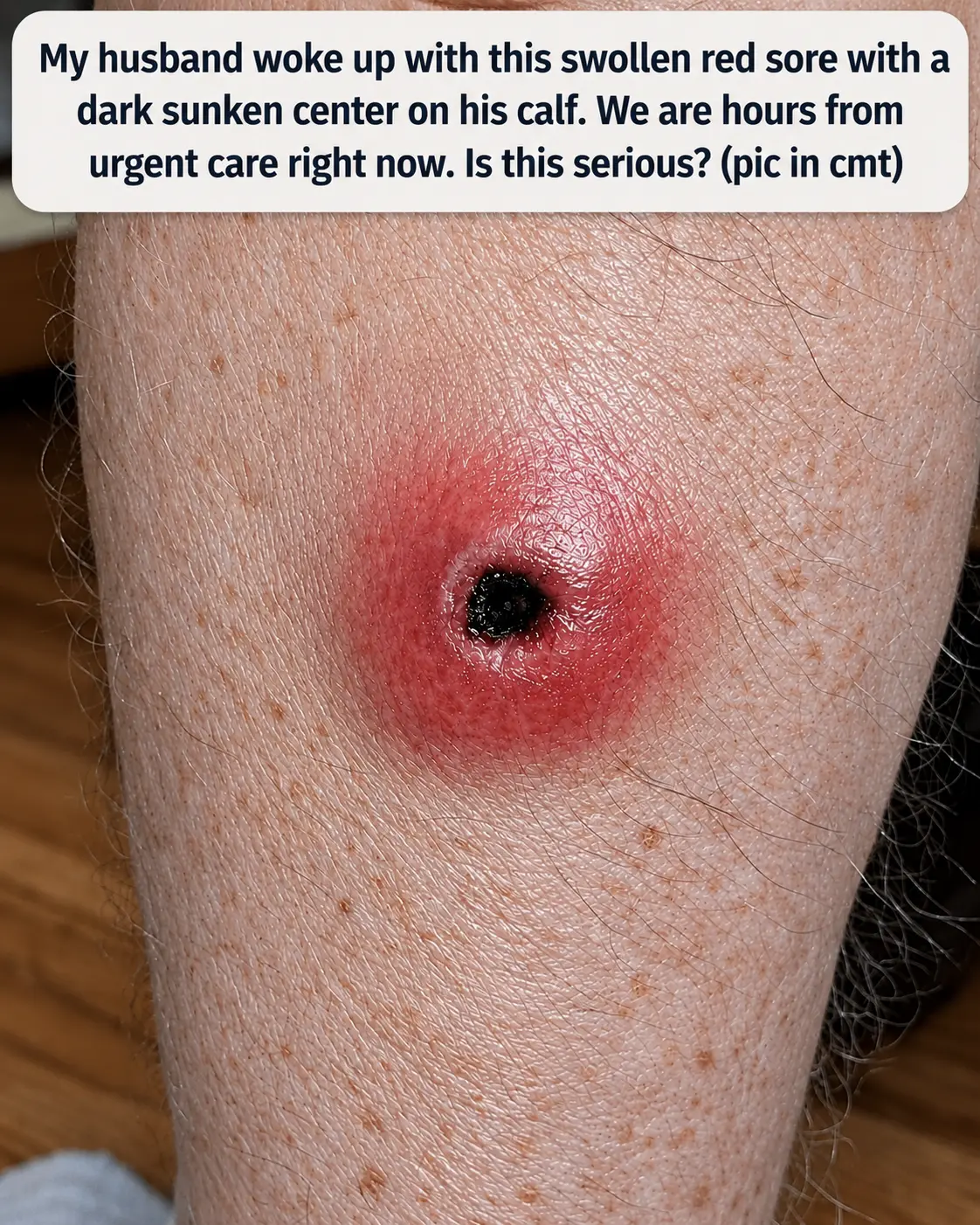
A swollen, painful red sore on the calf can already be concerning.
Add a dark, sunken, purple, gray, or black center, and that is not something I would casually brush off as a harmless bug bite.
Several things can cause a sore like this. A skin infection, boil, abscess, cellulitis, tissue injury, or certain insect or spider bites can all produce redness and swelling. The important part is that a dark center can sometimes point to damaged tissue or a deeper process under the skin. :contentReference[oaicite:0]{index=0}
If the area is getting larger, hotter, more painful, or more swollen, or if the person has fever or feels sick overall, prompt medical care matters.
Here’s what to look for, what you can safely do at home while arranging care, and which symptoms mean the situation should not wait.
Why a Dark Center Can Be Concerning
A simple mosquito bite usually causes a small itchy bump.
A sore with spreading redness and a darker center is different.
The center may look:
- Purple
- Gray
- Black
- Bruised
- Blistered
- Sunken
- Crater-like
That appearance can sometimes reflect damaged tissue, reduced blood flow, a collection of infection beneath the skin, or another process that needs medical assessment. :contentReference[oaicite:1]{index=1}
You cannot reliably tell the exact cause just by looking at it at home.
That is especially true when the wound is painful or changing quickly.
Could It Be a Brown Recluse Spider Bite?
It is possible in areas where brown recluse spiders live, especially parts of the south-central and Midwestern United States.
These spiders tend to hide in quiet places such as:
Closets.
Basements.
Garages.
Sheds.
Boxes.
Shoes.
Gloves.
Stored bedding.
Some bites are not immediately painful. A person may notice redness or discomfort later.
A suspected bite may develop a pale, dusky, blistered, or ulcer-like center over time. :contentReference[oaicite:2]{index=2}
However, there is an important catch.
Many wounds blamed on spiders turn out to be bacterial skin infections instead.
So unless someone actually saw and identified the spider, it is safer to think of the problem as an unexplained skin lesion rather than assuming the cause.
Skin Infections Can Look Like “Spider Bites”
This happens a lot.
A red painful sore with swelling and a dark or draining middle can be caused by:
Cellulitis.
A boil.
An abscess.
A staph infection.
MRSA.
Inflamed hair follicles.
Other bacterial infections.
These can sometimes progress quickly.
An abscess may need drainage.
Cellulitis may need antibiotics.
That is why a worsening lesion deserves medical evaluation even if nobody feels sure what caused it.
What Features Make the Sore More Urgent?
A few details raise concern more than others.
Pay close attention if the sore has:
Increasing redness.
Rapidly worsening swelling.
A darkening center.
A blister.
A blood-filled blister.
Drainage.
Foul odor.
Severe pain.
A growing crater.
Red streaks traveling upward.
Swelling that makes one calf look noticeably larger than the other.
The source material specifically notes that a dark, bluish, purple, or black center can suggest poor blood flow or tissue death in the middle of the lesion. :contentReference[oaicite:3]{index=3}
That is not something I would ignore.
Check for Whole-Body Symptoms Right Away
The sore itself matters.
So does how the person feels overall.
Ask about:
Fever.
Chills.
Nausea.
Vomiting.
Body aches.
Dizziness.
Weakness.
Headache.
Fast heartbeat.
Trouble breathing.
Confusion.
Extreme sleepiness.
Shakiness.
These symptoms may suggest a spreading infection or a stronger systemic reaction.
Take the Temperature
Use a thermometer.
Do not rely on touching the forehead.
Write down the temperature and the time.
The source material flags a temperature of 100.4°F or higher as a reason for greater concern, especially with worsening pain or other symptoms. :contentReference[oaicite:4]{index=4}
If the person looks seriously ill, though, do not wait for a perfect temperature reading before seeking help.
Should You Check Blood Pressure or Oxygen?
If you already have a blood pressure cuff or pulse oximeter, you can check them.
But do not delay care just to collect more numbers.
A visibly worsening wound plus serious symptoms matters more than getting a complete home vital-sign set.
What to Do in the Next 30 Minutes
If the person is stable and you are arranging care, there are a few safe steps you can take.
1. Wash the Area Gently
Use mild soap and lukewarm water.
Clean the area gently.
Do not scrub aggressively.
Pat dry with a clean towel.
2. Cover Open Skin
If the sore is open, place a clean dry dressing or gauze over it.
Do not wrap it tightly.
You want protection without trapping swelling.
3. Remove Tight Clothing
Take off tight socks, compression sleeves, or anything squeezing the calf.
Swelling needs room.
4. Elevate the Leg
Raise the leg slightly above heart level if practical.
This can help with swelling.
5. Use a Cool Compress
A cloth-wrapped cold pack can help discomfort and swelling.
The source suggests about 10 minutes on and 10 minutes off. :contentReference[oaicite:5]{index=5}
Do not place ice directly on damaged skin.
Do not leave intense cold in place for a long time.
Mark the Edge of the Redness
This is one of the most practical things you can do.
Use a pen to lightly mark the outside edge of the red area.
Write the time nearby.
Then take a photo.
If the redness extends beyond that line over the next hour or two, you now have clear evidence that it is spreading.
That information can help the clinician.
Do not spend hours watching an obviously worsening lesion just to document it, though.
The point is to track change while arranging care, not to delay care.
Take Clear Photos
Photograph the sore before leaving.
Take:
One close-up.
One wider photo showing the calf.
Another photo if the area changes.
Time-stamped images can help a clinician see whether the lesion worsened over two hours, six hours, or overnight.
That can be more useful than trying to remember exactly what it looked like.
What Not to Do
This part matters.
Do Not Cut It Open
Do not lance it.
Do not poke it with a needle.
Do not try to drain it yourself.
If it is an abscess, improper drainage can spread infection or cause injury.
Do Not Squeeze It
Squeezing can irritate tissue and may push infection deeper.
Do Not Try to “Remove Venom”
There is no safe home method for sucking venom out of tissue.
Do not use suction devices.
Do not cut around the lesion.
Do Not Use a Tourniquet
A tourniquet can reduce blood flow and cause more damage.
Avoid Heat
Heat can worsen swelling in some situations.
A cool compress is a safer short-term choice.
Skip Harsh Home Remedies
Avoid repeatedly applying:
Full-strength hydrogen peroxide.
Bleach.
Essential oils.
Baking soda paste.
Butter.
Strong alcohol.
Other irritating substances.
These can damage already-injured skin.
Do Not Start Leftover Antibiotics
Old antibiotics from another illness may be the wrong drug, the wrong dose, or the wrong duration.
Starting them can also make later evaluation more confusing.
Use antibiotics only when prescribed for the current problem.
What About Pain Medicine?
If the person normally takes over-the-counter pain medicines safely, a labeled dose of acetaminophen or ibuprofen may help.
But medical conditions and medications matter.
Extra caution is needed with:
Kidney disease.
Liver disease.
Stomach ulcers.
Blood thinners.
Bleeding disorders.
Certain heart conditions.
Other medication interactions.
Follow the package directions and do not exceed the recommended dose.
Pain that keeps getting worse despite ordinary pain medicine is itself useful information to report.
When to Call Emergency Services Instead of Driving
Some symptoms make a long car trip the wrong choice.
Call emergency services if the person has:
Trouble breathing.
Swelling of the lips or tongue.
Fainting.
Severe confusion.
Chest pain.
Repeated uncontrolled vomiting.
Severe weakness.
Gray or clammy appearance.
Difficulty waking.
A rapidly worsening general condition.
The source also warns about a leg that suddenly becomes extremely swollen, cold, blue, numb, or difficult to move. :contentReference[oaicite:6]{index=6}
Those signs can point to a circulation or deep-tissue emergency.
When Same-Day Medical Care Makes Sense
Even without dramatic whole-body symptoms, I would seek same-day evaluation if the sore has:
A dark or black center.
Spreading redness.
Increasing swelling.
Moderate or severe pain.
Drainage.
A blister.
Worsening tenderness.
Fever.
A cratered appearance.
The source also recommends greater caution when the lesion is larger than about an inch across or clearly expanding. :contentReference[oaicite:7]{index=7}
The exact size is less important than the pattern of change.
A rapidly worsening small lesion can matter more than a stable larger one.
Some People Need Care Sooner
A lower threshold for medical evaluation makes sense if the person has:
Diabetes.
Poor circulation.
Immune suppression.
Recent chemotherapy.
Chronic steroid use.
Kidney disease.
A history of serious skin infections.
These conditions can make wound complications more likely or harder to control.
Why Diabetes Matters
Diabetes can affect circulation, immune response, and wound healing.
A skin lesion that might be minor in one person can become more serious in someone with diabetes.
Do not wait for severe symptoms before seeking care if redness, swelling, or tissue damage is increasing.
What a Clinician May Check
At urgent care or the emergency department, a clinician will usually inspect:
The size.
Color.
Warmth.
Tenderness.
Depth.
Drainage.
Swelling.
Dark center.
Any blistering.
They may also press gently to see whether there is fluctuance, which can suggest a pocket of pus beneath the skin. :contentReference[oaicite:8]{index=8}
They may ask:
When it started.
Whether it changed overnight.
Whether anyone saw an insect or spider.
Whether there has been fever.
Whether the person has had similar infections before.
Whether there are medical conditions affecting immunity.
What Treatment Might Be Needed?
Treatment depends on the cause.
If there is a bacterial infection, antibiotics may be needed.
If there is a true abscess, drainage may be necessary.
If the lesion is thought to be from a spider bite, care may focus on wound care, pain control, monitoring, and follow-up.
Blood tests may be ordered if the person appears systemically ill.
Not every skin lesion needs laboratory testing.
The clinical picture decides that.
What to Watch for Over the Next 24 to 72 Hours
Some concerning lesions do not look terrible on day one.
They can worsen later.
Watch for:
Increasing size.
More swelling.
More pain.
A darker center.
Purple or black discoloration.
New blistering.
Yellow or green drainage.
Bad odor.
Red streaks moving up the leg.
Fever.
Worsening fatigue.
New rash elsewhere.
The source material also highlights dark or cola-colored urine after a suspected brown recluse bite as a reason for immediate medical attention. :contentReference[oaicite:9]{index=9}
That symptom should not be watched at home.
Red Streaks Up the Leg Are Important
Red streaking can suggest that inflammation or infection is moving through lymphatic channels.
If streaks are spreading upward from the wound, seek prompt medical care.
Pair that with fever or worsening illness, and the situation becomes even more urgent.
What Does Black Skin in the Center Mean?
Black or gray tissue can sometimes represent tissue death, also called necrosis.
But not every dark spot is necrosis.
Bruising, dried blood, scabbing, and blistering can also look dark.
You should not try to diagnose that distinction yourself by scraping, picking, or cutting the center.
Let a clinician assess it.
Is Every Brown Recluse Bite Dangerous?
No.
Not every bite causes serious tissue damage.
Some remain mild.
Others can become more painful and develop a damaged center over time.
The difficulty is that many suspected recluse bites are never confirmed.
And many infected wounds look very similar.
That is why the safest approach is to focus on the lesion’s behavior rather than trying to identify the exact insect.
Did You Actually See the Spider?
If not, avoid becoming too attached to the spider-bite theory.
This matters because assuming “spider bite” can sometimes delay treatment for bacterial infection.
If a spider was actually seen and can be safely photographed without handling it, that may help.
Do not chase or handle a potentially venomous spider just for identification.
Could It Be MRSA?
Yes, some MRSA skin infections can look like what people describe as a spider bite.
They may start as:
A red bump.
A painful sore.
A boil.
A swollen tender area.
A lesion with pus.
A dark or crusted center.
Only a clinician can decide whether testing or specific antibiotic treatment is needed.
Could It Be Cellulitis?
Yes.
Cellulitis is a bacterial infection of deeper skin layers.
It can cause:
Redness.
Warmth.
Swelling.
Pain.
Tenderness.
Fever.
The red area may spread over time.
Cellulitis usually needs medical treatment rather than home remedies.
Could It Be an Abscess?
An abscess is a pocket of pus under the skin.
It can feel:
Tender.
Warm.
Firm around the edges.
Softer in the center.
Painful with pressure.
Some abscesses drain on their own.
Others require medical drainage.
Do not attempt to drain one at home.
Could It Just Be a Bug Bite?
Yes, some insect bites become red and swollen.
The issue is the dark or sunken center and the degree of swelling or pain.
If the sore is clearly worsening, that moves the situation away from routine home observation.
A mild itchy bump is one thing.
A painful expanding lesion with tissue color change is another.
What About a Tick Bite?
Tick bites can cause several skin reactions, but a dark-centered painful swollen sore is not enough information to identify one.
If there has been tick exposure, tell the clinician.
Bring up:
Recent hiking.
Tall grass.
Wooded areas.
Pets carrying ticks.
Known tick removal.
Again, don’t force the lesion into one diagnosis based on appearance alone.
What About a Blood Clot?
A blood clot in the leg usually does not cause a cratered dark sore by itself.
But severe calf swelling, pain, warmth, or one-sided leg enlargement can also raise concern for a clot.
If the calf becomes significantly more swollen than the other side, especially with shortness of breath or chest pain, that deserves emergency evaluation.
Don’t assume every calf problem is only about the skin.
A Simple Plan for a Long Drive to Care
If the person is stable enough to travel and a clinician has not advised emergency transport, prepare efficiently.
Bring:
Medication list.
Allergy list.
Insurance information.
Identification.
Phone charger.
Water.
Photos of the sore.
Notes about when symptoms started.
Temperature readings.
A clean dressing.
Keep the leg comfortable and avoid unnecessary pressure on the sore.
If the person is the one with significant pain or weakness, they should not be the driver.
Call Ahead If You Can
If you live far from care, a nurse line or emergency department can sometimes help with triage while you prepare.
Describe the lesion clearly.
For example:
“An adult woke up with a painful swollen red sore on the calf with a dark sunken center, and the redness appears to be increasing.”
That communicates much more than:
“He has a bite.”
Poison Control May Be Helpful for a Suspected Bite
The source material notes that in the United States, Poison Control can be reached at 1-800-222-1222 for guidance about suspected bites or stings. :contentReference[oaicite:10]{index=10}
That can be useful when a venomous bite is a real concern.
It should not delay emergency care if the person is seriously ill.
Frequently Asked Questions
Is a red swollen sore with a black center serious?
It can be. A dark center with increasing redness, swelling, pain, or drainage can suggest tissue damage or infection and should be medically assessed.
Could a brown recluse bite look like this?
Yes, some brown recluse bites can develop a dusky, blistered, or ulcer-like center. However, many suspected spider bites are actually bacterial skin infections.
Should I squeeze a sore with a dark center?
No. Do not squeeze, lance, or cut it. If there is an abscess, a clinician can decide whether drainage is needed.
Should I put ice directly on it?
No. Use a cool pack wrapped in cloth for short periods rather than applying ice directly to damaged skin.
Should I put peroxide on it?
Repeated full-strength hydrogen peroxide can irritate damaged tissue. Gentle soap and water is a safer basic cleaning method unless a clinician gives other instructions.
What does spreading redness mean?
Expanding redness may suggest increasing inflammation or infection. Mark the outer edge and note the time, but seek medical care if it continues spreading.
Does fever make it more urgent?
Yes. Fever with a painful spreading skin lesion raises concern for infection and deserves prompt medical evaluation.
What if there is pus?
Pus can suggest an abscess or bacterial infection. Do not drain it yourself.
What if red streaks appear?
Red streaks moving away from the sore can indicate spreading infection and warrant urgent medical care.
What if the calf becomes extremely swollen?
A suddenly very swollen, blue, cold, numb, or weak leg is an emergency. Seek immediate medical help.
What if he feels completely fine?
A person can feel fairly well early in a skin infection or tissue injury. A worsening dark-centered lesion still deserves attention even without fever.
Can I wait until tomorrow?
If the lesion is stable, mild, and not changing, a clinician may sometimes advise short observation. But a dark center, spreading redness, increasing pain, swelling, drainage, or fever are reasons not to delay.
Final Thoughts
A swollen red sore with a dark center on the calf can have several causes, and some of them need prompt treatment.
It might be an insect or spider bite.
It might be cellulitis.
It might be an abscess.
It might be another skin infection.
What matters most is whether the lesion is changing.
If the redness is spreading, the center is becoming darker, swelling is increasing, pain is worsening, drainage appears, or fever develops, arrange medical care promptly.
If the person becomes confused, faint, short of breath, severely weak, hard to wake, or the leg suddenly becomes cold, blue, numb, or massively swollen, call emergency services.
At home, keep the first steps simple.
Wash gently.
Cover open skin.
Use a cool compress.
Elevate the leg.
Mark the edge of the redness.
Take photos.
And please don’t cut, squeeze, burn, or try to “draw out” whatever caused it.
When the choice is between an inconvenient long drive and waiting on a painful dark-centered wound that is clearly getting worse, getting it checked is the safer move.