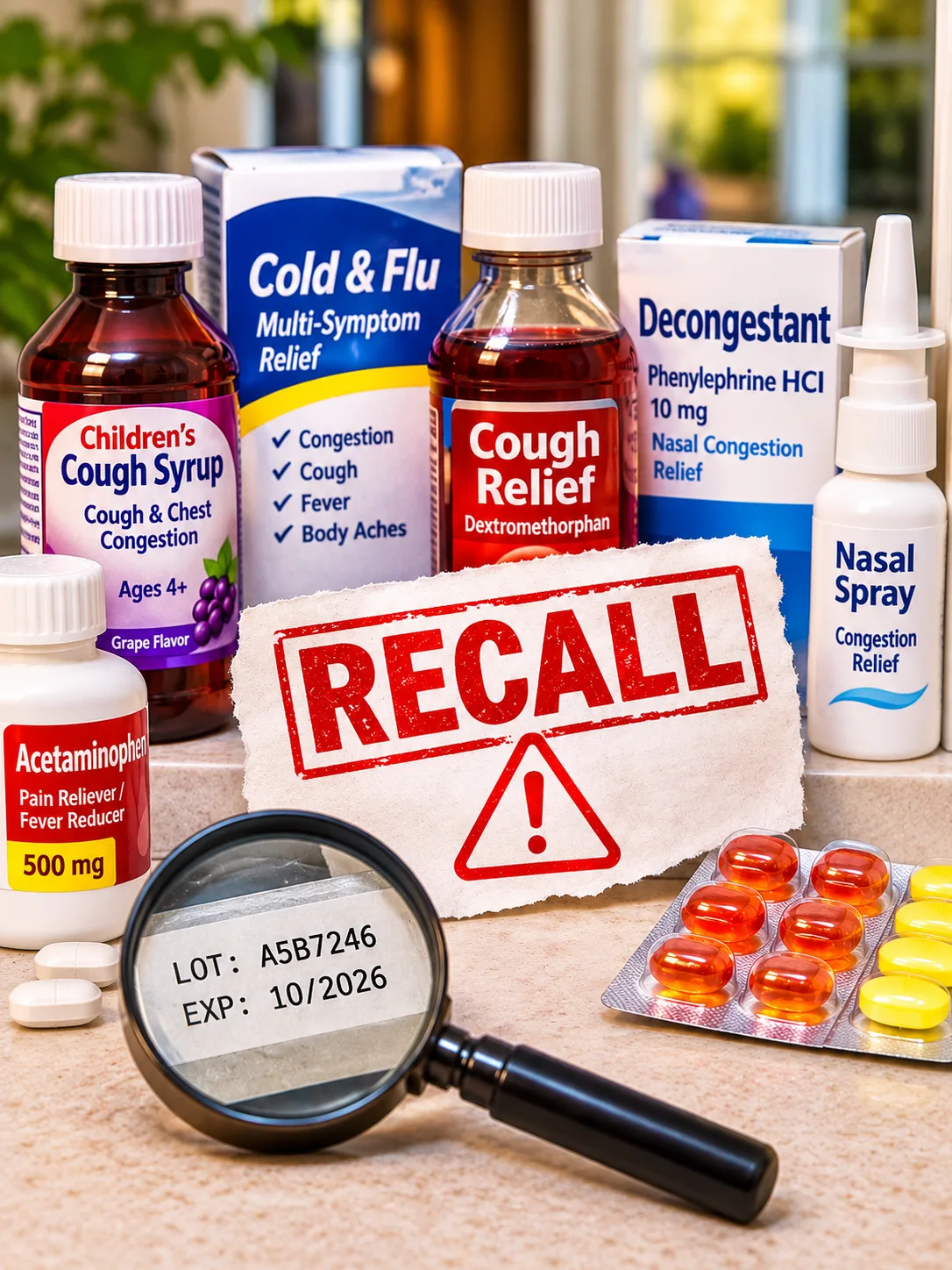
Every October, when the first hard frost nips the pumpkin leaves and the grandkids start sniffling after school, I do what my mother did and what I’ve done for decades: I open the medicine cabinet and take stock. Most of us mean well when we tuck away a half-used bottle of cough syrup or a box of cold tablets “just in case,” but that old habit can turn risky in a hurry. Recalled medicines have a way of lingering in bathroom cupboards, kitchen junk drawers, and bedside baskets long after the warning flashes across the news.
This is one of those subjects that calls for plain talk. If you have cold and flu medicine at home this October, it is worth taking 15 quiet minutes to read labels, lot codes, and expiration dates. Below, I’m walking through 11 recalled cold and flu medication warnings that may still be affecting products Americans commonly keep on hand, along with what to check, why the recalls happened, and what I’d do in my own farmhouse before anyone in the family takes another spoonful.
1. Children’s cough syrups recalled for contamination risk
One of the most concerning warnings in recent years involved children’s liquid medications recalled because of possible microbial contamination. In several high-profile cases, products marketed for infants and children were pulled after testing raised concerns about bacteria or other contamination during manufacturing. That matters because little ones may already be dehydrated, feverish, or worn down when a parent reaches for those medicines.
If you have a children’s cough syrup, cold syrup, or infant fever-and-cold combination product, check three things: the brand name, the lot number printed near the bottom or side seam, and the expiration date. Lot numbers are often a string of 6 to 10 letters and numbers. If the label is smeared or missing, I would not keep it. In my kitchen, if I can’t clearly identify a medicine, it goes in the discard pile right away.
2. Decongestant products containing phenylephrine under heavy scrutiny
This is the warning many folks are still hearing about: oral phenylephrine products for nasal congestion. While this issue was not a classic contamination recall in every case, it became a major safety-and-effectiveness warning after federal review found that oral phenylephrine may not work as intended when taken by mouth at the approved dose. That includes many cold and flu tablets, daytime capsules, and combination products sold for stuffy nose relief.
If your box says “phenylephrine HCl” on the Drug Facts panel, usually in 5 mg or 10 mg amounts per dose, it is worth pausing before you use it. Many people bought these products in bulk, especially 24-count, 48-count, and 72-count family boxes, and they can sit for months. The concern here is not always contamination but relying on a medicine that may not actually relieve congestion. That can lead people to take more than directed or combine products unsafely.
3. Store-brand cold and flu liquids tied to manufacturer recalls
One thing I’ve learned over the years is that the label on the front doesn’t tell the whole story. A national brand, a discount chain brand, and a pharmacy house brand may all be made by the same manufacturer. When one plant has a quality-control problem, the recall can spread across a surprising number of store-brand cold and flu liquids.
That means your bottle from a dollar store, big-box retailer, or neighborhood pharmacy deserves the same careful look as a name-brand product. Check the recall notice against the manufacturer listed on the back label, usually in very small print. I keep a magnifying glass in the junk drawer for just this purpose. If the manufacturer matches a recalled company and the product category lines up, don’t assume you’re safe just because the front label looks different from the one shown on television.
4. Cough syrups recalled for incorrect dosing markings
Some recalls happen because the medicine itself is not contaminated, but the packaging can still put a family at risk. A dosing cup with wrong measurement lines, a syringe marked in teaspoons instead of milliliters, or a label that conflicts with the enclosed instructions can all lead to overdosing. With cough and cold medicines, even a small measuring error matters, especially in children under 12.
Look for dosing devices marked in mL only, with clear lines such as 2.5 mL, 5 mL, and 10 mL. If your package came with no measuring device, or if the cup is cracked, faded, or mismatched, do not improvise with a kitchen spoon. A household teaspoon can vary by more than 1 mL, which is enough to throw off a child’s dose. I’ve seen too many folks in a rush use the nearest spoon in the silverware drawer, and it’s simply not precise enough.
5. Acetaminophen combination products that invite accidental double-dosing
Many recalled or relabeled cold and flu products involve combination formulas containing acetaminophen along with a decongestant, antihistamine, or cough suppressant. The danger is that people may take that multi-symptom medicine and then also take a separate fever reducer, not realizing they are doubling up on the same ingredient.
Acetaminophen may appear as “acetaminophen 325 mg,” “500 mg,” or abbreviated as “APAP” in some settings, though consumer labels usually spell it out. Adults should pay close attention to total daily intake. In practical home terms, if someone takes 2 doses of a nighttime cold medicine and then adds extra Tylenol-style tablets every 4 to 6 hours, the total can climb too fast. Any recalled or misbranded product in this category deserves extra caution because the labeling confusion itself becomes part of the hazard.
6. Nasal sprays recalled for sterility concerns
Nasal sprays feel simple and harmless, but they are one of the products I watch closely because they go directly into the nose, where irritated tissue is already vulnerable. Some sprays have been recalled for sterility problems, foreign material concerns, or manufacturing defects that could affect the contents or the nozzle.
Inspect the bottle before use. If the spray tip is discolored, the liquid looks cloudy when it should be clear, or the pump sputters after only a few uses, set it aside. Also check whether the safety seal was intact when opened. In my house, once a nasal spray has rolled around in a purse, truck console, or coat pocket through temperature swings from 20°F to 80°F, I’m less trusting of it even before the expiration date.
7. Imported cold remedies sold online without proper FDA oversight
This is a newer trouble spot, and it’s one I mention to my own grown children all the time. A surprising number of cold and flu remedies are bought through online marketplaces, often in multi-packs of 2, 4, or 6 boxes. Some are imported, some are labeled partly in another language, and some make big claims that sound better than anything at the local pharmacy. When those products are recalled, many families never hear about it.
If the package lacks a standard Drug Facts panel, has no U.S. distributor listed, or uses unfamiliar ingredient names without doses in mg or mL, be very cautious. Keep the shipping email or order history if you buy medicines online. That record can help you match a recall later. A medicine cabinet stocked from the internet can become a mystery shelf in a hurry if nobody remembers where a product came from.
8. Cough suppressants with dextromethorphan and label mix-ups
Dextromethorphan, often listed as DXM, is a common cough suppressant found in syrups, gels, and capsules. It turns up in plenty of combination cold remedies too. Some recalls and safety alerts have involved packaging errors, such as the wrong carton around the wrong bottle or a mismatch between the active ingredients listed on the box and those in the actual product.
That is why I always tell people to compare the bottle to the box before using a medicine, especially if it came from a crowded cabinet where cartons and bottles may have been separated. If the outer box says “cough only” but the bottle says “multi-symptom,” or if the cap color and product name do not match, stop there. A label mix-up can lead to someone taking a sedating nighttime medicine at 7 in the morning or giving a child an ingredient they should not have.
9. Pediatric cold medicines that should not be used by age group
Not every warning comes with dramatic headlines, but age-related safety warnings matter just as much. Many over-the-counter cough and cold medicines should not be given to children under 4, and some are not recommended under 6 depending on the product and symptom. Yet bottles linger from one winter to the next, and the child who was 6 last year may have a younger sibling now.
Read the “do not use” section carefully. If a bottle says “for ages 6 to 11” or “do not use in children under 4 years,” treat that as a hard stop. I know how tempting it is when a little one is miserable at 2 a.m., but adult or older-child dosing scaled down by guesswork is not safe. If the product was part of a recall or relabeling action, I would be even more conservative and clear it out altogether.
10. Expired flu symptom medicines people mistake for still-safe stock
This one may not sound as urgent as a formal recall, but every fall I find expired cold tablets and old syrups tucked behind bandages and toothpaste. Once a product is 12, 18, or 24 months out of date, there is no good reason to keep treating it as dependable medicine. Potency can decline, packaging can degrade, and in liquid products the texture, taste, or consistency may change.
October is the perfect month to do a sweep because cold season is ramping up, and people are more likely to reach for whatever is already on hand. Pull everything out into a single pile. Group tablets, capsules, syrups, sprays, and children’s products separately. Check each expiration date line by line. It takes me about 10 minutes for a small cabinet and 20 minutes if I’m helping one of the kids with a bigger household stash.
11. What to do right now if you find a recalled product
If you identify a recalled or questionable cold and flu medicine, don’t donate it, don’t pass it to a neighbor, and don’t leave it in the cabinet “until you remember to deal with it.” Seal it in a bag and follow local disposal guidance. Many pharmacies, clinics, and sheriff’s offices have medication take-back boxes. If no take-back option is available, follow FDA guidance for household disposal unless the label gives specific instructions.
If anyone has already taken the medicine and seems unwell, call your doctor, pharmacist, or Poison Help at 1-800-222-1222 in the United States. Have the bottle, lot number, dose, and time taken ready before you call. I keep a notepad in the kitchen for exactly that kind of information, because when somebody is coughing and feverish, memory gets foggy fast.
How I do an October medicine-cabinet check
My routine is simple and old-fashioned, and it has served me well. I spread a dish towel on the table, bring over every medicine from the bathroom, kitchen, purse, and car, and sort them into four rows: keep, verify, expired, and discard. Anything with a missing label goes straight to discard. Anything I suspect may be subject to a recall goes in verify until I check the lot number against the FDA recall page or the manufacturer’s website.
I also write the date of the cabinet check on a sticky note and tuck it inside the door. It sounds fussy, but six months later it saves guesswork. Medicines, like canned goods and freezer meat, benefit from a little household order. A tidy shelf is not just neatness for neatness’ sake; it helps protect the people you love.
A safer way to stock up for cold and flu season
Instead of buying three or four overlapping “multi-symptom” products, I prefer a simpler approach: one fever reducer, one cough option if your doctor or pharmacist says it fits your family’s needs, saline nasal spray, tissues, and a good thermometer with fresh batteries. Keep the products in original packaging, and avoid storing them in damp bathrooms if you can. A hall closet shelf or a bedroom drawer often stays drier and more temperature-stable.
And buy for one season, not three. A couple of well-chosen products are better than a jumble of half-used bottles from 2022 and 2023. Around here, that kind of common-sense housekeeping has always been part of caring for a family. When the wind turns cold and everyone starts looking for relief, it’s a comfort to know the medicine you reach for is the right one, clearly labeled, and safe to use.