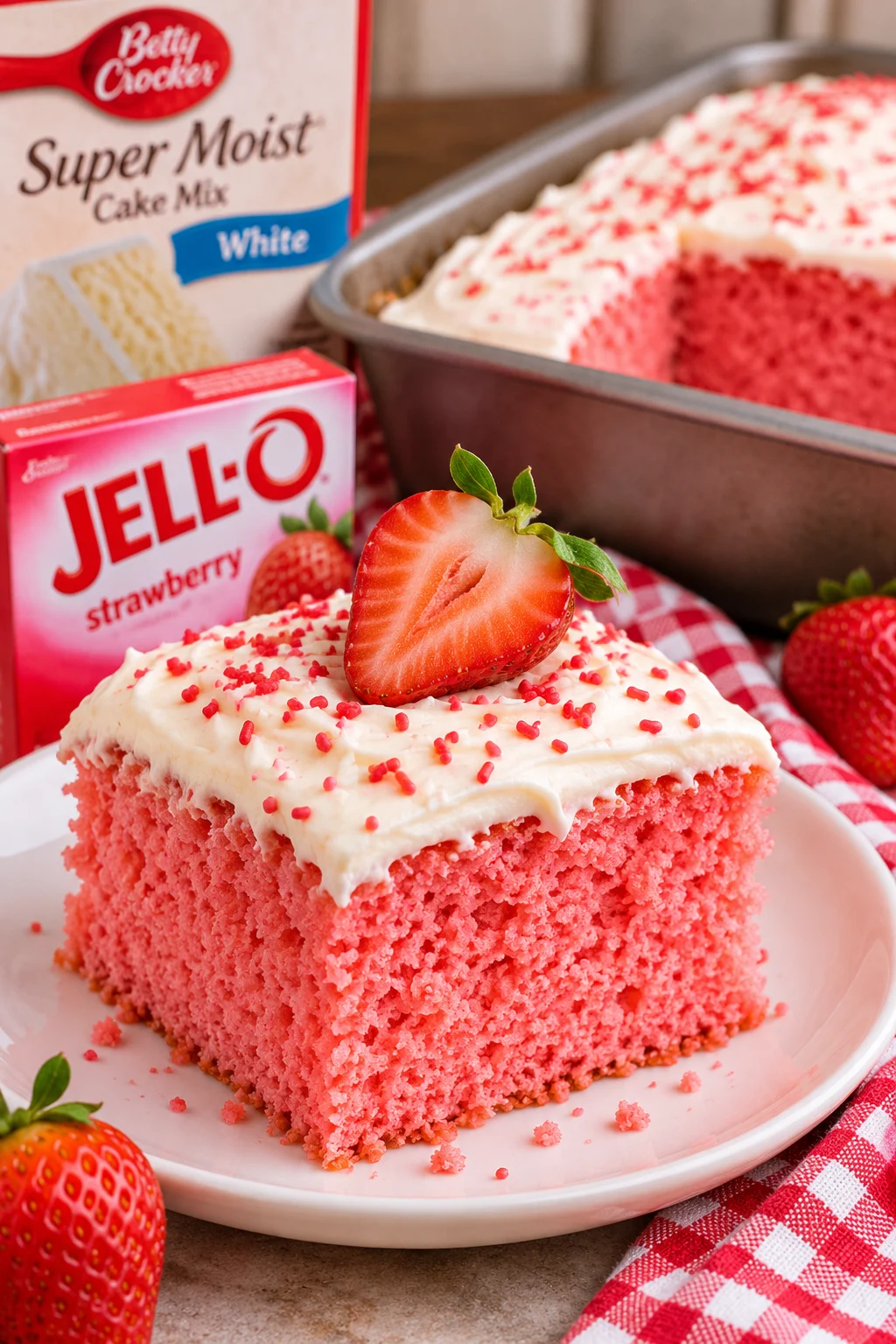
I’ll be honest: this started as one of those end-of-the-day kitchen experiments that happens when I’m tired, curious, and trying not to waste what’s already in the pantry. I had a boxed white cake mix on the counter, a couple packets of strawberry Jell-O in the cabinet, and just enough energy to think, “What if I swap the water and see what happens?” Forty-five minutes later, my kitchen smelled like birthday cake and strawberry candy, and I had a very real answer.
If you’ve ever wondered whether gelatin dessert mix can do more than flavor poke cakes or retro salads, here’s the full play-by-play. I’m going to walk you through exactly what I used, what changed in the batter, how the cake baked up, what tasted great, what got weird, and whether I’d actually do it again on a busy weeknight when I need a dependable dessert.
1. What I actually used
For this little experiment, I kept everything as close to a standard boxed-cake setup as possible so I could tell what the Jell-O changed. I used one 15.25-ounce box of white cake mix, 3 large eggs, 1/2 cup vegetable oil, and 1 cup of prepared strawberry Jell-O in place of the 1 cup of water the box called for.
That last part matters. I did not dump dry gelatin powder straight into the cake mix and skip the water completely. I made the Jell-O first with boiling water, stirred until dissolved, then let it cool until just warm, not hot. If you pour very hot liquid into cake batter, you can affect the texture and start partially cooking the eggs, which is not the kind of surprise anybody wants at 7 p.m. on a Tuesday.
2. How I prepared the Jell-O
I used one 3-ounce box of strawberry gelatin dessert mix. I stirred it into 1 cup of boiling water for about 2 minutes, until the granules were fully dissolved and the liquid looked clear and glossy. Normally you’d add cold water and chill it, but for this cake test, I stopped after the hot-water step because I only needed 1 cup of liquid to replace the water in the cake mix.
Then I let it sit for roughly 10 to 12 minutes. By the time I used it, it was still fluid but no longer steaming. That cooling window was important. Warm Jell-O blended smoothly into the batter; hot Jell-O would have been riskier, and fully chilled Jell-O would have started thickening, which would change the mixing and the bake time.
3. The first thing I noticed in the mixing bowl
The batter changed color immediately. Instead of the usual pale ivory you get from white cake mix, it turned a soft, bubblegum pink. It was honestly pretty cute and gave me that little rush of “okay, this might actually work.”
The second thing I noticed was texture. The batter seemed slightly glossier and just a touch looser than usual at first, but after about 60 to 90 seconds of mixing, it thickened back up. My guess is that the sugar and gelatin in the prepared Jell-O altered how the batter hydrated. It still poured normally into the pan, but it looked silkier and a bit shinier than a standard boxed cake batter.
4. The pan, oven temperature, and bake time
I baked the cake in a 9-by-13-inch metal pan that I had lightly greased. I followed the cake mix oven temperature, which was 350 degrees Fahrenheit. Because I changed one ingredient, I didn’t want to start adjusting everything else too. When I test recipes, I try to tweak one variable at a time so I can actually tell what made the difference.
The cake baked for 34 minutes in my oven. At the 28-minute mark, the center was still a little too jiggly, so I added time in 3-minute increments. By minute 34, the top was lightly golden at the edges, springy in the middle, and a toothpick came out with a few moist crumbs but no wet batter.
5. What the cake looked like after 45 minutes
By the 45-minute mark from the start of baking prep and oven time, I had a fully baked, cooled-for-a-few-minutes cake sitting on my counter. The biggest visual surprise was that the pink color did not bake out completely. The inside stayed a gentle rosy pink, especially toward the center of the cake.
The top was slightly glossier than a plain white cake, and the crumb looked tighter and more even when I cut into it. It didn’t rise quite as high as the same mix made with plain water, but we’re talking about a modest difference, maybe 1/4 to 1/2 inch less overall height in the center. It still looked like a proper sheet cake, not a collapsed mistake.
6. How it smelled and tasted
The smell was probably the most dramatic change. Usually boxed white cake has that familiar vanilla-bakery scent. This one smelled like vanilla cake crossed with strawberry candy and a little bit of fruit punch. It was sweet even by cake standards, and if you walked into my kitchen blind, you would have guessed I had added strawberry extract or a flavored frosting.
The taste was definitely sweeter than the original recipe. Since Jell-O contains sugar, replacing plain water with prepared Jell-O essentially adds flavor and extra sweetness at the same time. The strawberry flavor came through clearly but not in a fresh-berry way. It was more nostalgic, like pink starburst, strawberry soda, or the filling in a grocery store cupcake. If that’s your thing, it’s fun. If you want a more natural strawberry cake, this isn’t the route I’d take.
7. The texture was the real surprise
This is where the experiment got interesting. The cake was soft, moist, and slightly springier than usual. Not rubbery, not gummy, but a little more bouncy when pressed lightly with a fingertip. That makes sense because gelatin is a setting agent, and even in a baked cake, it can subtly affect structure.
The crumb was also a bit tighter. A standard white cake from a box often has a fluffy, airy texture with larger, irregular bubbles. This version had smaller, more uniform air pockets. It sliced neatly and held together very well, which would actually make it nice for potlucks, lunchbox treats, or a sheet cake you need to frost and transport without crumbling everywhere in the car.
8. What worked well
The biggest win was moisture. Even the next day, the cake stayed very soft when covered tightly. I left a piece under a cake dome overnight and another piece in an airtight container, and both were still tender the following afternoon. That’s a huge plus if you’re baking ahead after work and don’t want something dry by the time guests come over or the office potluck rolls around.
The flavor was also built in. You don’t need extra extract, jam, or fruit puree to get a distinct taste. For a quick semi-homemade dessert, that’s convenient. I could see this being a nice shortcut for birthday cakes, baby shower desserts, or cupcakes where you want a bright color and candy-like fruit flavor without a lot of extra steps.
9. What didn’t work as well
The sweetness level crept pretty high. If you frost this with a standard canned vanilla frosting, it can tip into overwhelmingly sweet territory fast. When I tried a piece with a thick layer of frosting, I immediately wished I had gone lighter. A thin swipe of whipped topping or a less-sweet cream cheese frosting would have balanced it better.
The other downside is that the flavor can feel a little artificial if you’re expecting real-fruit depth. My husband took one bite and said, “It tastes like strawberry cake mix from the 1990s,” which was both funny and, honestly, accurate. Not bad at all, just very specific.
10. Why this happens from a baking perspective
When you replace water with prepared Jell-O, you’re adding more than liquid. You’re also adding dissolved sugar, gelatin, color, flavoring, and food acid. Every one of those can influence the batter. The extra sugar can make the cake moister and sweeter. The gelatin can slightly tighten or spring up the crumb. The acids and flavor compounds can shift the overall taste and even affect browning a little.
That’s why this didn’t just taste like regular cake with a hint of strawberry. It behaved differently too. Baking is chemistry, and even a “small” swap like liquid-for-liquid can have a chain reaction in texture, rise, and structure.
11. If you want to try it, here’s the method I’d recommend
If you want the best chance of success, use 1 box cake mix, the eggs and oil called for on the box, and replace only the water with 1 cup of prepared Jell-O that has been dissolved in boiling water and cooled until warm or room temperature. Mix according to package directions, then bake in the pan size listed on the box.
I would start checking the cake 3 to 5 minutes before the earliest suggested bake time, then every 2 to 3 minutes after that. Ovens vary, and the extra sugar can sometimes encourage quicker browning before the center is fully done. If the top gets too dark, loosely tent it with foil for the last few minutes.
12. The best flavors to use
Strawberry was fun, but it definitely made me think about other combinations. Raspberry Jell-O with white cake mix would probably give a stronger berry flavor and a deeper pink color. Orange Jell-O in yellow cake mix sounds like a creamsicle situation waiting to happen. Lemon Jell-O in white or yellow cake could be really bright and probably less candy-sweet than strawberry.
Cherry would work if you like a bold, old-school flavor. Lime could be surprisingly good in a white cake for something summery and retro. I’d be more cautious with grape because that can get intense very quickly, and I think it could overpower the cake base in a way that reads more novelty than dessert.
13. Frosting and topping ideas that balance it out
After tasting the finished cake, I learned pretty fast that the topping matters. My favorite pairing was a lightly sweetened whipped cream frosting made with 1 cup heavy cream, 2 tablespoons powdered sugar, and 1/2 teaspoon vanilla. It added richness without piling on too much extra sugar.
Cream cheese frosting would also work well, especially if you keep it tangy. A basic mix of 8 ounces cream cheese, 4 tablespoons unsalted butter, 2 to 2 1/2 cups powdered sugar, and 1 teaspoon vanilla would be enough for a 9-by-13 cake without making it cloying. Fresh sliced strawberries on top help, too, even though the cake itself doesn’t taste especially “fresh fruit.” The contrast is nice.
14. Would I make it again?
Yes, but with intention. I wouldn’t use this trick for every cake, and I definitely wouldn’t serve it when I want a classic vanilla birthday cake or something elegant. But for a casual dessert, bake sale tray, or kid-friendly cupcakes, it’s absolutely a fun pantry shortcut. It gave me a flavored cake without extra measuring, extra bowls, or a run to the store.
As someone who cooks after work more often than I cook in a calm, sunlit, leisurely Saturday way, I appreciate experiments that are low effort and still edible. This one was more than edible. It was genuinely tasty, just sweeter, springier, and more candy-like than a standard cake.
15. My final verdict after the experiment
So what happened 45 minutes later? The cake baked successfully, turned pink, smelled amazing, stayed extra moist, and picked up a strong strawberry candy flavor with a slightly bouncier texture. In other words, it didn’t fail dramatically, and it didn’t taste exactly like normal cake either. It became its own thing.
If you’re in the mood for a playful baking experiment and you have a box cake mix plus a packet of Jell-O hanging around, it’s worth trying once. Just go in expecting a sweeter, more colorful, more nostalgic dessert—not a bakery-style strawberry cake. Sometimes that’s exactly the vibe you want, especially on a busy night when a little weird kitchen curiosity turns into dessert.