You know those weeds that somehow appear in every crack of the driveway two days after you thought you got rid of them? Yeah, those little guys have impressive determination.
My grandmother’s generation had a home remedy for practically everything, and weeds were no exception. One popular homemade weed killer combines white vinegar, salt, and dish soap—three things many people already have at home.
It sounds almost too easy: mix them together, spray the weeds, and wait.
But there’s a catch.
While vinegar can damage weeds, this mixture doesn’t magically know the difference between a weed and the flowers you spent all spring growing. Salt can also create problems in soil.
So before you start spraying the backyard, here’s how this DIY weed killer works, where people commonly use it, and where you definitely don’t want it.
What Is the Popular Vinegar Weed Killer Recipe?
The traditional homemade mixture commonly uses:
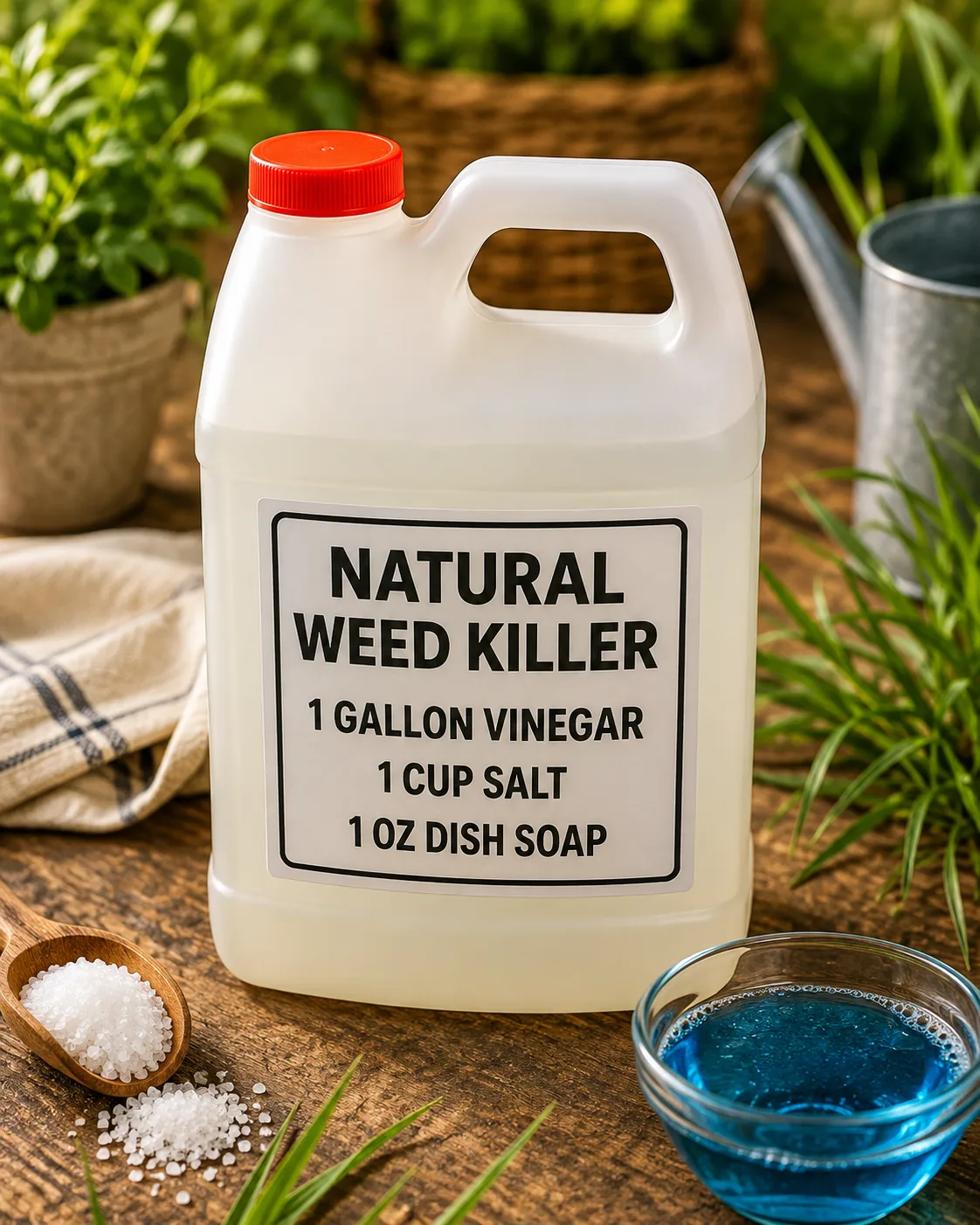
- 1 gallon white vinegar
- 1 cup table salt
- 1 tablespoon liquid dish soap
The ingredients are mixed together and applied directly to unwanted vegetation.
The basic idea is pretty simple. Vinegar damages plant foliage, while the soap helps the liquid coat the leaves.
Salt adds another drying effect, but it’s also the ingredient that makes me most cautious about recommending this mixture around garden soil.
How Does Vinegar Kill Weeds?
Regular household white vinegar usually contains about 5% acetic acid.
Acetic acid damages plant tissue when it contacts the leaves. Young weeds can begin looking wilted or dried fairly quickly after treatment.
But here’s something that’s easy to miss.
Vinegar mainly acts as a contact treatment.
That means visible foliage may die while established roots remain alive underground.
So when a big dandelion looks dead on Tuesday and pops back up later, the vinegar didn’t necessarily fail. It may have damaged the leaves without killing the entire root system.
Why Is Dish Soap Added?
Dish soap is generally added to help the liquid spread across and stick to plant leaves.
Without it, droplets can bead up and roll away.
A small amount of soap changes how the liquid coats the foliage, giving the vinegar more contact with the plant.
However, more soap isn’t automatically better.
Soap itself can injure plants, so this isn’t something you want drifting onto flowers, vegetables, shrubs, or lawn grass.
What Does Salt Do to Weeds?
Here’s where this old-school recipe gets a little tricky.
Salt can damage plants by interfering with their ability to manage water.
That sounds pretty useful when you’re staring at weeds growing between concrete slabs.
The problem is that salt doesn’t disappear just because the weed does.
Repeatedly putting salt into garden soil can make that soil less friendly to plants you may want to grow later.
That’s why I’d be very cautious about using a salt-heavy homemade weed treatment in flower beds, vegetable gardens, lawns, or anywhere you plan to plant.
Saving yourself five minutes of weeding isn’t worth creating a bigger gardening headache.
Where Might a Vinegar Treatment Make More Sense?
If someone chooses to use a vinegar-based approach, isolated weeds growing away from desirable plants are much easier targets than weeds mixed throughout a lawn or flower bed.
Think about weeds appearing in places such as pavement cracks or gravel areas.
Even there, overspray matters.
Vinegar is nonselective, which basically means it doesn’t care whether the leaf you’re spraying belongs to an unwanted weed or your favorite plant.
Hit both and you may damage both.
Don’t Spray This Across Your Lawn
This deserves its own warning because it’s an easy mistake.
If you spray a nonselective vinegar mixture over weeds growing inside your lawn, the surrounding grass may also be damaged.
The same rule applies around flowers and garden plants.
A breezy afternoon makes matters even worse because fine droplets can travel farther than expected.
If you need selective weed control in turf, choose a method specifically intended for that situation rather than treating the whole lawn with a homemade vinegar mixture.
Does Household Vinegar Kill Weeds Permanently?
Not necessarily.
Vinegar tends to perform better on small, young annual weeds than on large, established perennial weeds.
Why?
Roots.
An established perennial can have enough energy stored underground to produce new growth after its leaves have been damaged.
That’s why you may see a weed turn brown quickly and then return later.
Repeatedly spraying more salt into the soil isn’t a great answer to that problem either.
For individual perennial weeds, pulling or digging out as much of the root as practical may be the better approach.
When Does Vinegar Work Best on Weeds?
Young weeds are the easier targets.
Once weeds become large and establish strong root systems, controlling them becomes harder.
Good leaf coverage also matters because vinegar works through direct contact with plant tissue.
Dry weather can help keep a treatment from immediately washing away.
Still, don’t assume that “natural” means you can spray freely.
Nearby plants, soil, pets, surfaces, and your own eyes and skin still deserve consideration.
Is Stronger Vinegar Better?
This is another place where DIY gardening advice can get risky.
Household vinegar and high-strength horticultural vinegar aren’t the same thing.
Products with much higher concentrations of acetic acid can cause serious skin and eye injuries.
So please don’t see a stronger percentage online and think, “Well, that’ll work twice as fast!”
Gardening shouldn’t end with an emergency room visit.
If you purchase a product sold specifically for weed control, read and follow its label carefully.
Is Homemade Weed Killer Safe for Pets?
Don’t assume a homemade product is automatically pet-friendly because its ingredients came from the kitchen.
Keep pets away while you’re mixing or applying any weed treatment and follow relevant product guidance.
Also remember that ingredients such as concentrated acetic acid can irritate skin and eyes.
“Homemade” and “harmless” are two very different things.
Can You Use Vinegar Weed Killer in a Vegetable Garden?
I’d skip the broad spraying.
Vinegar doesn’t distinguish between your weeds and your tomatoes, lettuce, peppers, herbs, or beans.
Salt can also affect soil where future plants need to grow.
For vegetable beds, hand pulling, hoeing, mulching, and other targeted weed-management methods usually make more sense.
It takes a little more work, sure, but I’d rather pull weeds than accidentally wipe out the basil I waited two months to grow.
Better Ways to Keep Weeds From Coming Back
Killing visible weeds is only half the job.
Reducing the conditions that let weeds keep returning can save a ton of frustration.
Try maintaining a layer of appropriate mulch in garden beds. Pull young weeds before they mature and produce seeds. Keep lawns healthy and properly maintained so weeds have less open space to establish.
For cracks in hard surfaces, physical removal can also work surprisingly well.
And here’s my favorite low-tech strategy: deal with weeds while they’re tiny.
A two-minute job today can become a sweaty 30-minute battle three weeks from now. Ask me how I know.
Vinegar Weed Killer vs. Pulling Weeds
For a handful of weeds, pulling may still be the simplest answer.
Grab the plant close to the ground and remove as much of the root as possible.
This is especially useful for weeds with established roots that might regrow after their leaves are damaged.
Vinegar treatments are more appealing when you’re dealing with numerous tiny seedlings in an appropriate area, but they aren’t automatically a permanent fix.
Sometimes Grandma’s old-fashioned method—grab it and yank—is still pretty darn effective.
Common Mistakes With DIY Weed Killers
One common mistake is assuming that if a little works, a lot must work better.
Another is spraying desirable plants accidentally.
People also sometimes add large amounts of salt without considering what that salt may do to the surrounding soil.
Then there’s the biggest misconception: assuming a brown weed is a permanently dead weed.
If the root survived, round two may be coming.
Frequently Asked Questions
Does vinegar really kill weeds?
Vinegar’s acetic acid can damage plant foliage. It tends to work better on small, young weeds than on established perennial weeds.
Will vinegar kill weeds down to the root?
Not reliably. Vinegar generally acts on the plant tissue it contacts, so established weeds can regrow from surviving roots.
Why do people put dish soap in homemade weed killer?
A small amount of soap helps the liquid spread across and remain on plant leaves instead of immediately beading up and rolling off.
Why is salt added to homemade weed killer?
Salt can damage and dehydrate vegetation. However, it can also harm soil, which makes salt-based mixtures a poor choice in places where you want plants growing now or later.
Will vinegar weed killer kill grass?
It can. Vinegar is nonselective and may damage grass and other desirable plants it contacts.
Can I spray vinegar around flowers?
That’s risky because accidental contact can damage the flowers too. Physical removal or another targeted method may be a better choice.
Is horticultural vinegar the same as kitchen vinegar?
No. Horticultural products can contain much higher concentrations of acetic acid and may pose greater risks to skin and eyes. Follow the product label carefully.
Final Thoughts
That old vinegar, salt, and dish soap weed killer isn’t completely made-up kitchen folklore. Vinegar can damage weeds, particularly young ones, and soap can help the liquid coat their leaves.
But the traditional recipe has limitations.
It can damage any plant it touches, established weeds may grow back, and salt can cause unwanted problems in soil.
So if Grandma’s recipe is going anywhere, I’d keep the salt away from productive garden soil and treat vinegar as a targeted contact treatment—not a miracle solution for the entire yard.
Sometimes the best weed-control tool is still the least exciting one sitting in the shed: a good old-fashioned weeding tool and a little patience.