I’ve kept a kitchen long enough to know that few things stir up stronger opinions than where butter belongs. In my part of the Midwest, I grew up seeing a covered butter dish on the table at supper and another tucked into the icebox, and nobody thought twice about it. These days, though, with colder refrigerators, warmer kitchens, and all the chatter online about food safety, even a simple stick of butter can turn into a household debate. So I decided to stop guessing and pay close attention to what really happens when butter lives in a butter crock on the counter instead of behind that refrigerator door.
What I found surprised me in some ways and confirmed a few old-fashioned habits in others. I took notes the way I do when I’m testing a pie crust or trying a new batch of pickles: room temperature, texture, flavor, smell, ease of use, and whether I’d do it again. If you’ve ever wondered whether a butter crock is practical, messy, wasteful, or secretly one of the handiest little tools in a country kitchen, here’s my honest account.
1. Why I decided to try a butter crock in the first place
The whole experiment began because I was tired of fighting cold butter. I bake a good deal, but even more than that, I cook everyday meals: toast at sunrise, biscuits on a Sunday, cornbread with bean soup, and the occasional grilled cheese for lunch. Refrigerated butter at 37 to 40 degrees Fahrenheit is simply too firm for easy spreading, especially on soft sandwich bread or warm muffins.
I had one of those little kitchen moments that probably sounds familiar: I tore a piece of toast trying to spread a hard pat across it and muttered, “There has to be a better way.” My grandmother always seemed to have soft, spreadable butter ready without making a fuss over it, so I bought a stoneware butter crock and decided to use it properly instead of letting it sit pretty on a shelf.
2. The exact setup I used
I used a standard French-style butter crock made of glazed stoneware, about 4 inches tall and wide enough to hold roughly 1 stick to 1 1/2 sticks of butter, depending on how firmly it was packed. For the test, I packed in 1 stick of salted butter, which is 1/2 cup or 113 grams. I chose salted butter on purpose because salt can help slow spoilage a bit, and that’s what most folks in my family leave out for table use anyway.
My kitchen temperature ranged from 67 degrees Fahrenheit at night to 74 degrees during the day, with one afternoon climbing to 76 when I had the oven on for a casserole. I changed the water in the base every day, usually in the morning around 8 a.m. I filled it with cool tap water to a depth of about 2 inches, enough to create a seal once the butter-filled lid was inverted into the crock.
3. How a butter crock actually works
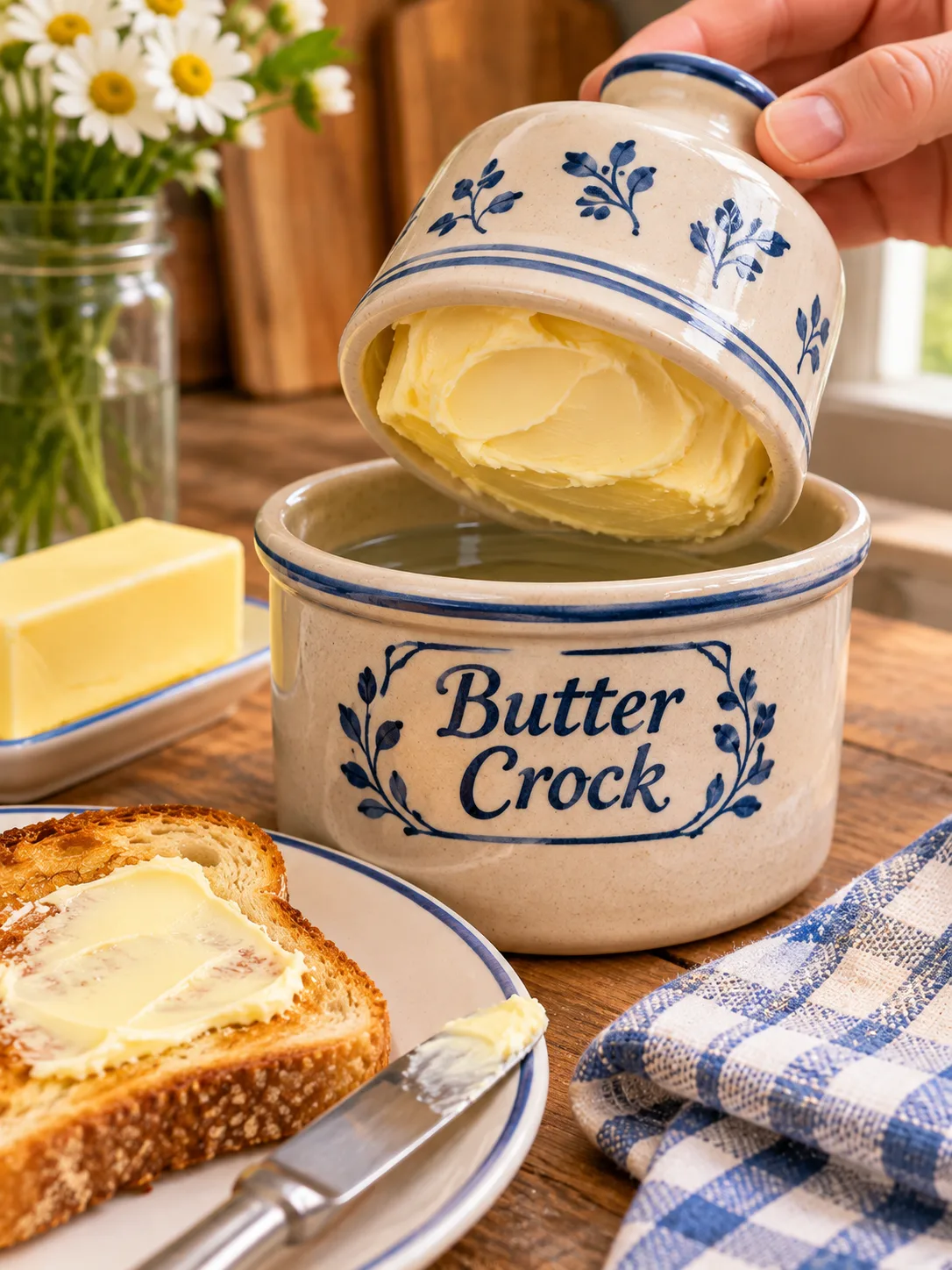
If you’ve never used one, a butter crock is a simple little thing, but it’s clever. The butter gets packed into the bell-shaped lid, and the crock base holds water. When you place the butter-filled lid upside down into the water-filled base, the water creates a barrier that helps keep air away from the butter. Less exposure to air means less oxidation and fewer off flavors.
It’s not refrigeration, of course, and I wouldn’t pretend otherwise. What it does best is keep butter at a cool-ish room temperature while protecting it from dust, kitchen odors, and too much oxygen. In practical terms, that means soft butter you can spread with a knife instead of shaving off cold curls and waiting 20 minutes.
4. Packing the crock was messier than I expected the first time
I let the stick of butter soften on the counter for about 45 minutes before packing it in. At 70 degrees Fahrenheit, that was enough to make it pliable but not greasy. I pressed it into the lid with a small spatula, making sure to push out any air pockets. That step matters more than I realized. If you leave gaps, the butter doesn’t sit as securely, and it can slump or even fall into the water.
The first day, I overfilled it just a touch, and when I inverted the lid, a thin ribbon of butter squeezed near the edge. Not a disaster, but not neat either. By the second refill, I learned to leave about 1/4 inch of clearance from the rim. After that, the crock stayed tidy and sat snugly in place.
5. The biggest change showed up at breakfast
By the very first morning, I understood why people swear by these crocks. The butter spread beautifully. Not melted, not oily, just soft enough to glide over toast, English muffins, and biscuits without tearing them apart. If I had to put a number on it, I’d say it handled like butter that had been out on the table for 20 to 30 minutes, but all day long.
That may sound like a small thing, but in a lived-in kitchen, little conveniences add up. I found myself using butter more deliberately and with less waste because I could spread a thin, even layer. Cold butter often breaks into chunks, and I end up using more than I need. With the crock butter, 1 tablespoon went farther.
6. The texture stayed pleasant, but it changed a little with the weather
From days 1 through 5, the texture was nearly perfect. Smooth, creamy, and easy to scoop with a butter knife. On the warmer afternoon when my kitchen reached 76 degrees, the butter softened more noticeably. It still held its shape in the crock, but the top edge looked glossier, and the knife slid in with almost no resistance.
On cooler mornings around 67 or 68 degrees, it firmed up slightly, though never enough to be troublesome. This taught me something useful: the success of a butter crock depends a great deal on your kitchen climate. In a farmhouse kitchen in January, it may be ideal. In August, especially if your house runs above 78 degrees, it may be another story altogether.
7. I watched closely for smell, color, and flavor changes
This was the part I paid the most attention to because rancidity doesn’t always announce itself dramatically at first. Each day, I checked the butter for three things: any sour or stale smell, any darkening or yellowing beyond the natural butter color, and any off taste. For the first week, there was no negative change at all. It smelled sweet and creamy, exactly as fresh butter should.
By around day 10, I noticed a very slight difference in flavor, but only when I tasted the butter plain from the knife. On toast or bread, I doubt most people would have picked it out. It was not spoiled, not sour, and not unpleasant. It simply tasted a touch less bright than a newly opened stick from the refrigerator. By the end of the full period, that subtle fading was the biggest change I observed.
8. The water needed daily attention, no excuses
If there was one non-negotiable lesson, this was it: you must change the water regularly. I changed mine every 24 hours, and once, just to see, I let it go closer to 36 hours. That was enough to remind me why the daily routine matters. The water didn’t look terrible, but it had lost that fresh, clean feel, and I could detect a faint mustiness when I lifted the lid.
After that, I went right back to a strict daily change. It took less than 1 minute at the sink. Empty, rinse, refill. If your kitchen is especially warm, you might even want to change it twice a day. A butter crock is not hard to maintain, but it is not a fill-it-and-forget-it tool either.
9. Salted butter behaved better than unsalted would have
I’ll say this plainly: I would be much more cautious with unsalted butter. Salted butter has a little more protection and tends to hold flavor better at room temperature. In my own cooking, unsalted butter is what I save for baking cakes, cookies, and pie dough, and I keep that in the refrigerator or freezer.
For table butter, toast butter, biscuit butter, salted is the sensible choice in a crock. If you want specific guidance, I’d keep unsalted butter on the counter only for very short periods, perhaps a day or two in a cool kitchen, while salted butter is the more practical option for this setup.
10. Cleanliness made more difference than I expected
I washed the crock thoroughly before I started, using hot soapy water and drying it completely. Midway through, on day 7, I emptied the remaining butter into a small bowl, washed the crock again, dried it, and repacked it. That one extra cleaning gave me peace of mind and, I suspect, helped preserve the fresh flavor.
Little habits matter here. Use a clean knife, not one that’s been through jam, toast crumbs, or egg yolk. Don’t let bits of bread or herbs get pushed into the butter. In a busy family kitchen, cross-contamination is what turns a good old-fashioned method into a poor one.
11. It worked best because I used the butter steadily
A butter crock makes the most sense for a household that actually eats butter regularly. During my test, I used that 1 stick over the course of several days, then repacked fresh butter as needed to continue the routine. That steady turnover matters. Butter that sits untouched for long stretches will naturally have more time to lose freshness.
For one person who rarely eats toast or bread, a crock may be more charming than practical. But for a family that goes through 1 stick every 5 to 7 days, it fits right in. In my kitchen, with morning toast and supper vegetables getting a pat of butter, it felt natural rather than wasteful.
12. The counter location mattered more than the crock itself
I kept the crock away from the stove, sunny windows, and the dishwasher vent. It sat on a shaded section of counter about 6 feet from the range. That helped keep the temperature steadier. If I had placed it next to the coffee maker or where afternoon sun hits, I’m sure the butter would have softened too much.
This may be the difference between success and disappointment for many folks. If your counter has hot spots, steam, or direct light, the crock will struggle. A cool, shaded place is part of the method, not an optional detail.
13. What happened by the end surprised me in a very ordinary way
After 14 days, the butter was still usable, spreadable, and pleasant enough to eat, but it was not identical to day 1. It had lost a little of that just-opened sweetness, and the very outer surface looked slightly more satiny than fresh-packed butter. There was no mold, no sour smell, and no dramatic failure. What happened was subtler than that.
In plain terms, the butter crock did exactly what it promised, provided I did my part. It kept butter conveniently soft and reasonably fresh on the counter. It did not perform miracles. It did not make butter immortal. It simply offered a practical middle ground between rock-hard refrigeration and leaving a stick exposed on a dish.
14. Would I keep doing it?
Yes, with conditions. I would absolutely use a butter crock again in cool and moderate weather, especially fall through spring, when my kitchen stays below about 75 degrees Fahrenheit. I would keep using salted butter, change the water daily, clean the crock regularly, and avoid packing in more butter than I’ll use within 5 to 7 days if I want the best flavor.
In the heat of summer, especially during humid spells or when I’m canning and the kitchen runs warm for hours, I’d be more cautious. On those days, I might keep only a smaller amount out, perhaps 1/3 to 1/2 stick, or return to a refrigerator butter dish and soften what I need.
15. My honest takeaway for anyone thinking of trying it
If you want soft butter for everyday use, a butter crock is a genuinely useful tool, not just a quaint kitchen decoration. But it works best when you treat it like a small food-preservation system: keep it clean, keep it cool, keep the water fresh, and don’t overload it. Those are the plain kitchen truths of it.
I came away thinking of my mother and grandmother, who often knew the practical answer long before we dressed it up with modern debate. They understood that many kitchen habits depend on attention, not perfection. That’s what this little experiment reminded me of. A butter crock won’t suit every household, but in the right kitchen, with a bit of daily care, it makes butter easy, pleasant, and ready for the table just when you need it.