In August, when my kitchen already felt like it was working overtime, I tried a small experiment that sounded practical on the surface: I slid a wooden cutting board under my toaster to “absorb” heat and save my countertop from getting warm. I left it that way for 14 days and paid close attention to how the toaster performed, how hot the board got, whether my counters stayed cooler, and whether this was actually a smart kitchen habit or just one of those ideas that sounds better than it works.
I cook a lot, and after years of testing cookware, appliances, and all manner of kitchen shortcuts, I’ve learned that heat behaves in very specific ways. A toaster may look harmless compared with an oven or stovetop, but it still produces concentrated heat, radiant warmth, and airflow around its base and sides. What happened over those two weeks was useful, but not in the way I expected. If you’ve ever considered putting a board, towel, tray, or mat under a toaster, here’s what I observed, what concerned me, and what I’d recommend instead.
1. Why I tried it in the first place
My toaster lives on a laminate countertop near the coffee maker. In summer, especially during an August heat wave, I become very aware of every appliance that adds warmth to the kitchen. I’d noticed that after toasting two rounds of sourdough or running a bagel cycle, the counter under and around the toaster felt slightly warm to the touch.
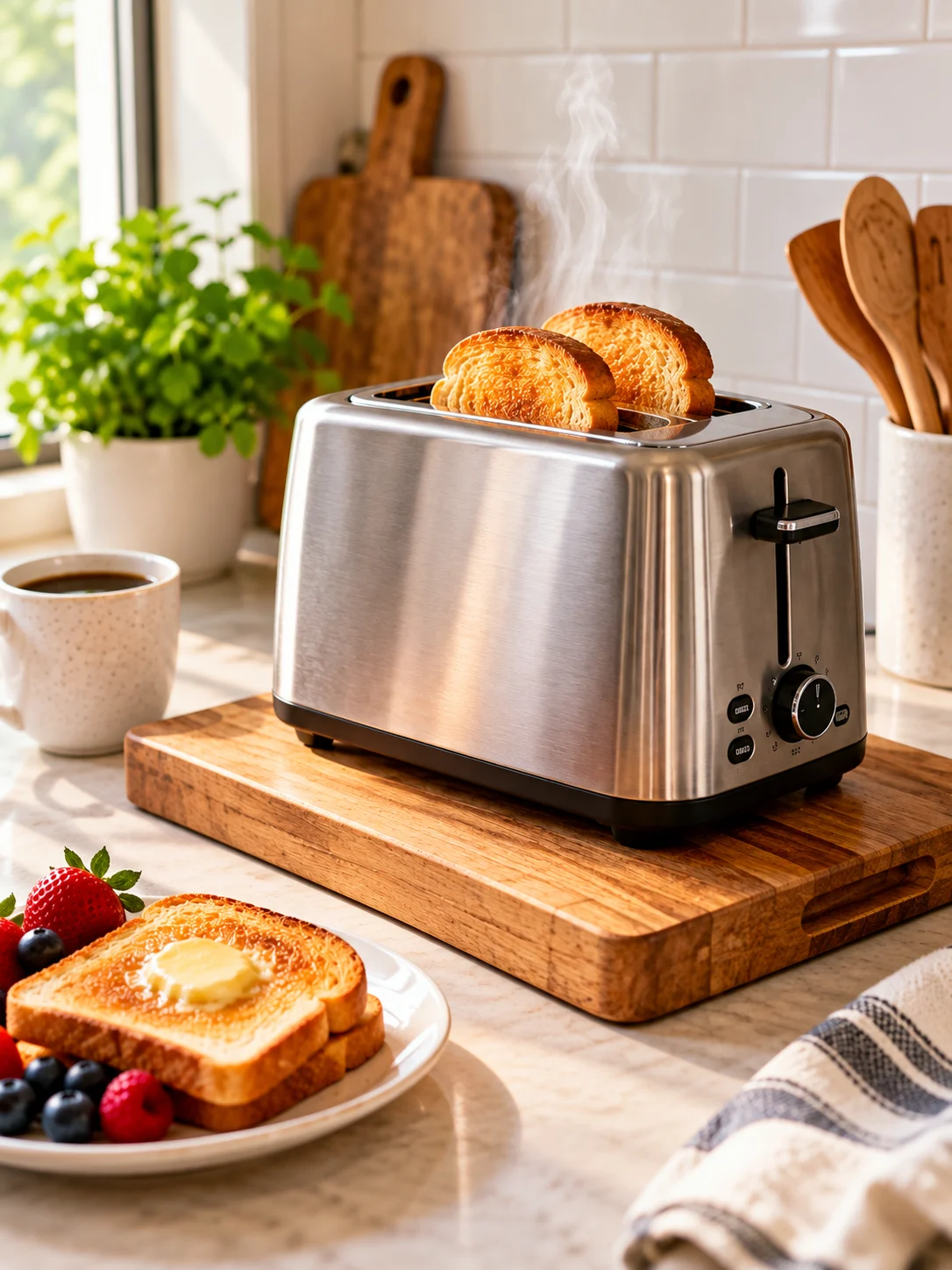
The wooden cutting board seemed like an easy fix. Mine was a medium-size maple board, about 14 inches by 10 inches and roughly 3/4 inch thick. I chose it because it was sturdy, flat, and already sitting out on the counter. My thinking was simple: wood feels less heat-conductive than stone or laminate, so perhaps it would buffer the counter and “soak up” some of that warmth.
2. The setup I used for 14 days
I used a standard two-slot pop-up toaster, approximately 11 inches wide, with side vents and a crumb tray underneath. I set it squarely in the center of the cutting board, leaving about 1 1/2 inches of board visible on each side and a little more at the front and back. The board sat on my usual countertop, and the toaster stayed plugged into the same outlet throughout the test.
Each day, I used the toaster one to three times. Most mornings, that meant two slices of sandwich bread at a medium setting. A few afternoons, I toasted frozen waffles or reheated a split bagel. On three of the 14 days, I ran back-to-back cycles, which is when heat buildup became easiest to notice.
3. The countertop did feel a little less warm
On the narrow question of whether the counter felt cooler, the answer was yes, a little. The laminate directly beneath the board stayed noticeably less warm than when the toaster sat directly on the counter. When I touched the countertop after a toast cycle, it was closer to room temperature than I expected.
But the key point is that the heat did not vanish. It moved into the board and into the air around the toaster. The board itself grew warm, particularly in the center area under the toaster base. So while I succeeded in reducing warmth on the countertop surface, I didn’t meaningfully reduce the total heat generated by the appliance.
4. The board got warmer than I expected
By day 3, I started checking the board more carefully after each use. After one cycle, it was mildly warm. After two back-to-back cycles, the middle section felt distinctly warm, not scorching, but enough that I noticed it immediately when I lifted the toaster. The underside of the toaster was also warmer than I had paid attention to in the past.
Wood is not magic insulation. It can slow heat transfer in one direction, but it also holds warmth. In practical terms, the board became a heat-holding layer under an appliance that is designed to sit on a stable, heat-tolerant surface with proper airflow around it. That distinction mattered more to me as the days went on.
5. Crumbs and trapped debris became a bigger nuisance
One thing I didn’t anticipate was how quickly the board turned into a crumb catcher. Tiny bits of toast, cinnamon-raisin sugar crystals, and sesame seeds collected under and around the toaster base. On a plain countertop, I can wipe those away in 10 seconds. On a cutting board with a slightly porous surface and knife marks from years of use, cleanup took longer.
By the end of the first week, I could see a faint ring of fine crumbs where the toaster feet rested. That may sound minor, but crumbs plus warmth is not a combination I like to encourage around any appliance. It made me more diligent about emptying the crumb tray every 3 to 4 days instead of letting it go a week or two.
6. The biggest issue was airflow, not surface temperature
This was the most important lesson of the whole experiment. Toasters need ventilation. Many models release heat from the sides, top, and bottom, and they rely on open air around the unit to cool down after use. Even if a wooden board does not immediately create a hazard, it can change how heat lingers beneath the appliance, especially if the toaster’s underside is meant to dissipate warmth.
I noticed that after repeated cycles, the toaster seemed to stay warm longer when it sat on the board. I’m not claiming a dramatic malfunction, because there wasn’t one, but there was enough retained warmth under the base that I stopped feeling comfortable about the setup. In kitchen safety, “probably fine” is not my favorite standard.
7. The board showed subtle signs of wear from the heat
After 14 days, the cutting board had not charred, cracked, or warped dramatically, but it did look different. The finish in the center appeared slightly drier and duller than the outer edges. This was a well-used maple board that I oil periodically with food-safe mineral oil, so I know its normal appearance pretty well.
Heat and fluctuating moisture are hard on wood over time. Even moderate repeated warming can dry the surface, stress the fibers, and shorten the life of a board you might otherwise keep for years. I’d rather preserve a good cutting board for chopping herbs, slicing peaches, or serving cheese than turn it into a permanent toaster platform.
8. It did not make the kitchen feel cooler
This may sound obvious, but it’s worth saying clearly: placing a wooden board under the toaster did nothing measurable for the overall kitchen temperature. If your goal is to keep the room cooler in August, the board will not help. The toaster still uses electricity to generate heat, and that heat still ends up in your kitchen.
What did help a little was reducing repeat cycles, toasting earlier in the morning, and using the toaster oven less often than the pop-up toaster. In my kitchen, a toaster oven can heat the room far more because it runs longer, often 5 to 10 minutes instead of 2 to 3.
9. I realized I was using the wrong tool for the job
A cutting board is designed for food prep. It is not engineered as an appliance base. That sounds basic, but many of us improvise in the kitchen all the time. We use trays as catch-alls, dish towels as temporary hot pads, and boards as serving platters. Usually that flexibility is harmless. Under a toaster, though, I decided improvisation wasn’t worth it.
If your actual concern is protecting the counter, a better solution is to check the toaster manufacturer’s instructions and make sure the appliance is sitting on a clean, dry, heat-resistant, stable surface with ample clearance. In many kitchens, the countertop itself already meets those requirements.
10. What concerned me most from a safety perspective
My concern was not that the board burst into flames. That did not happen, and I want to be precise about that. My concern was cumulative heat, restricted cooling, and the presence of combustible material under an appliance that can produce significant localized warmth over repeated use.
Wood is combustible. So are paper towels, cloth placemats, recipe cards, and the decorative runners people sometimes place under small appliances. A setup can seem harmless for days or even months until one longer cycle, one mechanical fault, or one overlooked crumb changes the equation. I’ve cooked long enough to respect low-probability kitchen risks before they become real problems.
11. What I’d do instead if your countertop gets warm
First, confirm that the warmth is normal and not excessive. A mildly warm counter under a toaster can be completely ordinary. If the appliance base or the counter becomes unusually hot, check the manual and consider whether the toaster needs servicing or replacement. A toaster that smells strongly of burning, overheats, or toasts unevenly is not one I would keep using.
Second, give it space. I like at least 4 inches of clearance on the sides and more above, especially if it sits under cabinets. Third, empty the crumb tray regularly. Fourth, keep the area underneath and around it free of linens, mail, wooden utensils, and other clutter. If you want easier cleanup, a removable, manufacturer-approved appliance tray is a better path than repurposing a cutting board without guidance.
12. My practical takeaway after 14 days
Did the wooden cutting board absorb heat? Yes, to a degree. Did it solve a meaningful problem? Not really. It shifted heat away from the countertop and into the board, created more cleanup, and introduced enough questions about airflow and safety that I stopped the experiment at the end of the two weeks.
Once I removed the board, I didn’t miss it. The toaster went back onto the bare countertop, where it had better stability and ventilation. I simply became more mindful about not running unnecessary extra cycles and about cleaning the appliance more often.
13. The small kitchen habits that matter more
In my experience, the most useful habits are also the least dramatic. Unplugging a toaster before a deep clean, shaking out crumbs only when the appliance is cool, wiping the surrounding counter daily, and replacing an aging toaster before it becomes unreliable all do more for safety than makeshift heat-catching layers.
I’d add one more habit: read the manual, even for a simple appliance. Manufacturers usually specify clearance distances, acceptable surfaces, and warnings about storing or operating the toaster near combustible materials. It’s not glamorous advice, but it’s far more reliable than kitchen folklore.
14. Final verdict: I wouldn’t recommend it
After living with this setup for 14 days in the hottest part of August, my conclusion is straightforward: I would not recommend placing a wooden cutting board under a toaster to absorb heat. It offered only a minor benefit to the countertop while creating enough downsides to make it a poor trade.
As someone who loves practical kitchen solutions, I understand the appeal of using what you already have on hand. But this is one of those cases where the clever workaround is not better than the standard setup. Your toaster is happiest on a proper, uncluttered countertop with room to breathe, and your cutting board deserves a much tastier assignment.