
You’re standing in front of the bathroom mirror, and there it is again.
Maybe it’s a little brown spot on your cheek. Maybe it’s a tiny raised bump that catches the light. Or perhaps there’s a rough patch that seems more noticeable every time you put on makeup.
Then your phone serves up one of those irresistible skin-care videos.
“Put this on overnight.”
“Leave it on the spot.”
“Watch the mole disappear.”
Yeah, I’ve seen them too.
The promise sounds almost too convenient: one household ingredient, one dab before bed, and supposedly that unwanted mole, bump, or textured spot dries up and disappears.
There’s a pretty important catch, though.
A spot that looks like a harmless mole to you may not be the same thing as a skin tag, clogged pore, keratosis pilaris, seborrheic keratosis, acne mark, or another type of skin growth. And treating an unidentified spot with strong acids or homemade mixtures can leave you with a burn or scar while also delaying the diagnosis of a suspicious lesion.
So, before leaving any viral DIY treatment on your cheek, here’s what you should know.
The Viral Mole Removal Method Sounds Simple — But It Comes With a Catch
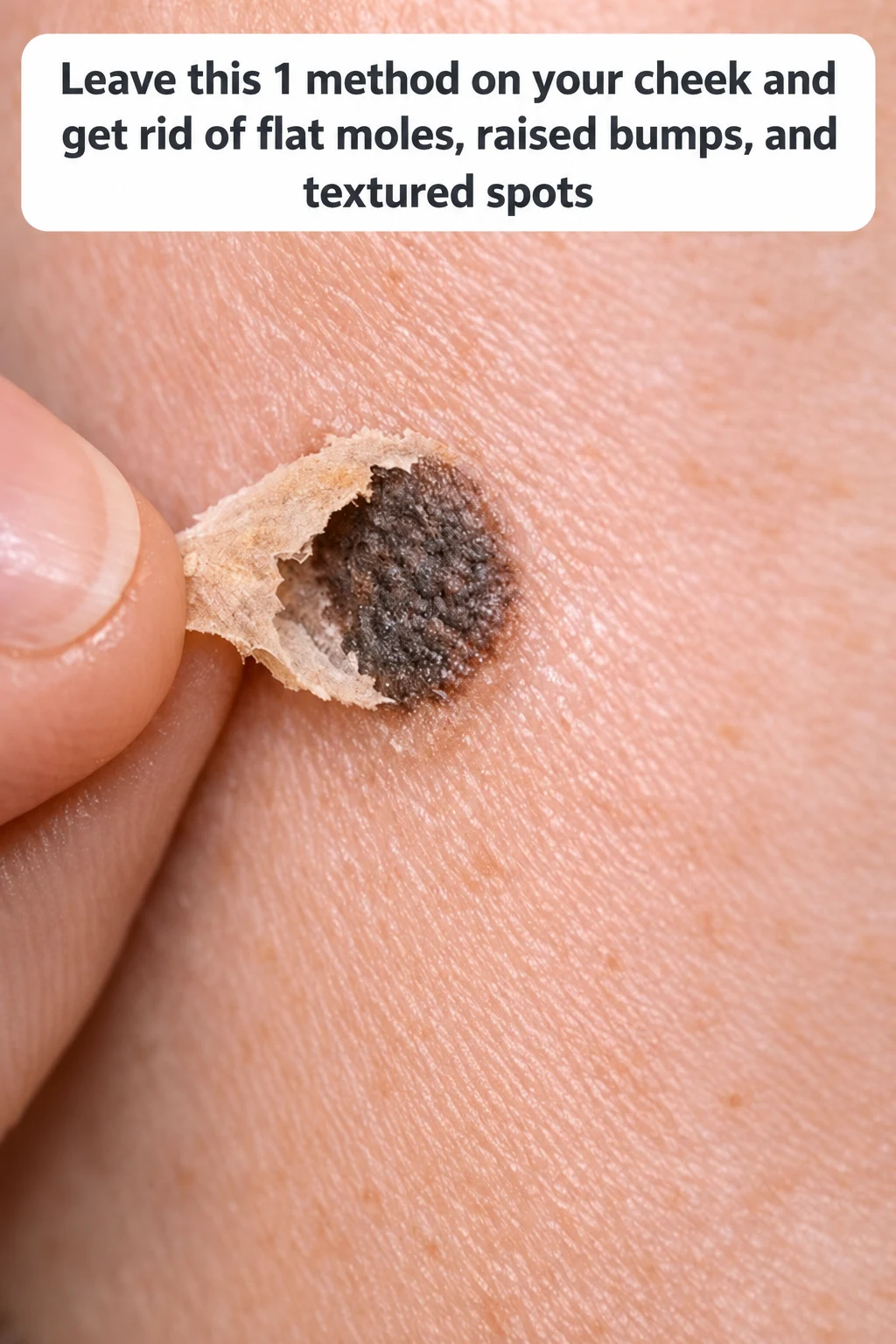
One of the most common internet tricks involves putting an acidic ingredient directly on a mole or raised spot and leaving it there.
Apple cider vinegar often gets the starring role.
The theory is that its acidity will damage the tissue until the spot darkens, scabs, and eventually falls away.
That transformation can look convincing in a quick social media video.
But damaged tissue isn’t proof that a treatment safely removed the right thing.
The FDA has warned about products marketed for at-home mole and skin-tag removal. According to the agency, there are no legally marketed over-the-counter drugs in the United States for removing moles or skin tags, and these products can cause injuries and scarring.
In other words, making a spot crust over is not the same thing as safely treating it.
Especially on your face.
Your “Mole” Might Not Actually Be a Mole
Here’s where things get tricky.
People use the word “mole” for all kinds of little spots.
But dermatologists distinguish between many different skin growths and conditions.
A typical mole may be flat or slightly raised and can appear brown, tan, black, pink, red, blue, skin-colored, or even colorless. Many ordinary moles stay relatively stable from month to month.
A rough raised growth might instead be a seborrheic keratosis.
Tiny rough bumps can sometimes be keratosis pilaris.
A little protruding growth could be something else entirely.
And pigmentation left behind after acne or irritation may look nothing like a true mole when examined closely.
That’s why treating every spot the same way doesn’t make much sense.
The right treatment depends on what the spot actually is.
Why I Wouldn’t Put Apple Cider Vinegar on a Mole
Apple cider vinegar has practically become the Swiss Army knife of internet home remedies.
People put it on everything.
Hair.
Feet.
Scalp.
Bumps.
Moles.
You name it.
But acidic substances can irritate skin, and aggressively treating a concentrated area may damage healthy tissue surrounding the spot.
The face deserves even more caution because a visible scar or pigment change can stick around far longer than the original cosmetic concern.
The FDA has also warned against certain high-strength chemical peel products sold for home use. Products containing high concentrations of acids such as TCA, glycolic acid, salicylic acid, and lactic acid can cause serious chemical burns when used without appropriate professional supervision.
So that burning sensation?
It isn’t a sign that the hack is “working.”
Sometimes a burn is simply a burn.
Garlic Isn’t a Safe Shortcut Either
Garlic gets mentioned in DIY mole-removal posts surprisingly often.
The usual advice involves crushing a clove, placing it against the growth, covering it, and letting it sit.
That might sound harmless because garlic is natural.
But “natural” doesn’t automatically mean gentle on skin.
Leaving irritating plant compounds pressed against one small area of the face can cause redness and irritation.
And even if the growth changes afterward, you still haven’t answered the most important question:
What was the growth in the first place?
That’s why destroying the visible surface before getting an uncertain lesion checked can create another problem.
You may remove or alter features that a clinician would otherwise examine.
The Safest First Method Is Much Less Exciting
Here comes the part that probably won’t rack up five million TikTok views.
If you have an unidentified mole or raised growth that you want removed, the safest first move is getting it identified by a qualified medical professional.
I know.
That isn’t nearly as dramatic as “put this kitchen ingredient on your cheek tonight.”
But it matters.
The American Academy of Dermatology advises having a dermatologist examine a mole that looks different from your others, changes, itches, or bleeds. A new mole appearing after age 30 should also be evaluated.
Once you know what you’re dealing with, you can talk about cosmetic treatment.
Diagnosis first.
Removal second.
That order is worth remembering.
Check Moles With the ABCDE Rule
One useful way to monitor pigmented spots is the ABCDE rule.
A — Asymmetry: One half doesn’t match the other.
B — Border: The edge looks irregular, scalloped, or poorly defined.
C — Color: The spot contains different shades or colors rather than one fairly uniform color.
D — Diameter: Melanomas are often larger than 6 millimeters when diagnosed, though they can be smaller.
E — Evolving: The spot is changing in size, shape, color, or overall appearance.
The American Academy of Dermatology uses these signs to help people recognize possible melanoma warning signs.
One detail I think people sometimes miss is the “E.”
Change matters.
A spot doesn’t have to look wildly dramatic to deserve attention.
Bleeding and Itching Deserve Attention Too
There are other clues worth noticing.
A mole that starts bleeding without an obvious reason should be checked.
So should one that begins itching or changing.
And if one spot suddenly looks totally different from every other mole on your body, that difference is worth mentioning to a dermatologist.
The AAD specifically advises medical evaluation for spots that change, itch, bleed, or look different from the others.
Basically, don’t try to “erase” the evidence first.
Get the spot checked.
What About Raised, Waxy-Looking Bumps?
Some raised spots turn out to be seborrheic keratoses.
These are common benign growths.
They may look waxy, rough, or almost as though somebody stuck them onto the surface of the skin.
Here’s the problem: sometimes a seborrheic keratosis can resemble skin cancer.
The AAD notes that dermatologists can usually identify these growths through examination, but when a growth resembles skin cancer, it may need to be removed and examined under a microscope.
That’s another reason the “just burn it off at home” approach makes me nervous.
Different-looking growths can overlap visually.
A bathroom mirror isn’t a pathology lab.
Dermatologists Have Real Ways to Remove Benign Growths
Once a growth has been identified as benign, removal may actually be pretty straightforward.
For seborrheic keratoses, dermatologists may use cryosurgery, which freezes the growth with liquid nitrogen.
Another option can involve electrosurgery, sometimes combined with curettage, where the treated tissue is carefully removed.
When a suspicious growth needs microscopic examination, a clinician may remove it in a way that allows the tissue to be sent for analysis.
The exact method depends on the diagnosis, location, size, appearance, and other factors.
That’s a whole lot more controlled than dabbing something acidic onto your cheek and hoping for the best.
What If the Problem Is Tiny Rough Bumps Instead?
Now we’re talking about a completely different situation.
Tiny rough bumps — especially ones that feel almost like permanent goosebumps — can sometimes be keratosis pilaris.
Children can even develop these bumps on the cheeks.
Unlike an actual mole, keratosis pilaris involves plugs of dead skin cells and can sometimes respond to skin-care ingredients aimed at smoothing rough texture.
That’s why correctly naming the problem matters so much.
You wouldn’t treat a mole the same way you treat dry, rough skin.
Ingredients Dermatologists Use for Keratosis Pilaris
When keratosis pilaris is the diagnosis, dermatologists may recommend moisturizers or products containing ingredients such as:
- Lactic acid
- Glycolic acid
- Salicylic acid
- Urea
- Certain retinoids
These ingredients can help with dead skin buildup and rough texture when used properly. The AAD also warns that overuse can make skin raw, dry, or irritated.
Notice the important distinction.
These ingredients may make sense for an identified rough-skin condition.
That does not mean you should put the same ingredients on an unidentified mole and try to remove it.
Same bottle.
Very different situation.
Moisturizer Can Make Rough Texture Look Better
Sometimes we get so focused on strong active ingredients that we forget how much plain dryness affects texture.
Dry skin can make tiny bumps look and feel more noticeable.
For keratosis pilaris, the AAD recommends regular moisturizing and notes that products containing urea or lactic acid may help with dryness.
I’m a big fan of starting gently when the issue is simply rough texture.
Scrubbing harder isn’t always better.
In fact, aggressive rubbing can leave already-bumpy skin looking angrier than it did before.
Please Don’t Pick or Cut a Raised Spot
This one sounds obvious.
And yet, the internet exists, so here we are.
Don’t cut off an unidentified bump with scissors.
Don’t scrape it.
Don’t tie dental floss around something you think is a skin tag unless a qualified medical professional has first confirmed what it is and advised you appropriately.
And please don’t repeatedly pick at it hoping it will disappear.
Traumatizing skin can lead to bleeding, irritation, infection, or scarring.
You may also make the growth harder to assess later.
That tiny bump suddenly becomes a much bigger hassle.
Be Extra Careful With Anything on Your Cheek
Facial skin deserves special consideration.
Your cheek is highly visible, so even a small scar or patch of altered pigmentation can become much more frustrating than the original spot.
There’s also the temptation to keep adding more product when nothing happens quickly.
More acid.
Longer contact.
Another night.
A tighter bandage.
That’s exactly how a small DIY experiment can turn into an injury.
If a method depends on intentionally destroying tissue until it falls away, I would not treat that as casual skin care.
What About Dark Spots That Aren’t Moles?
Sometimes people call any brown facial mark a mole.
But a flat dark spot can have plenty of other causes.
Past acne, inflammation, irritation, or sun exposure can all leave visible pigmentation.
The treatment for pigmentation is different from mole removal.
That’s good news in one sense because many discoloration concerns can be approached without physically removing anything.
But again — you need to know what the spot is first.
If there’s any doubt that you’re looking at ordinary discoloration rather than a mole or another growth, get it checked before covering it with active ingredients.
Sunscreen Matters More Than Most Viral Hacks
I know sunscreen isn’t exactly glamorous advice.
Nobody makes a dramatic before-and-after video showing someone putting sunscreen on every morning for years.
Still, daily sun protection is one of the basic habits that matters for skin health and helps limit UV-related skin damage.
For facial skin, choose a broad-spectrum sunscreen that works with your skin type and that you’ll actually wear consistently.
Because the fancy bottle you hate wearing does you no favors sitting untouched in the bathroom cabinet.
Consistency beats shelf decoration.
When You Should Book a Skin Check
I’d make an appointment rather than experimenting at home when a spot:
- Is new or noticeably changing
- Has an irregular shape or border
- Contains several colors
- Looks very different from your other moles
- Bleeds without an obvious injury
- Repeatedly itches or becomes irritated
- Changes in size, color, shape, or texture
- Appears as a new mole after age 30
These signs don’t automatically mean cancer.
But they’re good reasons to get a professional opinion instead of playing dermatologist with a bottle from the kitchen cabinet.
Take a Photo Instead of Treating It Immediately
Here’s a much safer home trick.
If you’re watching a questionable spot, take a clear photograph.
Use similar lighting and distance when taking another picture later.
That can make changes easier to notice.
The AAD encourages people to become familiar with where their moles are and what they normally look like so changes are easier to spot.
That’s a home method I can actually get behind.
No burning.
No scraping.
No mystery paste.
Just useful information you can bring to a doctor if something changes.
The Bottom Line on Viral Mole-Removal Tricks
I understand why these hacks spread.
A professional appointment takes effort.
A bottle of apple cider vinegar is already sitting in the pantry.
And a video showing a spot apparently disappearing in a few days can feel incredibly convincing.
But there’s a difference between making tissue fall off and receiving an appropriate diagnosis and treatment.
The biggest concern isn’t simply whether a DIY trick works.
It’s whether you know what you’re treating.
A flat mole, raised bump, rough patch, seborrheic keratosis, keratosis pilaris bump, and suspicious pigmented lesion are not interchangeable problems.
So if there’s one method worth remembering, it’s this:
Identify the spot before trying to remove it.
For ordinary rough texture that has already been identified, gentle moisturizers and appropriate skin-care ingredients may help.
For moles or unexplained raised growths, let a qualified medical professional determine what they are first.
It may not have the drama of waking up to a mysterious spot supposedly falling off your cheek.
But your skin — and probably your future self — will be much happier with that choice.