You hear a little scratching above the ceiling at night.
Then another scratch.
Maybe a tiny thump.
And suddenly you’re lying in bed thinking, “Please tell me that’s the house settling.”
Yeah… sometimes it isn’t.
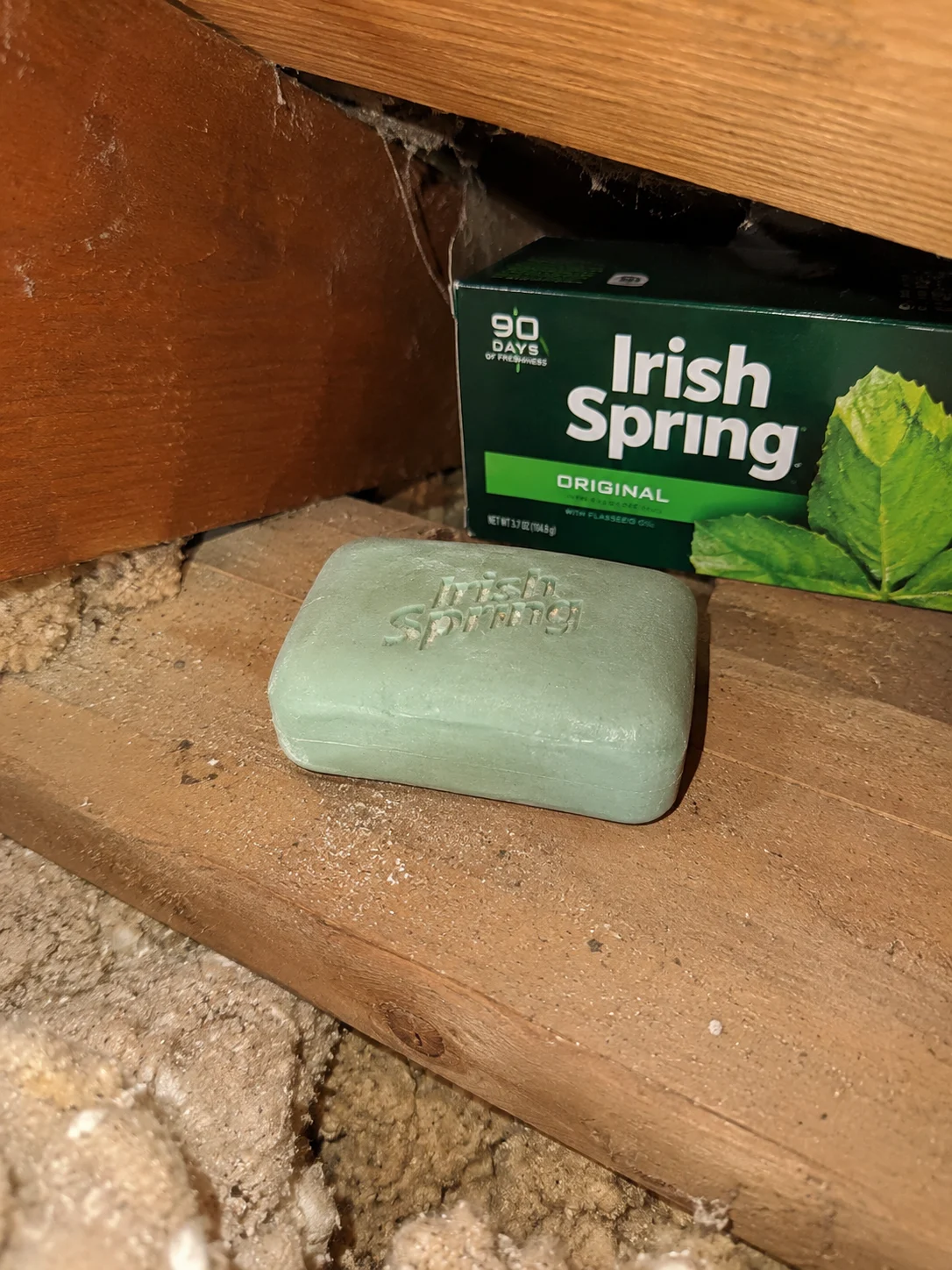
When mice get into an attic, people try all kinds of home remedies to convince them to leave. One of the most popular is surprisingly simple: Irish Spring soap for mice. The idea is that the soap’s strong fragrance bothers mice enough to keep them away.
It sounds perfect. A bar of soap is cheap, easy to find, and much more pleasant to deal with than a mousetrap.
But does Irish Spring actually repel mice?
The answer isn’t quite as satisfying as the internet makes it sound.
Strong scents may affect how mice behave temporarily, but putting soap in an attic isn’t a reliable long-term solution for an established mouse problem. If mice can still find shelter, warmth, nesting material, and an easy way inside, a fragrant bar of soap probably won’t convince them to move out.
Here’s what can happen when you try the trick, why results vary, and what works better for keeping mice out of an attic.
Why Do People Put Irish Spring Soap in Their Attics?
The theory comes down to smell.
Irish Spring has a strong, recognizable fragrance. Humans may associate that scent with a freshly cleaned bathroom, but the theory behind this home remedy is that mice find the smell unpleasant.
So people place whole bars or pieces of soap in areas where rodents might travel.
Common spots include attics, garages, sheds, campers, storage areas, and around suspected entry points.
Then they wait.
If scratching stops, it’s tempting to credit the soap.
But there’s a problem.
Mouse activity naturally changes depending on food, temperature, nesting behavior, disturbances, and many other factors.
A quiet attic for a few nights doesn’t automatically mean the mice packed their tiny suitcases because they hated your soap.
Does Irish Spring Soap Really Keep Mice Away?
There isn’t strong evidence that a bar of Irish Spring provides dependable long-term mouse control.
That’s the key point.
A strong unfamiliar odor could potentially make an area less appealing for a short period. However, mice can become accustomed to smells, particularly when the area still provides everything they need.
Think about it from the mouse’s perspective.
There’s warmth.
There’s insulation.
There’s protection from predators.
There’s possibly food nearby.
And there’s a convenient opening into the house.
Would one strongly scented object necessarily outweigh all of that?
Probably not.
What Might Happen During a 30-Day Soap Test?
Imagine placing several bars of strongly scented soap around an attic and checking the area regularly for a month.
During the first few days, you might think activity has decreased.
Maybe you hear fewer noises.
Maybe a particular corner appears undisturbed.
That can feel promising.
But as the days pass, the fragrance may become less noticeable, and any mice already living in the attic may simply avoid the soap itself rather than abandon the entire space.
That’s an important distinction.
Repelling a mouse from one square foot of attic isn’t the same as removing mice from the house.
Mice Can Simply Walk Around the Soap
This is the biggest weakness with scent-based tricks.
A bar of soap doesn’t create an invisible force field.
If a mouse doesn’t like the smell, it can potentially change its route.
Place soap beside one wall?
The mouse may travel along another.
Put it near a suspected nest?
The animal may move a short distance away.
Unless the underlying entry points are addressed, the attic remains available.
It’s basically like putting an air freshener beside an unlocked front door and expecting burglars to reconsider.
The door is still open.
Some Mice May Even Investigate the Soap
Here’s where the trick gets a little funny.
People often assume mice will immediately run from anything with a strong fragrance.
Rodents are curious animals.
A new object in their environment may attract investigation before it causes avoidance.
Depending on the soap’s ingredients and the individual animal, you may even find tooth marks on a bar.
So if you check the attic and discover your “mouse repellent” has been nibbled?
Well, the mice did not receive the memo.
Why Strong Smells Aren’t a Complete Mouse-Control Plan
You’ll find endless scent-based rodent remedies online.
Soap.
Peppermint.
Dryer sheets.
Spices.
Essential oils.
The list goes on.
The problem is that scent alone doesn’t address why mice entered the building.
Mice generally seek basic resources such as food, shelter, nesting locations, and protection.
An attic can provide excellent shelter.
Wall cavities can provide travel routes.
A pantry can provide food.
Tiny gaps around the building can provide access.
Until those factors are addressed, replacing one smell with another doesn’t solve the underlying problem.
The Better Question: How Are the Mice Getting Inside?
This is where successful mouse prevention usually starts.
Instead of asking, “What smell do mice hate?” ask:
Where are they entering my home?
Mice can fit through surprisingly small openings.
Check around areas such as:
- Utility penetrations
- Pipes
- Exterior vents
- Roof edges
- Foundation gaps
- Garage doors
- Door frames
- Damaged siding
- Openings around cables
- Gaps around exterior construction joints
Attics can be particularly tricky because entry points may be high above ground and difficult to see.
If you’re uncomfortable inspecting the roofline or accessing dangerous areas, call a qualified pest professional rather than climbing somewhere unsafe.
Look for Signs of Mouse Activity
You don’t necessarily need to see a mouse to know one has been visiting.
Droppings are one common clue.
You might also notice gnawed materials, shredded nesting material, damaged food packaging, scratching noises, tracks in dusty areas, or unusual odors.
In an attic, inspect insulation carefully without disturbing suspected contaminated areas unnecessarily.
Mice may build nests in insulation, stored cardboard, fabric, paper, and other soft materials.
And once you’ve found signs, don’t simply put a soap bar beside them and call it a day.
You need to figure out whether the activity is current.
Don’t Handle Mouse Droppings Carelessly
This part matters.
If you find rodent droppings or nesting material, don’t immediately sweep or vacuum everything while it’s dry.
Disturbing dry contaminated material can send particles into the air.
Follow current public-health guidance for cleaning rodent-contaminated areas.
Typically, contaminated material should be wetted with an appropriate disinfecting solution before removal, with suitable protective precautions.
For a large infestation, heavily contaminated attic, or difficult cleanup, professional help may be the better choice.
This isn’t the moment for your regular Saturday vacuuming routine.
Seal Entry Points
If there’s one idea worth remembering, it’s this:
Removing mice without blocking their entry routes can turn into an endless cycle.
Once active animals have been properly addressed, gaps and openings need suitable exclusion work.
The material you use matters.
Mice can gnaw through some soft materials, so stuffing a hole with whatever happens to be nearby may not provide lasting protection.
Depending on the opening, professionals may use appropriate metal mesh, flashing, hardware materials, sealants combined with gnaw-resistant barriers, or other building-specific repairs.
The exact repair depends on where the opening is located.
Be Careful About Sealing an Active Infestation Inside
Don’t randomly seal every hole the moment you hear scratching.
If mice are actively living inside the structure, poorly timed exclusion can trap animals inside walls or attic spaces.
That’s not the outcome you’re after.
You want to identify activity, deal with the animals appropriately, and close access routes as part of a coordinated plan.
For complicated infestations, professional inspection can save a lot of guessing.
Remove Food Sources
Your attic may be where mice sleep.
Your kitchen may be why they stay.
Store vulnerable foods in sturdy containers.
Clean crumbs and spills.
Don’t leave pet food sitting out unnecessarily overnight.
Keep birdseed and animal feed in rodent-resistant containers.
Check garages and utility spaces for forgotten food.
Even seemingly minor sources can matter.
A mouse doesn’t need a dinner reservation.
A few accessible crumbs can be enough to make your house worth revisiting.
Reduce Clutter in Storage Areas
Cardboard boxes are incredibly convenient.
Mice may agree.
Paper, cardboard, fabric, and other soft materials can provide nesting material or sheltered hiding places.
If your attic or garage is packed with old cardboard boxes, consider moving suitable belongings into sturdy storage containers with secure lids.
Keep areas reasonably organized so signs of rodent activity are easier to spot.
You don’t need a magazine-perfect attic.
You just want fewer hidden mouse condos.
What About Peppermint Oil?
Peppermint is another wildly popular mouse remedy.
It smells strong.
It’s easy to buy.
And people love the idea of making their home smell minty while rodents flee dramatically into the sunset.
Unfortunately, scent-based repellents shouldn’t replace exclusion and established pest-control methods.
Any behavioral effect may be temporary, inconsistent, or limited to a small area.
There’s also another consideration: concentrated essential oils can pose risks around pets depending on the substance, dose, and exposure.
So “natural” doesn’t automatically mean harmless.
What About Dryer Sheets?
Same basic problem.
A fresh dryer sheet has a strong smell.
That doesn’t make it a dependable mouse barrier.
Mice living in a comfortable nesting location may simply avoid the sheet or become accustomed to the odor.
If you enjoy the smell of dryer sheets in your storage space, that’s one thing.
If you’re relying on them to protect your house from rodents, that’s another.
What About Mothballs?
Don’t casually use mothballs as mouse repellent.
Mothballs are pesticide products intended for specific labeled uses, and their vapors can be hazardous when products are misused.
They aren’t harmless little odor bombs for attics, closets, crawl spaces, or random corners of the home.
Always follow pesticide labels exactly.
Never assume that because a product is sold in a grocery or hardware store, you can safely scatter it anywhere you want.
What About Ultrasonic Mouse Repellers?
Those little plug-in devices sound appealing.
No traps.
No chemicals.
No mess.
Just invisible sound waves supposedly telling mice, “Sorry, this house is closed.”
Real-world results can be inconsistent.
Furniture, walls, insulation, room layouts, and animal habituation can affect how these devices perform.
I wouldn’t rely on an ultrasonic device as the main defense against an established mouse infestation.
Physical exclusion remains much more important.
What Actually Works Better for Mice?
A successful mouse-control plan generally combines several approaches.
First, identify where mice are active.
Then determine how they’re entering.
Address the existing population with suitable control methods.
Remove accessible food and nesting opportunities.
Finally, close entry routes with appropriate materials.
Monitoring matters too.
After the problem appears solved, continue checking for new droppings, gnawing, noises, or other activity.
That’s much less exciting than “Put soap in your attic and never see a mouse again.”
But boring solutions have a funny habit of working better.
Are Snap Traps Still Useful?
Properly placed snap traps remain a common tool for controlling mice indoors.
Placement matters because mice often travel close to walls and along established routes.
Traps should be positioned where activity has actually been observed rather than randomly scattered throughout a huge attic.
Keep traps away from children and pets.
Follow the manufacturer’s directions.
If you aren’t comfortable handling traps or dealing with captured rodents, a pest-control professional can handle the situation.
There’s no prize for doing every household job yourself.
Be Cautious With Rodent Poison Indoors
Rodenticides introduce additional risks.
They can pose hazards to children, pets, and non-target wildlife when handled or placed incorrectly.
There’s another unpleasant possibility with indoor infestations: a poisoned rodent may die somewhere inaccessible.
Like inside a wall.
And yes, your nose may eventually tell you exactly what happened.
If chemical control is necessary, follow all product labels and local requirements, or work with a qualified pest-control professional.
Why Attics Are So Attractive to Mice
An attic can be mouse paradise.
It’s usually quiet.
It’s protected.
It’s relatively undisturbed.
Insulation can provide nesting opportunities.
Stored boxes can create hiding spots.
And during cold weather, the building provides shelter from harsh outdoor conditions.
That’s why simply introducing an unpleasant smell often isn’t enough.
You’re competing against a pretty attractive housing package.
Soap has its work cut out for it.
When Should You Call a Pest-Control Professional?
One mouse sighting doesn’t always mean you have a massive infestation.
But repeated signs deserve attention.
Consider professional help when you notice frequent droppings, multiple mice, persistent nighttime scratching, significant gnawing, damaged insulation, inaccessible nesting areas, or activity that continues despite reasonable control measures.
A professional can also help locate exterior entry points you might miss.
That’s particularly useful with attic infestations because rooflines can have complicated openings.
So, Is Putting Irish Spring Soap in the Attic Worth Trying?
If you already have a bar and simply want to see whether mice avoid that particular spot, placing soap there may give you an interesting little household experiment.
Just keep expectations realistic.
Don’t treat it as your primary mouse-control strategy.
Don’t see a quiet night and immediately assume the infestation is gone.
And don’t postpone sealing entry points because the attic suddenly smells like a shower.
The soap may change the smell.
It doesn’t repair the hole.
That’s the difference.
A Simple 30-Day Mouse Monitoring Plan
If you suspect attic mice, use the next month for monitoring rather than relying on scent alone.
During the first few days, inspect accessible areas for signs of activity.
Note where you find droppings, gnaw marks, nesting materials, or likely travel routes.
Then address the active mouse problem with appropriate methods.
Inspect possible exterior access points.
Remove accessible food sources.
Reduce clutter.
Complete suitable exclusion work at the correct stage.
Continue checking the attic weekly for fresh evidence.
At the end of 30 days, you’re not asking, “Can I still smell the soap?”
You’re asking, “Is there fresh evidence of mice?”
That’s a much better measurement.
Frequently Asked Questions
Does Irish Spring soap keep mice away?
There isn’t strong evidence that Irish Spring soap provides reliable long-term mouse control. A strong fragrance may affect rodent behavior temporarily, but mice can remain when shelter, food, and entry points are still available.
What smell do mice hate the most?
Several strong scents are commonly claimed to repel mice, including peppermint and strongly fragranced household products. However, odor-based remedies aren’t a dependable replacement for trapping, sanitation, monitoring, and exclusion.
How long does Irish Spring keep mice away?
There is no dependable period because soap isn’t a proven long-term mouse-control method. Any apparent effect can vary with the environment and individual animals.
Can mice eat soap?
Rodents may investigate or gnaw many household materials. Finding tooth marks on soap doesn’t necessarily mean they’re eating it as a normal food source.
Where should I put soap to repel mice?
If you’re experimenting with scented soap, people commonly place it near suspected travel areas. However, soap shouldn’t replace established mouse-control measures.
What’s the best way to keep mice out of an attic?
Identify and address active mice, locate entry routes, remove accessible food and nesting opportunities, and complete appropriate exclusion work so rodents can’t easily return.
Should I vacuum mouse droppings?
Don’t casually vacuum or sweep dry rodent droppings. Use current public-health recommendations for safely wetting, disinfecting, and removing contaminated material.
Can mice live in attic insulation?
Yes. Attics can provide warmth, protection, and nesting material, making insulation and surrounding storage areas attractive to rodents.
Will peppermint oil get rid of mice?
Peppermint oil shouldn’t be treated as a stand-alone solution for an established infestation. Any scent-based effect may be temporary or inconsistent.
When should I call an exterminator?
Consider professional help when activity is persistent, widespread, difficult to access, or continues after basic control and prevention measures.
Final Thoughts
I’ll admit it.
The Irish Spring mouse trick sounds great.
Buy a few inexpensive bars.
Put them in the attic.
Enjoy a fresh smell.
Mice disappear.
Problem solved.
Unfortunately, mouse control usually isn’t that simple.
A strongly scented bar of soap might make a particular location less appealing temporarily, but it doesn’t remove the reasons mice entered your home in the first place.
And that’s where your attention really belongs.
Find the activity.
Identify possible entry points.
Address the existing mice appropriately.
Remove accessible food.
Reduce nesting opportunities.
Then close the routes they’re using to get inside.
If you still want to put a bar of Irish Spring in the attic afterward?
Hey, your attic will smell fresh.
Just don’t ask the soap to do the job of proper mouse control.