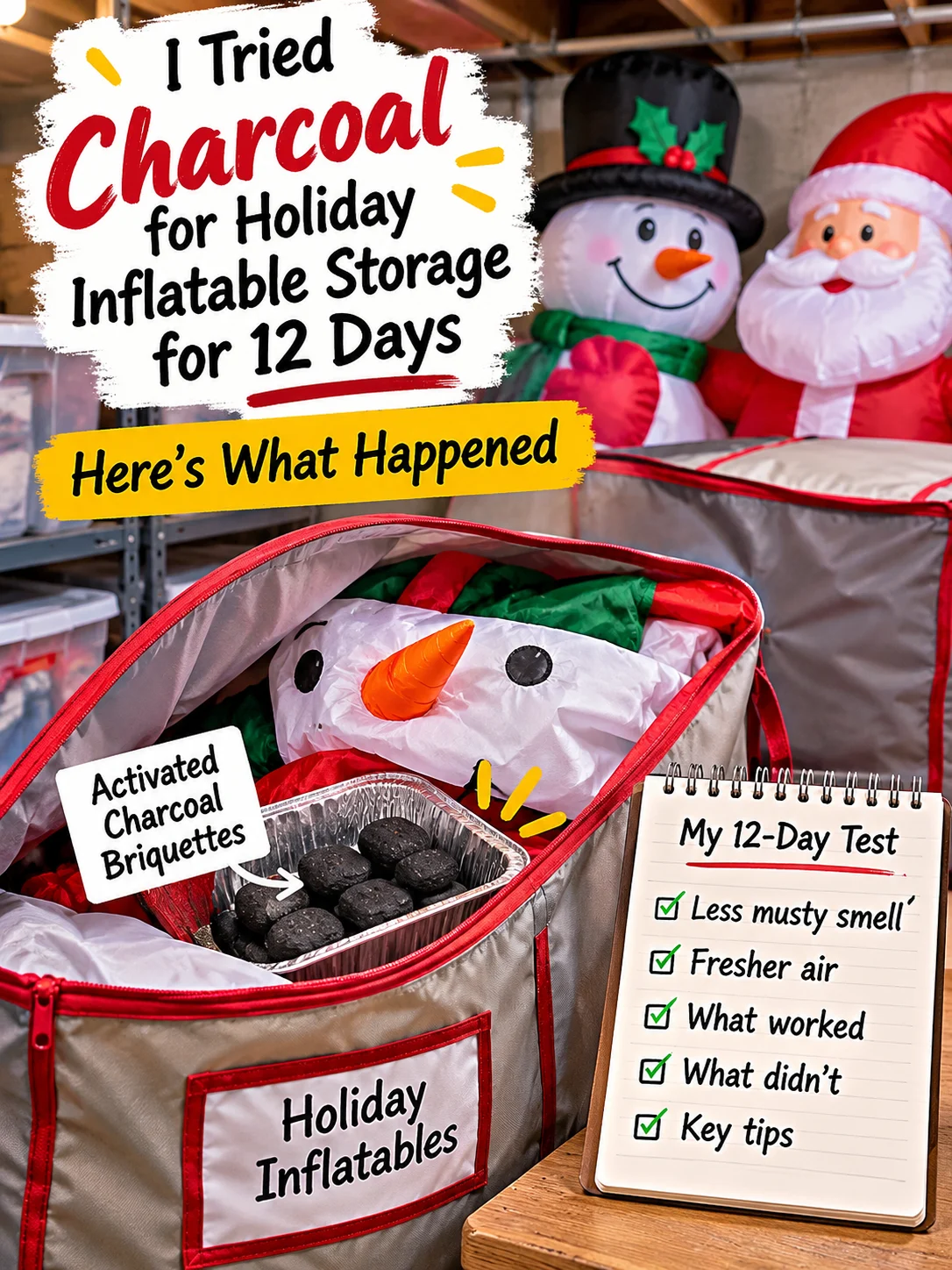
Every December, I tell myself I’m going to put away our holiday inflatables the right way: fully dry, neatly folded, labeled, and tucked into storage without a second thought. And every December, real life steps in. It’s freezing outside, the lawn decorations come down damp from snow flurries or morning frost, and I end up stuffing a slightly clammy 8-foot snowman or a wrinkled inflatable Santa into a storage bag in the basement because dinner still needs to be made and Monday is coming fast. This year, after noticing that trapped, stale humidity smell when I opened one of those bags, I decided to try something simple: I placed activated charcoal briquettes inside my basement holiday inflatable storage bags for 12 days and paid close attention to what changed.
I’m sharing exactly what I did, what I noticed day by day, what improved, and what did not. If you store seasonal décor in a cool basement, garage, or utility room like I do here in the Midwest, this little test may save you from opening a bag next year and getting hit with that musty “oh no” smell. I’ll also tell you the big caution I learned along the way, because while the experiment helped in a few very real ways, it was definitely not a magic fix for actually wet decorations.
1. Why I tried charcoal in the first place
My basement stays usable but not perfectly climate controlled in winter. In December, the temperature down there usually sits around 58 to 64 degrees Fahrenheit, and the humidity tends to hover between 52% and 62% unless I’m running a dehumidifier. That’s fine for bins of ornaments and artificial garland, but it’s not ideal for fabric-and-plush holiday inflatables that get packed away before they are fully aired out.
Last year, I opened one storage bag and immediately noticed a damp, enclosed smell. Not a full mildew disaster, thankfully, but enough to make me nervous. Activated charcoal is known for adsorbing odor-causing compounds, and I had a bag of plain charcoal briquettes on hand. Since I was dealing with trapped air and mild humidity inside zipped storage bags, I wanted to see whether charcoal would improve the smell and make the air inside feel less stale over a short 12-day period.
2. The exact setup I used
I tested this with three holiday inflatable storage bags in my basement. Two contained yard inflatables and one held assorted extension cords, stakes, and a smaller inflatable penguin. The bags were heavy-duty zippered fabric storage bags, each about 30 inches long, 18 inches wide, and 18 inches tall when packed.
Bag 1 held a 7-foot inflatable snowman that had been wiped down but still felt slightly cool and damp in a couple of seams. Bag 2 held a 6-foot Santa and a small reindeer, both packed after a cloudy day with visible surface moisture already gone but likely some residual dampness inside the folds. Bag 3 held a 4-foot penguin plus accessories and was my “comparison” bag with no charcoal added.
For Bag 1 and Bag 2, I placed 6 activated charcoal briquettes in each bag. I did not toss them in loose. I wrapped the briquettes in two layers of paper towel and placed them inside an open-top disposable aluminum loaf pan so the charcoal dust would stay contained and not rub directly against the inflatables. Then I zipped each bag fully closed and left them undisturbed for 12 days.
3. A quick note on the charcoal itself
This is important: I used plain activated charcoal briquettes, not lighter-fluid-infused charcoal and not anything with added ignition chemicals. If a charcoal product is labeled “match light,” “easy light,” or has a petroleum smell, I would not put it near fabric holiday décor. Mine had almost no added scent and felt dry to the touch.
Even so, briquettes can shed black dust. That was my biggest concern from the start. That’s why I treated the charcoal more like an odor absorber sitting in a container inside the bag, not like a loose bag filler. If you skip that step, you risk staining white trim, plush fabric, or light-colored nylon sections on your inflatable decorations.
4. What the bags smelled like on day 1
On the first day, Bag 1 smelled the worst. It had that unmistakable zipped-up moisture smell: part wet fabric, part basement air, part stale plastic. If I had to describe the intensity on a simple scale of 1 to 10, with 10 being “I do not want this in my house,” Bag 1 was about a 6.
Bag 2 was milder, maybe a 4 out of 10. It did not smell bad exactly, but it smelled enclosed. Bag 3, my no-charcoal comparison bag, was about a 3 at the start. I wrote these down because I know from experience that memory gets fuzzy fast once you start “checking” things and hoping for results.
5. What I noticed after 3 days
By day 3, the difference was subtle but real. When I unzipped Bag 1 for about 10 seconds and sniffed near the opening, the smell was still there, but it was less sharp. The musty edge had softened. Bag 2 showed a similar change, though because it was less damp to begin with, the improvement was smaller.
What surprised me most was that the air inside the charcoal bags felt less “heavy.” I know that sounds unscientific, but if you have ever opened a sealed storage bag full of fabric décor, you know the difference between stale trapped air and air that feels more neutral. The comparison bag, Bag 3, still had that same sealed-up smell with no real shift by day 3.
6. What happened by day 6
Day 6 was where the charcoal seemed to prove it was doing something. Bag 1 had dropped from what I’d called a 6 out of 10 odor level to about a 3. The bag still did not smell fresh like laundry, but the damp smell was no longer the first thing I noticed. It smelled more like normal stored fabric with a faint basement note.
Bag 2 was down to maybe a 2. I was happy with that result because this was the kind of bag I would normally ignore until next season. The comparison bag, Bag 3, was still sitting around a 3 and maybe even edging toward 4 after being sealed in the same basement conditions without any absorber inside.
I also checked the aluminum pans holding the briquettes. They remained dry. The paper towel wrapping felt a little softer than on day 1, which made me think it had picked up some moisture from the air, but there was no visible condensation anywhere inside the bags.
7. What happened at the full 12-day mark
At 12 days, the results were noticeable enough that I would call the experiment worthwhile. Bag 1, the dampest and smelliest one, improved the most. The odor did not disappear 100%, but it shifted from “I’m concerned about this” to “this is probably okay if I also dry it properly before long-term storage.” On my little smell scale, it ended around a 2.
Bag 2 ended around a 1 to 2. It mostly smelled neutral. Not perfumed, not particularly fresh, just normal. Bag 3, the no-charcoal bag, smelled almost exactly the same as it had on day 1. That side-by-side comparison was what convinced me the charcoal wasn’t just wishful thinking.
The biggest practical outcome was this: when I reopened the treated bags, I no longer got that immediate wave of trapped humidity odor. For anyone storing seasonal fabric decorations in a basement, that alone makes a difference.
8. What the charcoal helped with — and what it did not
The charcoal clearly helped reduce stale, musty odor in enclosed storage bags. It also seemed to improve the feel of the trapped air, making the bags smell less closed-up after nearly two weeks. For mildly damp items, that is useful.
What it did not do was actually dry a truly wet inflatable in any dramatic way. If an item is soaked from rain, melting snow, or condensation inside the body of the inflatable, charcoal in the bag is not a shortcut. It will not replace fully air-drying the decoration for several hours, or even overnight, before storage.
In other words, charcoal helped with the environment inside the bag. It did not undo poor storage habits completely. I know that is probably the least glamorous conclusion possible, but it’s the honest one.
9. The biggest risk I found
The risk was charcoal dust. Even with my paper towel and pan setup, I saw a light black residue inside one of the pans when I removed the briquettes. If those briquettes had been loose in the bag, I am almost certain the white trim on my snowman would have ended up with gray smudges.
That matters because many holiday inflatables have light polyester, fuzzy trim, stitched details, or thin nylon surfaces that can hold dust in the texture. If you are going to try this, containment is not optional. Use a breathable barrier plus a rigid or semi-rigid tray so the charcoal stays upright and separate from the stored fabric.
10. My basement conditions mattered more than I expected
One reason this test worked reasonably well is that my basement was cool, not soaking wet, and only moderately humid. If your basement sits at 70% humidity or higher, or if you have had water intrusion, seepage, or visible mold issues, charcoal in a bag is not going to solve the larger problem.
I checked the area with a basic digital hygrometer a few times during the 12-day test. The room ranged from 59 to 63 degrees Fahrenheit and 54% to 60% relative humidity. That is not ideal, but it is also not a flood-prone environment. In a much damper space, I would prioritize a dehumidifier set around 45% to 50% humidity before experimenting with any passive odor absorber.
11. How I’d do it differently next time
Next year, I would still use charcoal for mildly stale storage bags, but I would pair it with better drying upfront. My ideal routine would be: bring the inflatable inside, unzip or open access points if possible, run the fan for 10 to 15 minutes to push air through, wipe down the outer surface, and let it sit in a dry room for at least 6 to 12 hours before packing.
Then, if I still felt unsure about a bag, I would place 4 to 6 briquettes in a breathable container inside the storage bag for a week. I would also label the bag with the date packed and a note like “charcoal inside” so I don’t forget it next season and accidentally dump black dust onto the carpet while unpacking in a hurry.
12. Alternatives I would also consider
If you do not want to use briquettes, silica gel packs are a cleaner option for moisture control, though they work differently and typically in smaller volumes. For a large 30-by-18-by-18-inch storage bag, I would use multiple large desiccant packs rather than one tiny packet saved from a shoebox.
Baking soda can help with odors too, but I would not leave an open box loose inside a soft-sided bag full of awkwardly folded décor. It tips too easily. DampRid-style products are more aggressive for moisture, but many contain calcium chloride, and I personally would not place a spill-prone moisture absorber near fabric decorations unless it was in a very secure secondary container.
For me, charcoal landed in the middle: better for odor than nothing, less messy than loose powder, and affordable because I already had it on hand.
13. Cost, effort, and whether it felt worth it
The actual cost of my experiment was low. I used 12 briquettes total, 2 disposable loaf pans, and a few paper towels. Even if I had bought everything specifically for this, it would have been under $10 to test on multiple bags. The time investment was maybe 15 minutes total to set up and a few quick check-ins over 12 days.
That made it feel worth trying, especially compared with the cost of replacing a large holiday inflatable, which can easily run $60 to $180 depending on size and brand. If a simple containment setup helps prevent that stale-storage smell from turning into something worse, I think it earns a place in the seasonal storage toolkit.
14. My final verdict
After 12 days, I’d call the experiment a qualified success. The activated charcoal briquettes noticeably reduced stale, humid odor inside my basement holiday inflatable storage bags. The improvement was strongest in the bag that started off the most musty, and the untreated comparison bag helped confirm that the change was not just in my head.
But I would not describe this as a miracle hack. It is a backup measure, not a substitute for drying decorations properly before storing them. If your inflatables are only mildly damp or just smell enclosed after December teardown, charcoal can help. If they are genuinely wet, you need airflow, drying time, and better storage conditions first.
Honestly, that was the biggest lesson for me as a busy person trying to put away holiday gear between work deadlines and everyday life. The small fix helped, but the boring basics still matter most. And unfortunately, holiday décor is just like laundry in that way: if you put it away damp, future you will absolutely hear about it.