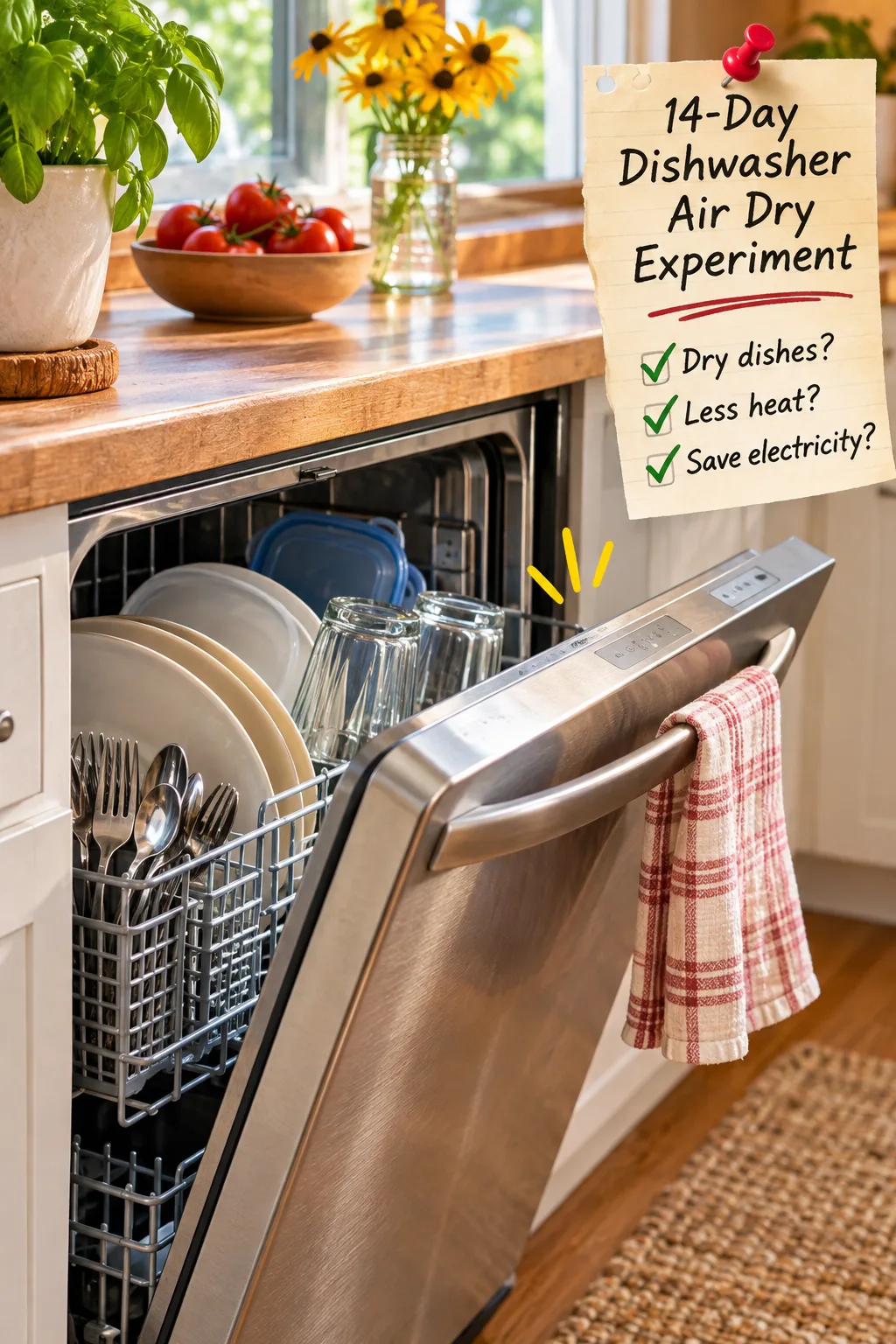
In August, when the kitchen already feels warm before breakfast and the tomatoes are ripening faster than I can can them, I started looking for little ways to cut back on extra heat in the house. One afternoon, after unloading a perfectly ordinary load of supper dishes, I turned off the heated dry setting and simply left the dishwasher door cracked open for about 2 hours instead. I kept at it for 14 straight days, just to see whether this old-fashioned, low-fuss habit would actually work in a real home kitchen.
I’m the sort of cook who pays attention to the small things: how long a pie needs to rest, how a cast-iron skillet sounds when it’s ready, and whether a dishwashing shortcut is truly a help or just another chore in disguise. Over those 2 weeks, I watched how dry the dishes got, whether glasses spotted more, how the kitchen felt, and whether I was saving any money worth mentioning. Here’s exactly what happened, what surprised me, and what I’d tell you before you try it in your own kitchen.
1. Why I tried it in the first place
In my house, August is not the month for adding one bit of unnecessary heat. We had several days between 84 and 91 degrees, and even with the air conditioner running, every little heat-producing appliance made itself known. Heated dry on a dishwasher may not seem like much, but when you’re cooking green beans, blanching corn, and baking the occasional cobbler, you start to notice every source of warmth.
I’d also been hearing more folks talk about using the dishwasher’s final rinse heat and then cracking the door afterward, rather than running a full heated dry cycle. It sounded sensible to me. My thinking was simple: the dishes are already hot at the end of the wash, so maybe that trapped steam just needs a place to escape.
2. How I set up the 14-day test
I kept this little experiment plain and practical. For 14 days, every dishwasher load was run without heated dry. As soon as the cycle ended, I opened the door about 3 to 4 inches and left it that way for roughly 2 hours. I didn’t prop it wide open, just enough to let steam out and air in.
During those 2 weeks, I ran 11 full loads and 2 smaller half-full loads. Most loads included dinner plates, cereal bowls, mason jars, drinking glasses, stainless steel flatware, a few plastic food containers, cooking spoons, and at least one skillet lid or casserole dish. That mattered, because I wanted to see how different materials behaved, not just easy-to-dry items.
3. The dishes were mostly dry, but not perfectly dry
The main result was this: most dishes came out dry enough to put away after the 2-hour rest. My plates, bowls, mugs, silverware, and glass baking dishes did just fine. On 10 out of the 11 full loads, those everyday items were either completely dry or had only a faint trace of moisture near the base ring.
The trouble spots were predictable. Plastic containers, especially the lighter-weight ones with recessed lids or raised bottoms, still held droplets. On average, I’d find 1 to 3 teaspoons of water scattered across a few plastic pieces in each load. That wasn’t disastrous, but it did mean I had to towel those items off before stacking them in the cupboard.
4. Glasses and plates looked better than I expected
I had half expected cloudy glasses or damp plates that felt unpleasant to the touch, but that didn’t happen. The glasses actually looked very good, especially when I unloaded them after the 2-hour window instead of letting them sit overnight. I think the escaping steam helped reduce that muggy, trapped moisture that can cling to everything if the door stays shut.
Dinner plates, salad plates, soup bowls, and stoneware mugs were the stars of the whole arrangement. Because they hold heat well, they seemed to finish drying themselves as the residual warmth faded. My heavy white stoneware plates were bone-dry every time except once, when two plates had been nested too closely together and stayed damp along the rims.
5. Plastic was the weak point every single time
If your dishwasher loads are full of plastic lunch containers, reusable snack boxes, sippy cups, and lightweight storage tubs, I’ll tell you honestly: this method will test your patience. Plastic does not retain heat like ceramic or glass, so it doesn’t shed water nearly as well. My leftover containers came out with pooled water in the bottoms, and lids with little grooves were still wet after the full 2 hours.
Over the 14 days, I started changing how I loaded those items. Tilting containers downward more sharply and avoiding flat, bowl-like positioning helped some. I’d say that improved drying by about 20 to 30 percent, but it didn’t solve everything. In my kitchen, plastic still needed a quick wipe more often than not.
6. The kitchen felt noticeably less hot
This was one of the clearest benefits, and one I could feel in my apron strings. Without the heated dry cycle running, the kitchen didn’t pick up that extra baked warmth that sometimes lingers around the dishwasher. Instead, I got a brief wave of steam when I cracked the door, and then that heat dispersed fairly quickly.
It wasn’t as though the room became chilly, of course, but on a hot August afternoon, the difference was real. If I had to put a plainspoken number on it, I’d say the kitchen felt a few degrees less stuffy during and after dishwashing. In a small rural kitchen like mine, that matters, especially when the oven has already been on.
7. I likely saved a little electricity, though not a fortune
I’m too practical to promise grand savings from one dishwasher habit. Still, skipping heated dry does reduce electricity use. Depending on the machine, heated drying can add a noticeable bit to each cycle. On many home dishwashers, the extra energy for heated dry may range roughly from 0.2 to 0.5 kilowatt-hours per load.
Using a simple estimate, if my machine would have used an extra 0.3 kilowatt-hours for heated dry and I skipped that on 11 full loads, that comes to 3.3 kilowatt-hours saved over the 14 days. At an electric rate of about $0.15 per kilowatt-hour, that’s around 50 cents. Not enough to retire on, certainly, but over a year of 4 to 5 loads a week, it adds up more respectably, and the reduced heat in summer is worth something too.
8. I had to be more mindful about timing
This method worked best when I was at home and able to unload within that 2-hour stretch. If I ran the dishwasher at 7:00 p.m., cracked the door at 9:00 p.m., and put everything away by 11:00 p.m., it was easy. If I forgot and left the door just barely ajar until morning, the dishes were still fine, but the kitchen looked untidy and the whole process felt less finished.
That timing requirement is the trade-off. Heated dry is convenient because it asks almost nothing of you. Door-cracking asks for a little cooperation. During canning season, when I’m in and out of the kitchen anyway, that was no trouble. On busier days, I had to remind myself not to leave the dishwasher in limbo.
9. There was less of that closed-up dishwasher smell
One pleasant surprise was the smell—or rather, the lack of one. When steam can escape instead of lingering behind a closed door, the dishwasher interior seems to air out better. Over the 14 days, I noticed less of that faint damp-appliance odor that sometimes develops, especially in warm weather.
By the end of the experiment, the inside of the machine smelled cleaner and fresher. Not perfumed, just clean. If you’ve ever opened a dishwasher the next morning and caught a musty note from pooled moisture around the seal, you know exactly what I mean.
10. I did have to think about safety and kitchen traffic
Now, in a quiet household like mine, a dishwasher door cracked open a few inches isn’t much of a hazard. But I wouldn’t ignore this point. In a home with small children, pets underfoot, or a narrow galley kitchen, that partly open door could be a tripping problem.
If your kitchen is busy, you’d want to open the door only when folks are done passing through, or crack it at a time when the room is calmer. I kept mine open mostly in late evening, after supper cleanup, when foot traffic was low. That made the whole thing more practical.
11. Load arrangement made a bigger difference than I expected
By the fourth or fifth load, I could see that drying success depended heavily on how I loaded the dishwasher. Bowls angled downward dried better than bowls that sat too upright. Plastic tubs did better if they weren’t crowded. Cups needed space between them so steam could move around. And spoons nested together stayed wetter than forks and knives spread apart.
I also found that the top rack needed special attention. If I overloaded it with measuring cups, storage lids, and odd-shaped prep bowls, moisture clung much longer. When I gave those items a bit more breathing room, they dried more cleanly. In other words, skipping heated dry rewards a neat loader.
12. It worked best on everyday dishes, not every possible item
For a standard supper load—plates, glasses, bowls, flatware, serving spoons, and a casserole dish—this method worked beautifully well. For awkward items, it was less perfect. Think deep plastic containers, lid-heavy loads, and items with little wells where water naturally collects. Those pieces still needed attention.
I also wouldn’t rely on this approach if I needed every single item cupboard-ready the minute the cycle ended. If I were cleaning up after a church potluck or family reunion and needed all my containers back in service right away, I might choose convenience over thrift and use heated dry that day.
13. After 14 days, here’s the habit I’m actually keeping
At the end of the 2 weeks, I did not go running back to heated dry full-time. In fact, I’ve mostly kept this new habit, especially during warm months. For everyday use, I’m comfortable skipping heated dry, cracking the dishwasher door for 2 hours, and giving a few plastic pieces a quick towel-off if needed.
Come January, when the furnace is running and a little extra kitchen warmth doesn’t bother me, I may be less strict about it. But in August and September, this simple change suits me just fine. It feels a little like the old Midwestern way of doing things—using what you have, wasting less, and letting patience do part of the work.
14. My honest bottom line
So what happened? I got dishes that were about 85 to 95 percent as dry as they would have been with heated dry, depending on the load. I had less heat in the kitchen, likely saved a modest bit on electricity, and noticed a fresher-smelling dishwasher. The downside was that plastic remained annoying, and I had to be more intentional about when I unloaded.
If you like simple household experiments that don’t cost a thing, this one is worth trying for a week or two. Start with a normal load, crack the door 3 to 4 inches, wait 2 hours, and see what your own machine does. In my kitchen, it turned out not to be a miracle, but it was a solid, sensible improvement—and at my age, I’ve learned that those are often the best kind.